Authorization bypass allows changing email address of other users
The Change E-mail screen requires the current password, but the admin agency-user endpoint accepts a POST that updates any user's email address, including an administrator's, without asking for that password. An authenticated attacker who can reach the User Access page could change the admin's email and potentially take over the account.

- Triaged in under an hour
- Fixed in 4 days
- Disclosed after 26 days
==Version: Revive Adserver 6.0.0==
##Summary: The Change E-mail UI requires the current password, but the admin panel endpoint /admin/agency-user.php accepts a POST that updates a user’s email (including admin) without requiring the account password. The application does not require re-authentication before updating email addresses.
##Step to reproduce:
- Log in page
- Go to Preferences → Change E-mail, observe that changing the email normally requires the current password.
██████ 3. Navigate to Inventory → User Access, select the admin user, and click Save changes while intercepting the request. 4. Modify and send the following request:
submit=1&login=admin&token=ba6ff2f70a69a509d5bcc84cb2225517&userid=1&[email protected]&agencyid=1
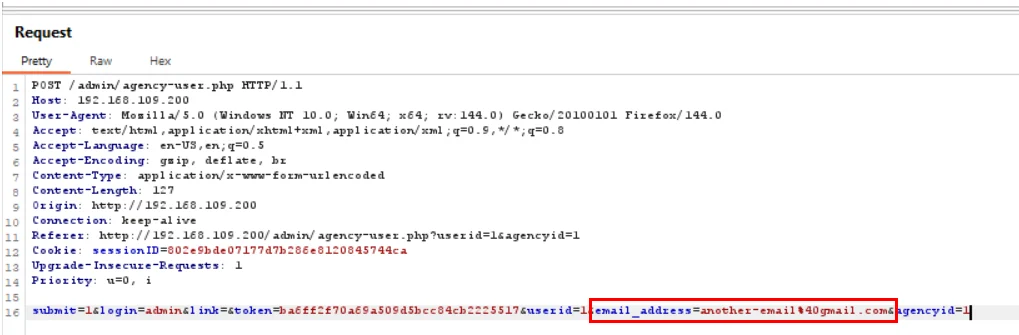
- Observe that the admin user’s email is successfully updated without password confirmation.
███████
Impact
- An authenticated attacker (with access to the User Access page) can change the administrator’s email address without authorization, potentially leading to account takeover or loss of access control integrity.
VIdeo PoC: ██████
Not written yet. The AI write-up for this report has not been written yet. The Original tab links to the source.
How it worked
Root cause
Likely the server-side handler for the user update endpoint does not enforce the re-authentication check that the Change E-mail UI applies.
Impact
An authenticated attacker with access to the User Access page could change the administrator's email address without authorisation, potentially leading to account takeover or loss of access control integrity.
What the attacker needed
Authenticated account; access to the User Access page
How it was found
- Log in to the application.
- Open Preferences then Change E-mail and note that the current password is normally required.
- Go to Inventory then User Access, select the admin user, and intercept the request sent by Save changes.
- Change the email address in the request and send it.
- Observe that the admin user's email is updated without any password confirmation.
Explained by bugbounty.wiki with AI from the original and checked against quotes from it; it can still be wrong. Read the original before relying on a detail.
Not written yet. The AI write-up for this report has not been written yet. The Original tab links to the source.
Some pages ask you to retype your password before making a sensitive change, like swapping your email. This report found that a different admin page could change anyone's email without that check. Someone already logged in with access to that page could quietly point the administrator's email at their own inbox.
What is Access control?
A user can do something their role should not allow: reach an admin function, act on a feature they have not paid for, or skip a permission check. IDOR is the special case where the object belongs to someone else.