Password reset token leak via "Host header" on third party website
The password reset link sent to a user's email contained a token that was also sent to a third-party website via the Host header. An attacker controlling that third-party site could capture the token and use it to reset the user's password.
 Originally disclosed on HackerOne
- Triaged in 3 days
- Fixed in 6 months
- Disclosed after 12 months
Hi Security Team,
#Product / URL https://your-store.wholesale.shopifyapps.com/
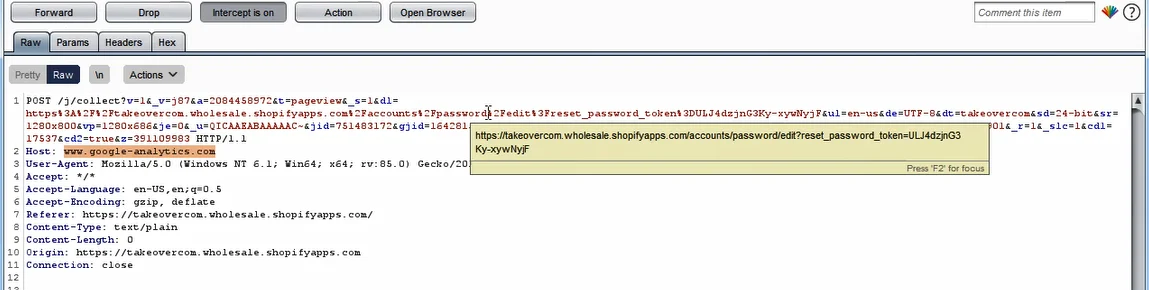
#Description It has been identified that the application is leaking Token to third party sites. In this case it was found that the Token is being leaked to third party sites which is a issue knowing the fact that it can allow any malicious users to use the reset password of user.
#Reproduction Instructions /
- Send reset password link to your email address.
2)Now go to email, turn burp suite intercept on and click on reset password link. Check for the requests having the token in "host" as third party website. And copy the link 3)Now turn intercept off and reset the password.(with that link) 4)Now reset the password.
#Proof of Concept F1180911
#Additional Information: Note also that if users can author content within the application then an attacker may be able to inject links referring to a domain they control in order to capture data from URLs used within the application.
Impact
As you can see in the Host the reset token is getting leaked to third party sites. So, the person who has the complete control over that particular third party site can Use the Token easily.
Attachments
Not written yet. The AI write-up for this report has not been written yet. The Original tab links to the source.
How it worked
Root cause
Likely the application used the Host header from the request to build the password reset link, allowing an attacker to redirect the token to a domain they control.
Impact
An attacker controlling the third-party site could capture the reset token and use it to reset the victim's password.
What the attacker needed
Victim requests a password reset; attacker controls a third-party site
How it was found
- Send a password reset link to your own email address.
- Open the email, enable interception in Burp Suite, and click the reset link.
- Look for requests where the token appears in the Host header pointing to a third-party site, and copy that link.
- Disable interception and use the copied link to reset the password.
Explained by bugbounty.wiki with AI from the original and checked against quotes from it; it can still be wrong. Read the original before relying on a detail.
Not written yet. The AI write-up for this report has not been written yet. The Original tab links to the source.
When you forget your password, a website emails you a special link with a secret code (token) to prove it's you. Here, that secret code was also sent to a different website, so whoever owns that other site could steal the code and change your password without permission.
What is Account takeover?
Getting into someone else's account through a flaw in sign-in, password reset, second factor, single sign-on or session handling.



