From an Android APK to Production MQTT: Exposed Credentials in Attendo (formerly Petpooja Payroll)
 Published on medium.com
Cybersecurity
The full write-up lives on its author's site
It belongs to its author, so we link to it rather than copy it. The other two tabs are our own rewrites, checked against it.
Context
Attendo, formerly known as Petpooja Payroll, is a payroll attendance platform. Its Android client, the Attendo Admin application, is a Flutter app that talks to a production MQTT (Message Queuing Telemetry Transport) broker. MQTT is the messaging layer the platform uses to carry attendance events, device telemetry and configuration data between attendance devices and the backend.
The assessment covered the Android application and the production messaging infrastructure it connects to. The primary weakness recorded is CWE-798, use of hard-coded credentials, in the Attendo Admin Android application, version 3.0.13 and earlier. The research reference is CAN-2026-2039034, the report date is 8 June 2026, severity is 9.3, and the CVSS v4.0 vector is:
4.0/AV:N/AC:L/AT:N/PR:N/UI:N/VC:H/VI:N/VA:N/SC:H/SI:H/SA:N/V:C/RE:H/U:Red
Remediation status is listed as fixed, and the CVE ID was still to be assigned at the time of writing.
Setup
The work started from the distributed Android APK. No account, role or special access on the platform is described as a precondition: the credentials were recovered from files packaged inside the application, and the broker accepted them. The report does not name the tooling used to unpack and inspect the APK or to connect to the broker. The affected version is 3.0.13 and earlier.
Finding it
The credentials were found in the Flutter assets bundled with the application. Four relevant files were present:
resources/assets/flutter_assets/.env/production.jsonresources/assets/flutter_assets/.env/staging.jsonresources/assets/flutter_assets/.env/device_command_production.jsonresources/assets/flutter_assets/.env/device_command_staging.json
The APK also contained corresponding staging configuration files. The production configuration held the MQTT connection settings, while the device command configuration held additional device communication and management information.
The point the report makes about this is that a secret does not become protected simply because it lives in an environment file rather than being shown in the application interface. Assets packaged inside an APK can be extracted and inspected independently of the application's normal execution.
Exploitation
Step 1: recover the credentials from the APK
The MQTT username and password were read out of the bundled Flutter asset configuration. The report shows the production credentials as observed:
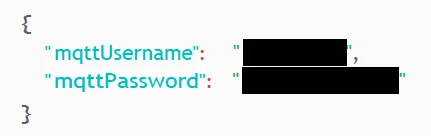
Observed Production Credentials
and the production.json asset they came from:
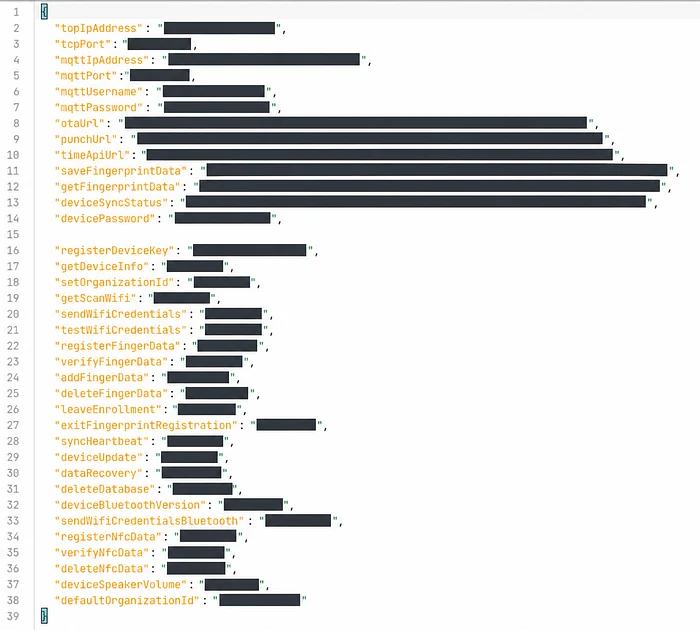
production.json
The values themselves are redacted in the public disclosure.
Step 2: authenticate to the production broker
The recovered credentials were used to establish a connection to the production broker on TCP port 1883. Authentication succeeded.
The broker was not accepting anonymous connections. The issue was that credentials distributed with the client application were valid and gave access to production messaging infrastructure.
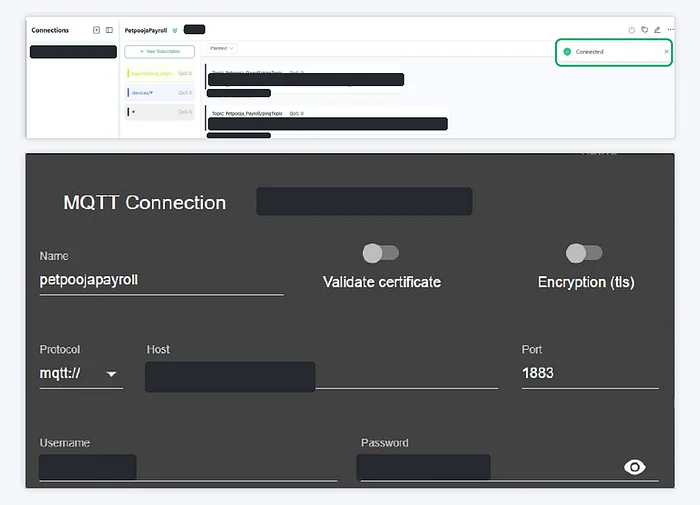
Connection to the MQQT Broker
Step 3: enumerate the messaging channels
After connecting, the researcher examined the messaging channels available to the authenticated client. The session gave access to topic families associated with attendance, employees, payroll and devices, including wildcard subscriptions. That meant messages from multiple parts of the payroll ecosystem could be inspected, rather than being limited to a single device or event.
The report draws the authentication versus authorization distinction here: successful authentication showed the credentials were accepted, and the subsequent message access showed the permissions available to the authenticated identity.
Step 4: read telemetry and configuration
The accessible data included device heartbeat messages and synchronization traffic. These messages exposed fields for device identifiers, MAC addresses, signal strength, synchronization activity, operational status and organization mappings.
Individually these fields look like ordinary telemetry. In combination they can reveal how devices are deployed and how they relate to the organizations using the platform.
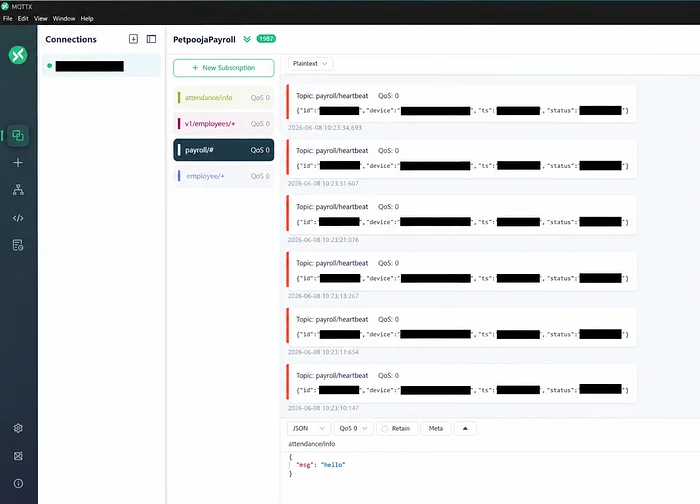
Further inspection found device configuration information in synchronization messages: device names, models, firmware versions, organization identifiers, MAC addresses and operational parameters. More significantly, device management responses exposed authentication material, including device passwords and registration-related values.
Step 5: attendance events and image-bearing payloads
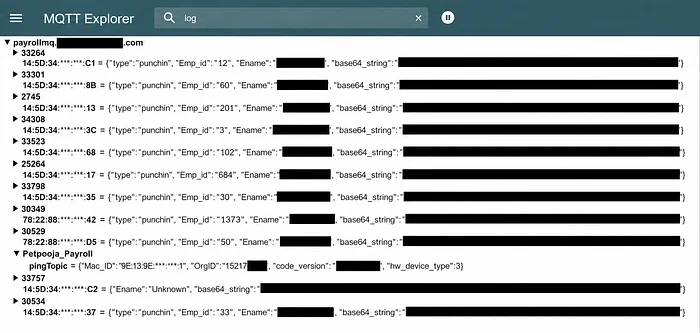
Attendance messages contained employee identifiers, names, event types and associated device information. The observed event types included clock-in activity, so attendance information could be observed through the messaging infrastructure.
Some messages also carried photographs encoded as Base64 strings. The images were embedded in the message payloads, and during testing the Base64 data was successfully reconstructed into viewable photographs. Someone with access to those messages could obtain the image data without going through the intended payroll application's user interface.
The report gives a simplified representation of the observed payload structure, with placeholders rather than production values:
This illustrates the exposed field structure, not a complete reproduction of a production message. Employee names, photographs and complete Base64 strings were deliberately left out of the disclosure because they are not needed to demonstrate the issue.
Step 6: test publish access
The assessment did not stop at reading messages. Message publication was tested through the authenticated MQTT connection. The published messages were visible through active subscriptions, confirming that the client had publish capability as well as the ability to consume messages.
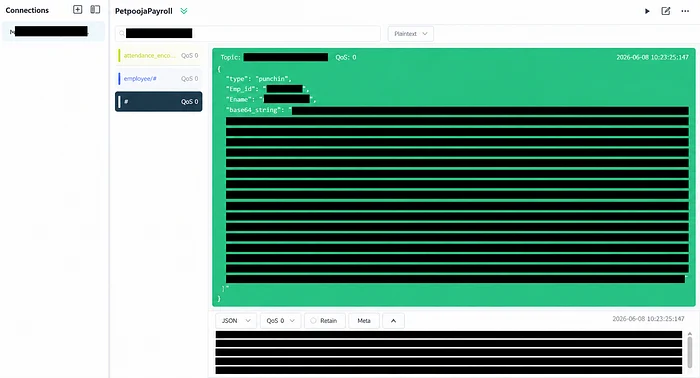
This changes the nature of the finding. Read access exposes employee information and operational details. Publish access introduces a potential integrity risk when other components trust messages received through the same messaging infrastructure. In an attendance system the consequences depend on the receiving application's implementation: a downstream service that accepts messages without validating the originating device, authorization context and event details could potentially process unauthorized events.
The evidence has a clear limit. The report documents a local-session demonstration of message and attendance workflow manipulation and explicitly states that organization data was not tampered with. It does not establish that authoritative production attendance records or payroll calculations were successfully modified. The confirmed result is that MQTT publication was possible; production record manipulation remains a potential consequence, not a demonstrated outcome.
Root cause
The central weakness was not MQTT itself. It was the combination of reusable credentials embedded in a distributed client application and the permissions granted after authentication. Once the credentials were extracted, they could be used to reach production messaging channels carrying employee information, photographs, device telemetry and device authentication material.
The APK's environment configuration also contained other sensitive values: authentication-related tokens, encryption configuration, API credentials and internal backend endpoint mappings. The report is careful about these: their presence does not automatically prove that every associated service was exploitable, since impact depends on whether each value remained valid, what permissions it carried and how the corresponding service enforced access control. Each exposed secret is a separate item to validate and, where appropriate, rotate.
The report does not analyse why the broker's authorization model allowed wildcard subscriptions and publication with the same credentials.
Impact
An attacker who extracts the credentials from the APK can authenticate to the production broker and subscribe to attendance, employee, payroll and device topics, including through wildcards. That exposes employee identifiers and names, clock-in events, photographs embedded in payloads, device telemetry (identifiers, MAC addresses, signal strength, synchronization activity, operational status, organization mappings), device configuration (names, models, firmware versions, organization identifiers, operational parameters) and device authentication material such as device passwords and registration-related values.
Because publication was also possible, there is a potential integrity risk for any downstream component that trusts messages from this broker without validating the originating device and event. The report does not claim that production attendance records or payroll calculations were modified; that remains a potential consequence rather than a demonstrated one.
Fix
The immediate priority is to revoke the exposed MQTT credentials and rotate any additional secrets confirmed to be valid. Replacing the configuration in a new APK alone is insufficient, because previously distributed copies may still contain the original values.
The broker should enforce separate permissions for subscribing and publishing at the topic level, independently of the application. Production and staging environments should use separate credentials and authorization policies. Devices should have individually managed identities rather than relying on broadly shared secrets, and device enrollment and management operations should require independent authorization. Device credentials and registration secrets should be rotated, and the enrollment process reviewed for ways to register unauthorized devices.
Sensitive employee data should be minimised in MQTT payloads; photographs and authentication material should not be sent to clients that do not need them. Finally, the backend must validate attendance events before treating them as authoritative: receiving an MQTT message should not by itself establish that an authorized device generated a legitimate event for a particular employee or organization.
After remediation, testing should verify that the original credentials are no longer accepted, that unauthorized subscriptions and publications are denied, and that backend services validate device identity and attendance events independently. The report lists the remediation status as fixed.
Variants to test
- Environment files in Flutter assets. Unpack an APK and look under
assets/flutter_assets/for.envdirectories and JSON configuration. A positive result is a production broker host, port, username or password in a file that ships with the client. - Broker accepts shipped credentials. Connect to the broker on its plain TCP port with the extracted credentials. A positive result is a successful CONNECT rather than a refusal or anonymous-only policy.
- Wildcard subscriptions. After authenticating, attempt wildcard subscriptions across topic families. A positive result is message flow from more than one device or organization on a single identity.
- Publish capability. Publish a test message and watch for it on an active subscription. A positive result is the message appearing, which shows the identity can write as well as read.
- Sensitive fields in payloads. Inspect telemetry, synchronization and attendance messages for identifiers, MAC addresses, firmware versions, organization mappings, embedded Base64 images and device passwords or registration values. A positive result is any of these appearing in payloads delivered to a client that does not need them.
- Staging versus production separation. Compare the staging and production configuration files and test whether staging credentials work against production or share the same authorization policy. A positive result is cross-environment acceptance.
- Downstream trust. Where a broker feeds a backend, check whether events are validated against device identity and authorization context. A positive result is a message from an unexpected publisher being processed as a legitimate business event.
What happened, in plain words
Attendo, formerly called Petpooja Payroll, is a payroll attendance platform. Companies use it to keep track of when their employees clock in and out, and to feed that information into payroll. The platform has an Android app called Attendo Admin, and behind the app there is a messaging system that carries attendance events, device status information and configuration data between the attendance devices and the company's servers.
That messaging system uses a technology called MQTT (Message Queuing Telemetry Transport). A useful comparison is a postal service for computers: programs drop short messages into named mailboxes called topics, and other programs that have subscribed to those topics receive them. A broker is the sorting office in the middle: every program connects to it, and it forwards each message to whoever is subscribed.
When the researcher looked inside the Android app, they found a username and password for the production MQTT broker sitting in the app's bundled configuration files. Production means the real, live system that real companies and real employees depend on, as opposed to a test system.
The first finding was simple: the app shipped with a working username and password for the live broker. The more serious part came when those credentials were tried. The broker accepted them, and the resulting session could read messaging channels carrying employee attendance information, device status information and configuration data. The researcher could also send messages through the same connection.
So a secret hidden inside an app turned into a much broader problem: the confidentiality of employee data, and the trustworthiness of a messaging system used by payroll attendance devices.
Background you need first
A few ideas come up again and again, so here they are from zero.
- APK: the file format of an Android app. It is basically a zip archive. It contains the code, the images, and also configuration files the app reads at runtime. Anyone who has the APK file on their computer can open it and look inside. There is no password on the archive.
- Flutter: a toolkit for building apps that run on several platforms from one codebase. Flutter apps keep their bundled files under a folder called
flutter_assetsinside the APK. - Environment file: a small configuration file, often ending in
.jsonhere, that holds settings such as server addresses and login details. Developers often use one file per environment, for example one for production and one for staging. - Staging: a test copy of the system, used before changes go live. It should be separate from production.
- Credentials: a username and password pair, the same idea as the login you use on a website.
- Broker: the central server in a messaging system. Clients connect to it, and it passes messages between them.
- Topic: a named channel inside the broker, similar to a folder or a chat room name. A client subscribes to topics to receive messages, and publishes to topics to send them.
- Wildcard subscription: a subscription that matches many topics at once, like searching for
attendance/*to get everything under the attendance family instead of one exact channel. - Authentication: proving who you are, for example by presenting a username and password. The broker checking your password is authentication.
- Authorization: what you are allowed to do once you are known. A building can let you in the front door (authentication) while still locking the server room (authorization).
- Base64: a way of writing binary data, such as a photograph, as plain text characters so it can travel inside a text message. It is not encryption; anyone can turn it back into the original image.
- Telemetry: automatic status reports sent by a device, such as "I am online, my signal is weak, my last sync was five minutes ago".
- API: a way for one program to talk to another over the network, usually with defined addresses (endpoints) and expected inputs and outputs. Think of it as a service counter: you ask in a specific way and get a specific answer.
- Token: a piece of text that stands in for a login, like a wristband at an event. Whoever holds it is treated as the person it was issued to, which is why tokens must be kept secret.
- CWE-798: a standard catalogue number for a class of weakness, here "Use of Hard-coded Credentials", meaning a password or key written directly into software instead of being kept outside it.
- CVSS: a scoring system for how severe a security issue is. The vector is a compact string describing the characteristics that produced the score.
The assessment at a glance
The work covered the Android application and the production messaging infrastructure it connects to. The recorded weakness is CWE-798, use of hard-coded credentials, in the Attendo Admin Android application, version 3.0.13 and earlier. The research reference is CAN-2026-2039034, the report date is 8 June 2026, the severity is 9.3, and the CVSS v4.0 vector is:
4.0/AV:N/AC:L/AT:N/PR:N/UI:N/VC:H/VI:N/VA:N/SC:H/SI:H/SA:N/V:C/RE:H/U:Red
Reading that string in plain words: the attack can be carried out over the network (AV:N), needs no special conditions (AC:L, AT:N), requires no privileges on the target (PR:N) and no action from a user (UI:N). Confidentiality of the vulnerable system is highly affected (VC:H), integrity and availability are not (VI:N, VA:N). The affected system's data is highly exposed (SC:H), and the systems it connects to are highly exposed for confidentiality and integrity (SI:H), while availability is not (SA:N). Remediation status is listed as fixed, and the CVE ID was still to be assigned at the time of writing.
Setup
The work started from the distributed Android APK. No account, role or special access on the platform is described as a precondition: the credentials were recovered from files packaged inside the application, and the broker accepted them. The report does not name the tooling used to unpack and inspect the APK or to connect to the broker. The affected version is 3.0.13 and earlier.
Why start from the APK? Because it is the one piece of the system that is handed to every customer. If a secret is inside it, that secret is effectively handed out too. Port 1883 is the standard MQTT port.
Finding it
The credentials were found in the Flutter assets bundled with the application. Four relevant files were present:
resources/assets/flutter_assets/.env/production.jsonresources/assets/flutter_assets/.env/staging.jsonresources/assets/flutter_assets/.env/device_command_production.jsonresources/assets/flutter_assets/.env/device_command_staging.json
Line by line, this is a list of file paths inside the APK:
resources/assets/flutter_assets/.env/production.jsonholds the settings for the live system.resources/assets/flutter_assets/.env/staging.jsonholds the settings for the test system.resources/assets/flutter_assets/.env/device_command_production.jsonholds device communication and management settings for the live system.resources/assets/flutter_assets/.env/device_command_staging.jsonholds the same for the test system.
The APK also contained corresponding staging configuration files. The production configuration held the MQTT connection settings, while the device command configuration held additional device communication and management information.
The point the report makes about this is that a secret does not become protected simply because it lives in an environment file rather than being shown in the application interface. Assets packaged inside an APK can be extracted and inspected independently of the application's normal execution. In everyday terms: putting your house key in a drawer instead of on the doormat does not help if the whole house is made of glass. The app's normal screens never show these files, but the files are still inside the package the user installs.
Exploitation
Step 1: recover the credentials from the APK
The MQTT username and password were read out of the bundled Flutter asset configuration. The report shows the production credentials as observed:
Observed Production Credentials
and the production.json asset they came from:
production.json
The values themselves are redacted in the public disclosure. The first image shows the credentials as they appeared during the assessment, and the second shows the configuration file they were taken from. This step was taken because the whole question was whether the app carries anything secret; the answer was a working username and password for the live broker.
Step 2: authenticate to the production broker
The recovered credentials were used to establish a connection to the production broker on TCP port 1883. Authentication succeeded.
The broker was not accepting anonymous connections. The issue was that credentials distributed with the client application were valid and gave access to production messaging infrastructure.
Connection to the MQQT Broker
This step matters because it separates two very different situations. If the broker let anyone in without a password, the problem would be a wide-open server. Here the door was locked, but the key had been handed out with the app. The image shows the successful connection to the broker.
Step 3: enumerate the messaging channels
After connecting, the researcher examined the messaging channels available to the authenticated client. The session gave access to topic families associated with attendance, employees, payroll and devices, including wildcard subscriptions. That meant messages from multiple parts of the payroll ecosystem could be inspected, rather than being limited to a single device or event.
The report draws the authentication versus authorization distinction here: successful authentication showed the credentials were accepted, and the subsequent message access showed the permissions available to the authenticated identity. Back to the building comparison: the key opened the front door, and then it turned out the same key also opened every office inside.
Step 4: read telemetry and configuration
The accessible data included device heartbeat messages and synchronization traffic. These messages exposed fields for device identifiers, MAC addresses, signal strength, synchronization activity, operational status and organization mappings.
A heartbeat is a regular "I am still here" message. A MAC address is the hardware address of a network card, a kind of serial number for the device's network interface. Synchronization traffic is the back-and-forth where a device and the server agree on the latest data. Organization mappings say which company a device belongs to.
Individually these fields look like ordinary telemetry. In combination they can reveal how devices are deployed and how they relate to the organizations using the platform. A single heartbeat is boring; a map of every device, its owner and its status is not.
Further inspection found device configuration information in synchronization messages: device names, models, firmware versions, organization identifiers, MAC addresses and operational parameters. Firmware is the software built into the device itself. More significantly, device management responses exposed authentication material, including device passwords and registration-related values. In other words, the messages did not just describe the devices, they contained the secrets the devices use to prove who they are.
Step 5: attendance events and image-bearing payloads
Attendance messages contained employee identifiers, names, event types and associated device information. The observed event types included clock-in activity, so attendance information could be observed through the messaging infrastructure.
Some messages also carried photographs encoded as Base64 strings. The images were embedded in the message payloads, and during testing the Base64 data was successfully reconstructed into viewable photographs. Someone with access to those messages could obtain the image data without going through the intended payroll application's user interface. The comparison: it is as if the photos were not kept in a locked album but printed on the outside of every envelope sent through the post.
The report gives a simplified representation of the observed payload structure, with placeholders rather than production values:
Line by line:
"type": "punchin"says what kind of event this message describes: an employee clocking in."Emp_id": "[REDACTED]"is the employee's identifier. The real value is removed here."Ename": "[REDACTED]"is the employee's name, also removed."base64_string": "[REDACTED IMAGE DATA]"is where the photograph would sit, written as Base64 text. The actual image data is removed.
This illustrates the exposed field structure, not a complete reproduction of a production message. Employee names, photographs and complete Base64 strings were deliberately left out of the disclosure because they are not needed to demonstrate the issue.
Step 6: test publish access
The assessment did not stop at reading messages. Message publication was tested through the authenticated MQTT connection. The published messages were visible through active subscriptions, confirming that the client had publish capability as well as the ability to consume messages.
This changes the nature of the finding. Read access exposes employee information and operational details. Publish access introduces a potential integrity risk when other components trust messages received through the same messaging infrastructure. Integrity here means the data is what it claims to be and was not altered by the wrong party. In an attendance system the consequences depend on the receiving application's implementation: a downstream service that accepts messages without validating the originating device, authorization context and event details could potentially process unauthorized events. Downstream means any program further along the chain that consumes these messages.
The evidence has a clear limit. The report documents a local-session demonstration of message and attendance workflow manipulation and explicitly states that organization data was not tampered with. It does not establish that authoritative production attendance records or payroll calculations were successfully modified. The confirmed result is that MQTT publication was possible; production record manipulation remains a potential consequence, not a demonstrated outcome.
Root cause
The central weakness was not MQTT itself. It was the combination of reusable credentials embedded in a distributed client application and the permissions granted after authentication. Once the credentials were extracted, they could be used to reach production messaging channels carrying employee information, photographs, device telemetry and device authentication material.
The APK's environment configuration also contained other sensitive values: authentication-related tokens, encryption configuration, API credentials and internal backend endpoint mappings. An endpoint mapping is simply the internal address of a server the app talks to. The report is careful about these: their presence does not automatically prove that every associated service was exploitable, since impact depends on whether each value remained valid, what permissions it carried and how the corresponding service enforced access control. Each exposed secret is a separate item to validate and, where appropriate, rotate. Rotating a secret means replacing it with a new one and retiring the old one, like changing a lock after losing a key.
The report does not analyse why the broker's authorization model allowed wildcard subscriptions and publication with the same credentials. Scoping means limiting an identity to exactly the topics it needs, no more.
Impact
An attacker who extracts the credentials from the APK can authenticate to the production broker and subscribe to attendance, employee, payroll and device topics, including through wildcards. That exposes employee identifiers and names, clock-in events, photographs embedded in payloads, device telemetry (identifiers, MAC addresses, signal strength, synchronization activity, operational status, organization mappings), device configuration (names, models, firmware versions, organization identifiers, operational parameters) and device authentication material such as device passwords and registration-related values.
Because publication was also possible, there is a potential integrity risk for any downstream component that trusts messages from this broker without validating the originating device and event. The report does not claim that production attendance records or payroll calculations were modified; that remains a potential consequence rather than a demonstrated one.
Fix
The immediate priority is to revoke the exposed MQTT credentials and rotate any additional secrets confirmed to be valid. Revoking means switching the credential off so it no longer works. Replacing the configuration in a new APK alone is insufficient, because previously distributed copies may still contain the original values. Old copies of an app do not update themselves out of existence.
The broker should enforce separate permissions for subscribing and publishing at the topic level, independently of the application. Production and staging environments should use separate credentials and authorization policies. Devices should have individually managed identities rather than relying on broadly shared secrets, and device enrollment and management operations should require independent authorization. Enrollment is the process by which a device is registered with the platform.
Sensitive employee data should be minimised in MQTT payloads; photographs and authentication material should not be sent to clients that do not need them. Finally, the backend must validate attendance events before treating them as authoritative: receiving an MQTT message should not by itself establish that an authorized device generated a legitimate event for a particular employee or organization.
After remediation, testing should verify that the original credentials are no longer accepted, that unauthorized subscriptions and publications are denied, and that backend services validate device identity and attendance events independently. The report lists the remediation status as fixed.
Variants to test
If you want to look for the same kind of problem elsewhere, these are the checks the report lists. Each one is a question with a clear positive answer.
- Environment files in Flutter assets. Unpack an APK and look under
assets/flutter_assets/for.envdirectories and JSON configuration. A positive result is a production broker host, port, username or password in a file that ships with the client. - Broker accepts shipped credentials. Connect to the broker on its plain TCP port with the extracted credentials. A positive result is a successful CONNECT rather than a refusal or anonymous-only policy.
- Wildcard subscriptions. After authenticating, attempt wildcard subscriptions across topic families. A positive result is message flow from more than one device or organization on a single identity.
- Publish capability. Publish a test message and watch for it on an active subscription. A positive result is the message appearing, which shows the identity can write as well as read.
- Sensitive fields in payloads. Inspect telemetry, synchronization and attendance messages for identifiers, MAC addresses, firmware versions, organization mappings, embedded Base64 images and device passwords or registration values. A positive result is any of these appearing in payloads delivered to a client that does not need them.
- Staging versus production separation. Compare the staging and production configuration files and test whether staging credentials work against production or share the same authorization policy. A positive result is cross-environment acceptance.
- Downstream trust. Where a broker feeds a backend, check whether events are validated against device identity and authorization context. A positive result is a message from an unexpected publisher being processed as a legitimate business event.
Closing
This finding began with credentials embedded in an Android application's configuration. Those credentials provided authenticated access to production MQTT messaging and exposed information that included employee attendance records, photographs, device telemetry and configuration data.
The ability to publish messages added an integrity concern beyond passive information disclosure. However, the distinction between message publication and modification of authoritative payroll records remains important, and the available evidence does not establish the latter.
The lesson is that secrets distributed with a client application cannot be relied upon to remain secret. Production messaging systems need independent authentication, narrowly scoped authorization, and backend validation of the operations that affect business-critical data.
Researcher: Vyom Nagpal Research reference: CAN-2026-2039034 Primary weakness: CWE-798, Use of Hard-coded Credentials Affected component: Attendo (formerly known as Petpooja Payroll) Admin Android application Affected version: 3.0.13 & earlier Severity: 9.3 **CVSS v4.0:**4.0/AV:N/AC:L/AT:N/PR:N/UI:N/VC:H/VI:N/VA:N/SC:H/SI:H/SA:N/V:C/RE:H/U:Red **Report Date:**8 June 2026 **Remediation Status:**Fixed CVE ID: [To be Assigned]
This disclosure describes the observed behaviour and its security implications. Production credentials, employee photographs, and complete sensitive payloads have been excluded/redacted from this public article.
Glossary
- APK: the installable file format of an Android app; a zip archive containing code, images and configuration files.
- API: a defined way for one program to talk to another over a network, with set addresses and expected inputs and outputs.
- Authentication: proving who you are, for example with a username and password.
- Authorization: what an authenticated identity is allowed to do.
- Base64: a text encoding that represents binary data such as images as plain characters; it is not encryption.
- Broker: the central server in a messaging system that receives messages and forwards them to subscribers.
- CVE ID: a public identifier assigned to a specific security vulnerability.
- CVSS: a scoring system and vector format for describing the severity and characteristics of a vulnerability.
- CWE-798: the catalogue entry for use of hard-coded credentials, meaning secrets written directly into software.
- Credentials: a username and password, or similar pair, used to log in.
- Downstream: any component further along the data flow that consumes messages or data produced earlier.
- Endpoint: a specific network address on a server that a program sends requests to.
- Enrollment: the process of registering a device with a platform so it is recognised.
- Environment file: a configuration file holding settings such as server addresses and login details, usually one per environment.
- Firmware: the software built into a hardware device itself.
- Flutter: a toolkit for building cross-platform apps; its bundled files sit under
flutter_assetsin the APK. - Heartbeat: a regular automatic message a device sends to show it is still online.
- Integrity: the property that data is genuine and has not been altered by the wrong party.
- MAC address: the hardware address of a network interface, a kind of serial number for it.
- MQTT (Message Queuing Telemetry Transport): a lightweight messaging protocol where clients publish and subscribe to named topics through a broker.
- Payload: the actual content carried inside a message.
- Production: the live system that real users and customers depend on.
- Publish: sending a message to a topic on a broker.
- Revoke: switch a credential off so it no longer works.
- Rotate: replace a secret with a new one and retire the old one.
- Scoping: limiting an identity's permissions to exactly what it needs.
- Staging: a test copy of a system used before changes go live.
- Subscribe: registering with a broker to receive messages from a topic.
- Telemetry: automatic status reports sent by a device, such as signal strength or sync activity.
- Token: a piece of text that stands in for a login and grants access to whoever holds it.
- Topic: a named channel on a broker that clients publish to and subscribe to.
- Wildcard subscription: a subscription pattern that matches many topics at once rather than one exact name.



