Bypassing Account Suspension Using Anonymous Posting
A suspended user could still post and comment in a group through anonymous posting because that feature creates a separate anonymous ID that is not checked against the suspension. An attacker could bypass account suspension to continue interacting in the group.

The user that has been suspended on the group can still post & comments via anonymous posting, this happen because anonymous posting generate an anonymous id aside from the real user id of suspended accounts.
The full write-up lives on its author's site
It belongs to its author, so we link to it rather than copy it. The other two tabs are our own rewrites, checked against it.
What the report shows
The target is a Facebook group feature, anonymous posting, and the researcher's finding concerns how that feature interacts with account suspension. The report opens with a short statement of the issue.
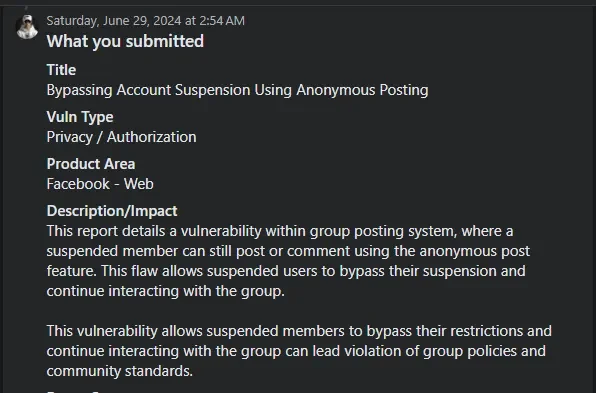
The claim is narrow and specific: a user who has been suspended on a group can still post and comment through anonymous posting. The researcher explains the mechanism as follows: anonymous posting generates an anonymous id in addition to the real user id of the suspended account. The researcher explains that anonymous posting generates an anonymous id aside from the real user id of the suspended account.
The proof of concept is a single screenshot.
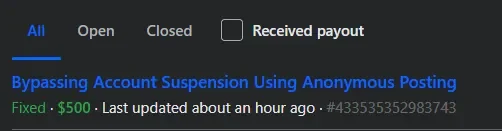
The report does not include the requests, parameters or responses involved, so there is no payload to reproduce here. It also does not state a severity rating or a weakness classification.
The timeline given is:
| Date | Event |
|---|---|
| June 29, 2024 | Initial report |
| July 1, 2024 | Triaged |
| July 3, 2024 | Bounty awarded |
| July 17, 2024 | Fixed |
The bounty was 500.00 USD. The report was disclosed on July 17, 2024.
Root cause
The report points to a split in identity. A suspension on a group is applied to the real user id, but anonymous posting creates a separate anonymous id, and the enforcement check does not account for that second identity. The report does not describe how the authorisation check is implemented.
In general terms this is a state-consistency problem: a restriction recorded against one identifier is not propagated to the other identifiers that the same principal can act through.
Impact
Within the scope of the report, the impact is that a group suspension does not actually stop the suspended user from posting and commenting in that group, as long as they use anonymous posting. Moderation action taken against an account is therefore partially ineffective, and the group's moderators cannot rely on the suspension to remove the user's ability to publish. The report does not describe any further consequence, such as access to other users' data or privilege escalation, and none should be assumed.
How this kind of bug works
Many platforms let a user act under more than one identity: a real account, a pseudonymous or anonymous identity, a page or business identity, a guest identity, or a per-context alias. Restrictions such as bans, suspensions, blocks and rate limits are usually stored against one of these identifiers, most often the real account. Every action that can be performed through an alternate identity needs to resolve back to the real account and check the restriction there.
Bugs appear when that resolution is missing or incomplete. Typical causes are:
- The alternate identity is stored in a separate table or service with no foreign key back to the account, so the check has nothing to join on.
- The restriction check is implemented in the endpoint used by the normal flow but not in the endpoint used by the alternate flow.
- The check is applied at read time (hiding content) rather than at write time (refusing the action), so the action succeeds and only its display is filtered.
- Caching or asynchronous propagation means the restriction is not yet visible to the service that handles the alternate identity.
Defences follow from this: resolve every acting identity to its owning account before authorising a write, enforce restrictions at the point of the write rather than at render time, and keep the mapping between identities and accounts in one place so new identity types cannot bypass it.
How to test for it
This class of bug is found by taking a restriction that applies to your own test account and then trying every alternate way of acting that the product offers.
- Set up two accounts you control: one that will be restricted and one that will observe. Create or join a group or similar shared space with both.
- Have a moderator or the platform restrict the first account in that space (suspend, ban, mute, block). Confirm the restriction works through the normal path: a normal post or comment should be refused.
- Enumerate the alternate identities the product exposes for posting: anonymous or pseudonymous posting, posting as a page, guest comments, scheduled posts, posts created through a different client or API version, replies versus top-level posts, edits of existing content, and reactions or polls.
- Perform each of those actions with the restricted account and check both the response and the observable result in the space as seen by the second account. A positive result is content that appears, or an action that succeeds, despite the restriction.
- Repeat after the restriction has had time to propagate, to rule out timing.
Common false positives: the content is accepted by the client but rejected server-side; the content is created but immediately hidden from everyone including the poster; the restriction was only a mute on notifications rather than on posting; the second account is a moderator and sees content that ordinary members cannot; or the restriction had already expired.
How it is fixed
Standard fixes for this bug class:
- Resolve the anonymous or alternate identity to its owning account on every write path, and evaluate the restriction against that account.
- Apply the check at the point where content is created, not only where it is displayed.
- Store the link between alternate identities and accounts so that new identity types inherit the same enforcement.
- Add regression tests that restrict an account and then exercise each alternate posting path.
Hunting notes
This bug class tends to hide wherever a product has more than one way to be a user. Look at features that deliberately decouple content from identity: anonymous or confessions-style posting, pseudonymous replies, guest checkout and guest comments, page and business identities, shared or delegated accounts, and any API that accepts an identity token separate from the session.
Recon signals worth following: endpoints that take an author id or anonymous id as a parameter, responses that contain two different identifiers for the same action, features described in help pages as letting you post without revealing your name, and any place where a restriction is described as applying to an account rather than to a space.
To make the report land, show the restriction working through the normal path and failing through the alternate path in the same session, with timestamps, and show the resulting content as a second, unrelated account sees it. Keep the demonstration to your own accounts and the minimum content needed to prove the point.
What happened, in plain words
A Facebook group lets people post and comment. It also has a feature called anonymous posting, which lets a member publish in the group without their name being shown. The researcher found that this feature could be used by someone who had been suspended in that group.
A suspension is a moderation action: a group admin or the platform decides that an account may no longer take part in that group. Normally that means the account cannot post or comment there. The researcher's claim is that a suspended user can still post and comment if they use anonymous posting instead of their normal account.
The explanation given is about identity. When you use anonymous posting, the platform creates an anonymous id for that action, separate from your real user id. The suspension is recorded against the real user id. The suspension is recorded against the real user id, while anonymous posting uses a separate anonymous id.
The proof of concept is a single screenshot.
The report does not include the requests, parameters or responses involved, so there is no payload to reproduce here. It also does not state a severity rating or a weakness classification.
The timeline given is:
| Date | Event |
|---|---|
| June 29, 2024 | Initial report |
| July 1, 2024 | Triaged |
| July 3, 2024 | Bounty awarded |
| July 17, 2024 | Fixed |
The bounty was 500.00 USD. The report was disclosed on July 17, 2024.
Root cause
The report points to a split in identity. A suspension on a group is applied to the real user id, but anonymous posting creates a separate anonymous id, and the enforcement check does not account for that second identity. The report does not describe how the authorisation check is implemented.
In general terms this is a state-consistency problem: a restriction recorded against one identifier is not propagated to the other identifiers that the same principal can act through.
Impact
Within the scope of the report, the impact is that a group suspension does not actually stop the suspended user from posting and commenting in that group, as long as they use anonymous posting. Moderation action taken against an account is therefore partially ineffective, and the group's moderators cannot rely on the suspension to remove the user's ability to publish. The report does not describe any further consequence, such as access to other users' data or privilege escalation, and none should be assumed.
How this kind of bug works
In general, many platforms let a user act under more than one identity: a real account, a pseudonymous or anonymous identity, a page or business identity, a guest identity, or a per-context alias. Restrictions such as bans, suspensions, blocks and rate limits are usually stored against one of these identifiers, most often the real account. Every action that can be performed through an alternate identity needs to resolve back to the real account and check the restriction there.
Bugs appear when that resolution is missing or incomplete. Typical causes are:
- The alternate identity is stored in a separate table or service with no foreign key back to the account, so the check has nothing to join on.
- The restriction check is implemented in the endpoint used by the normal flow but not in the endpoint used by the alternate flow.
- The check is applied at read time (hiding content) rather than at write time (refusing the action), so the action succeeds and only its display is filtered.
- Caching or asynchronous propagation means the restriction is not yet visible to the service that handles the alternate identity.
Defences follow from this: resolve every acting identity to its owning account before authorising a write, enforce restrictions at the point of the write rather than at render time, and keep the mapping between identities and accounts in one place so new identity types cannot bypass it.
How to test for it
In general, this class of bug is found by taking a restriction that applies to your own test account and then trying every alternate way of acting that the product offers.
- Set up two accounts you control: one that will be restricted and one that will observe. Create or join a group or similar shared space with both.
- Have a moderator or the platform restrict the first account in that space (suspend, ban, mute, block). Confirm the restriction works through the normal path: a normal post or comment should be refused.
- Enumerate the alternate identities the product exposes for posting: anonymous or pseudonymous posting, posting as a page, guest comments, scheduled posts, posts created through a different client or API version, replies versus top-level posts, edits of existing content, and reactions or polls.
- Perform each of those actions with the restricted account and check both the response and the observable result in the space as seen by the second account. A positive result is content that appears, or an action that succeeds, despite the restriction.
- Repeat after the restriction has had time to propagate, to rule out timing.
Common false positives: the content is accepted by the client but rejected server-side; the content is created but immediately hidden from everyone including the poster; the restriction was only a mute on notifications rather than on posting; the second account is a moderator and sees content that ordinary members cannot; or the restriction had already expired.
How it is fixed
In general, standard fixes for this bug class are:
- Resolve the anonymous or alternate identity to its owning account on every write path, and evaluate the restriction against that account.
- Apply the check at the point where content is created, not only where it is displayed.
- Store the link between alternate identities and accounts so that new identity types inherit the same enforcement.
- Add regression tests that restrict an account and then exercise each alternate posting path.
Hunting notes
In general, this bug class tends to hide wherever a product has more than one way to be a user. Look at features that deliberately decouple content from identity: anonymous or confessions-style posting, pseudonymous replies, guest checkout and guest comments, page and business identities, shared or delegated accounts, and any API that accepts an identity token separate from the session.
Recon signals worth following: endpoints that take an author id or anonymous id as a parameter, responses that contain two different identifiers for the same action, features described in help pages as letting you post without revealing your name, and any place where a restriction is described as applying to an account rather than to a space.
To make the report land, show the restriction working through the normal path and failing through the alternate path in the same session, with timestamps, and show the resulting content as a second, unrelated account sees it. Keep the demonstration to your own accounts and the minimum content needed to prove the point.
Glossary
- Account suspension: a moderation action that stops an account from taking part in a group or on a platform.
- Anonymous posting: a feature that lets a user publish content without showing their real name, using a separate anonymous id.
- Anonymous id: the identifier the platform creates for an anonymous post, distinct from the user's real account id.
- Real user id: the identifier of the actual account, which is what a suspension is recorded against.
- Identity: the name or identifier a user acts under; a platform can give one user several identities.
- Authorisation check: the step where the server decides whether an action is allowed for the identity making the request.
- Endpoint: a specific address or function on a server that handles one kind of action, such as creating a post.
- Request: the message a browser sends to a server asking it to do something.
- Response: the message the server sends back.
- Payload: the data sent inside a request, such as the text of a post.
- Parameter: a named value in a request, such as an id or a piece of text.
- Cookie: a small piece of data a site stores in your browser so it can recognise your session.
- Token: a value used to prove who you are or that a request is authorised.
- Session: the period during which a site remembers that you are logged in.
- State consistency: keeping the same fact (such as a restriction) true across all the places and identities where it matters.
- Foreign key: a link in a database that ties a record to a record in another table, such as an anonymous id to its owning account.
- Read time: the moment content is fetched and displayed.
- Write time: the moment content is created or changed on the server.
- Caching: storing a copy of data so it can be served faster, which can mean an update is not seen immediately.
- Asynchronous propagation: an update that spreads to other systems after a delay rather than instantly.
- Rate limit: a cap on how many actions an account can perform in a period.
- Privilege escalation: gaining more access or power than you are supposed to have.
- False positive: a result that looks like a bug but is not one.
- Regression test: an automated test that checks a fixed bug stays fixed.
- Recon: the information-gathering stage of security testing.
- Triaged: the stage where a report is reviewed and confirmed as a valid issue.
- Bounty: a payment made by a programme for a valid security report.
- Disclosed: made public, usually after the issue has been fixed.

