Group Admin Can’t Able to Moderate Comments
A group admin could not moderate comments on posts made by a linked page when using Facebook Lite. This allowed comments to remain unmoderated, potentially exposing group members to unwanted content.
 Published on medium.com
Prakash Panta
The full write-up lives on its author's site
It belongs to its author, so we link to it rather than copy it. The other two tabs are our own rewrites, checked against it.
Context
Facebook Groups can be linked to Facebook Pages. When a linked Page publishes a post into a Group, members can comment on that post. The Group Admin moderates comments in the Group, and in this case did so through FBLite, Facebook's lighter-weight interface. This write-up describes a case where that moderation did not work: comments made on a Page-authored post inside a Group could not be moderated by the Group Admin when using FBLite.
The researcher is Prakash Panta, writing about his second valid bug on Facebook, reported in 2020.
Setup
The report does not describe any special accounts, tools or versions. In the researcher's case the configuration was a Facebook Group linked to a Facebook Page, a post made in the Group by that linked Page, and comments left on that post by other users. The moderation attempt is made by the Group Admin through FBLite rather than the full Facebook interface.
Finding it
The researcher started from the documented behaviour that Groups can be linked to Pages. In his case, when a linked Page posted something in a Group and someone commented on that post, the Group Admin was not able to moderate the comments using FBLite. That is the whole of the observation as reported: the Group Admin was not able to moderate the comments in this specific path, where the post came from a linked Page and moderation was performed through FBLite. where the post came from a linked Page and moderation was performed through FBLite.
Exploitation
The report does not include any requests, responses, payloads or step-by-step reproduction detail. What it records is the sequence of events with the security team:
- June 13, 2020: initial report sent.
- June 17, 2020: the Facebook Security Team could not reproduce the issue, and the researcher sent further information.
- June 19, 2020: still not reproduced, and more details were sent.
- June 23, 2020: pre-triaged.
- July 8, 2020: triaged.
- July 16, 2020: closed as informative due to low impact. The researcher notes that he did not review the request or reopen the report at this point.
- August 11, 2020: fixed and bounty rewarded. The report was reopened and the bounty paid.
The researcher summarises the outcome as: the report was acknowledged, closed as informative, then Facebook found more impact due to the report, fixed the issue and rewarded him with a bounty.
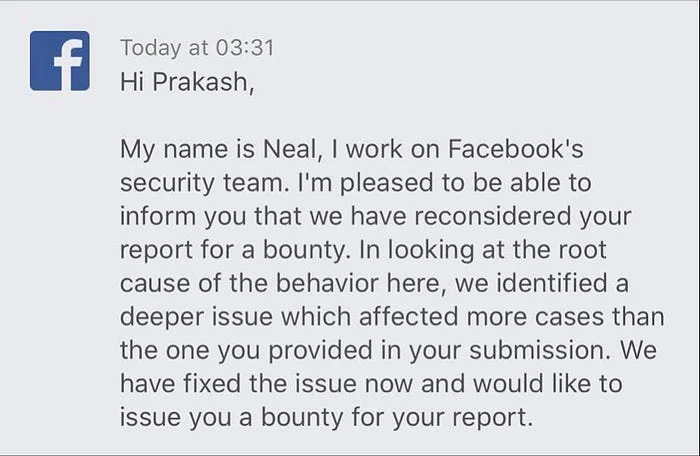
The first image is captioned by the researcher as Facebook finding more impact due to his issue.
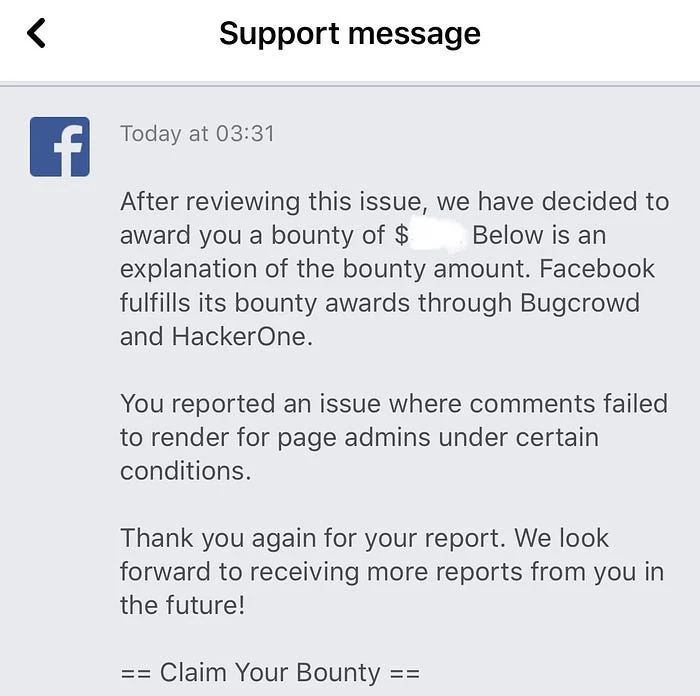
The second image is captioned as the bounty received from Facebook.
Root cause
The report does not state a root cause. It describes only the observable behaviour: a Group Admin cannot moderate comments on a post made by a linked Page when working through FBLite. The report gives no information about which component or permission check was at fault, so any specific cause would be speculation.
Impact
Under the conditions described, a Group Admin loses the ability to moderate comments on posts that a linked Page has made in their Group, as long as moderation is done through FBLite. The report was closed as informative due to low impact, before being later reopened, fixed and rewarded. The researcher's own framing is that Facebook found more impact than the initial assessment suggested.
Fix
The report says only that the issue was fixed, without describing the change. It does not identify what was modified.
Variants to test
Because the report gives no technical detail, the following are general directions rather than confirmed variants:
- Other linked Page and Group combinations: check whether a Group Admin can moderate comments on Page-authored posts in Groups with different linking configurations. A positive result is a comment that the admin cannot remove, hide or otherwise act on through the interface under test.
- Other interfaces: repeat the moderation attempt through the full Facebook interface as well as FBLite. A positive result is a difference in moderation capability between the two interfaces for the same comment.
- Other moderation actions: try the full set of moderation actions available to a Group Admin on the affected comments, not just one. A positive result is any action that silently fails or is unavailable only for Page-authored posts.
- Role variations: test with different admin roles and permissions within the Group. A positive result is a role that should be able to moderate but cannot, only in the Page-authored post path.
What happened, in plain words
Facebook lets a Group be linked to a Page. A Page is the public profile a business, brand or public figure uses; a Group is a place where people gather to discuss something. When the two are linked, the Page can publish a post into the Group, and ordinary members can comment on that post.
A Group Admin is the person who runs the Group. Part of that job is moderation: removing, hiding or otherwise acting on comments that break the rules. Facebook offers two ways to use the site: the full interface and FBLite, a lighter version built for slower connections and simpler devices. The researcher, Prakash Panta, found that when a linked Page made a post in a Group and people commented on it, the Group Admin could not moderate those comments while using FBLite. The Group Admin was not able to moderate those comments on that particular path.
This was his second valid bug on Facebook, reported in 2020. The report itself contains no requests, no parameters and no step-by-step reproduction. What it does contain is the story of what happened after he reported it, and two screenshots.
The setup
The report describes no special accounts, tools or software versions. The conditions in his case were:
- A Facebook Group linked to a Facebook Page.
- A post made in that Group by the linked Page.
- Comments left on that post by other users.
- The Group Admin trying to moderate those comments through FBLite rather than the full Facebook interface.
That is the whole setup.
Finding it
The starting point was documented, intended behaviour: Groups can be linked to Pages. A linked Page posted something in the Group, someone commented on the post, and the Group Admin then tried to moderate the comment using FBLite.
The moderation did not work. That is the entire observation as reported: the Group Admin was not able to moderate the comments in this specific path, where the post came from a linked Page and moderation was done through FBLite. There is no further technical detail about what exactly failed or why.
What happened after reporting
The report records the sequence of events with the Facebook security team. A bug bounty programme is a scheme where a company invites outside people to report security problems and pays for good ones; the security team is the group inside the company that reads and investigates those reports. "Triaged" means the team has looked at a report and accepted that it is a real issue worth working on; "pre-triaged" means it has passed an earlier, lighter check.
- June 13, 2020: initial report sent.
- June 17, 2020: the Facebook Security Team could not reproduce the issue, and the researcher sent further information. "Could not reproduce" means the team tried the steps and did not see the problem happen on their side.
- June 19, 2020: still not reproduced, and more details were sent.
- June 23, 2020: pre-triaged.
- July 8, 2020: triaged.
- July 16, 2020: closed as informative due to low impact. The researcher notes that he did not review the request or reopen the report at this point. "Closed as informative" was the outcome on July 16, 2020, attributed in the report to low impact.
- August 11, 2020: fixed and bounty rewarded. The report was reopened and the bounty paid.
The researcher sums up the outcome as follows: the report was acknowledged, then closed as informative, then Facebook found more impact because of the report, fixed the issue and rewarded him with a bounty.
The first image is captioned by the researcher as Facebook finding more impact due to his issue.
The second image is captioned as the bounty received from Facebook.
Why it happened
The report does not state a root cause. It describes only what could be seen: a Group Admin cannot moderate comments on a post made by a linked Page when working through FBLite. It says nothing about which part of the system or which permission check was at fault, so naming a specific cause would be guesswork.
What the impact was
Under the conditions described, a Group Admin loses the ability to moderate comments on posts that a linked Page has made in their Group, as long as moderation is done through FBLite. The report does not say what a commenter could gain from this, and it does not put a number on the exposure.
The report was closed as informative due to low impact. Later the issue was reopened, fixed and rewarded. The researcher's own framing is that Facebook found more impact than that first assessment suggested.
The fix
The report says only that the issue was fixed.
Things worth testing next
Because the report gives no technical detail, the following are general directions rather than confirmed variants. Each one is a way to look for the same kind of problem in a slightly different place.
- Other linked Page and Group combinations: check whether a Group Admin can moderate comments on Page-authored posts in Groups with different linking configurations. A positive result is a comment that the admin cannot remove, hide or otherwise act on through the interface under test.
- Other interfaces: repeat the moderation attempt through the full Facebook interface as well as FBLite. A positive result is a difference in moderation capability between the two interfaces for the same comment.
- Other moderation actions: try the full set of moderation actions available to a Group Admin on the affected comments, not just one. A positive result is any action that silently fails or is unavailable only for Page-authored posts.
- Role variations: test with different admin roles and permissions within the Group. A positive result is a role that should be able to moderate but cannot, only in the Page-authored post path.
Glossary
- Bug bounty programme: a scheme where a company invites outside people to report security problems and pays for good ones.
- Bounty: the payment a company makes for a valid report.
- Closed as informative: a report outcome where the team decides the issue does not qualify for the programme at that time.
- Comment: a reply that a member leaves under a post.
- FBLite: Facebook's lighter-weight interface, built for slower connections and simpler devices.
- Group: a place on Facebook where people gather to discuss something.
- Group Admin: the person who runs a Group and is responsible for moderating it.
- Impact: how much harm an issue could cause if someone took advantage of it.
- Linked Page: a Page that has been connected to a Group so it can publish posts there.
- Moderation: removing, hiding or otherwise acting on comments and posts that break the rules.
- Page: the public profile a business, brand or public figure uses on Facebook.
- Pre-triaged: an early, lighter check that a report has passed before full triage.
- Reproduce: to follow the steps in a report and see the problem happen yourself.
- Root cause: the underlying reason in the system that makes a problem possible.
- Security team: the group inside a company that reads and investigates security reports.
- Triaged: the state of a report that the team has reviewed and accepted as a real issue worth working on.
- Variant: a slightly different version of the same problem, tested in another place or configuration.


