How I Was Able to delete any facebook story where am I mentioned or tagged
When a user deactivated or deleted their account, any story that mentioned them was also deleted, even though the story belonged to another user. An attacker could therefore delete a victim's story by having the victim mention them and then deactivating their own account.
 Published on sank-dahal.medium.com
After many months I decided to write writeups regarding my first bounty from Facebook worth 1000$, before reading this writeup I would like to give credit to my big brother because without him I couldn’t have found this bug
The full write-up lives on its author's site
It belongs to its author, so we link to it rather than copy it. The other two tabs are our own rewrites, checked against it.
Context
Facebook Stories let a user post a photo or text that stays visible for a limited time, and a story can mention or tag another user. When a story mentions someone, that person is linked to the story and can be notified about it. The behaviour described here concerns what happens to that story when the mentioned user deactivates or deletes their own account.
The researcher reported the issue against Facebook Lite (FBLite) and classified it as a privacy and authorisation problem. The report was triaged by Meta and paid a bounty of 1000 USD.
Setup
Two accounts are needed:
- User A: the attacker, the account that is mentioned in the story.
- User B: the victim, the account that posts the story and mentions user A.
The researcher tested the behaviour from all of his devices before reporting. No special tools are described; the test is done through the normal Facebook Lite interface by deactivating or deleting an account.
Finding it
The bug was found by accident on the researcher's birthday. His brother posted a story that mentioned him and wrote "Happy birthday Sankalpa". After spending a long time on Facebook that day, the researcher decided to deactivate his account. At night his brother asked where the story he had posted and tagged him had gone, and whether the researcher had deleted it. The researcher had not.
When the researcher later reactivated his account to deal with school assignments, his brother said the story was back. His brother noticed the story was back, and that odd behaviour prompted the researcher to investigate. The researcher then established the pattern: whenever someone mentions him and he deactivates his Facebook account, the story is deleted too.
Exploitation
The report gives the reproduction as three steps with two users.
Step 1: post a story that mentions the attacker
From user B (the victim) account, post a story and mention user A (the attacker).
Step 2: deactivate or delete the attacker account
From user A account, deactivate or delete the account.
Step 3: observe the story
From user B account, the story is automatically deleted.
The researcher's own view of the correct behaviour is that the mention should be removed and not the whole story, which he calls "damn weird".
Root cause
The report does not describe the server-side code or the exact data model. What it establishes is a logic flaw: the lifecycle of a story is tied to the account state of a user who is only mentioned in it. When the mentioned account is deactivated or deleted, the story itself is removed rather than just the mention being detached. The report does not say which component makes that decision or why the existing checks did not prevent it; any explanation of the mechanism would be speculation.
Impact
Under the conditions in the report, an attacker can delete a victim's story by deactivating their own account, provided the victim has mentioned the attacker in that story. The attacker does not need access to the victim's account. The effect is limited to stories that mention the attacker, and the attacker has to give up their own account (deactivate or delete it) to trigger it.
Fix
Meta triaged the report and later paid a 1000 USD bounty. Based on the researcher's own suggestion, the expected behaviour is that deactivating or deleting a mentioned account removes the mention from the story and leaves the story itself in place.
Variants to test
- On other social products, mention a second account in a post or story, then deactivate that second account and check whether the whole object disappears. A positive result is the object vanishing for its author while the mention is the only link to the deactivated account.
- Repeat with account deletion instead of deactivation, and with reactivation afterwards, to see whether the object reappears. A positive result is the object returning when the mentioned account is restored, which confirms the object's state is tied to the mentioned account.
- Test the same flow from different clients (for example the Lite app and the main app) to see whether the behaviour is consistent across them. A positive result is the same deletion from every client.
- Test mentions in other object types, such as comments or tagged photos, and check whether deactivating the mentioned account removes the parent object. A positive result is the parent object being removed rather than only the mention.
What happened, in plain words
A researcher found that if someone mentions you in a Facebook Story, and then you deactivate or delete your own Facebook account, the whole story disappears for the person who posted it. Not just your name being removed from the story: the entire story is gone. He found this by accident on his birthday, reported it to Meta, and was paid 1000 USD.
This article walks through the same story for someone who has never done security work. You only need to know how to use a browser and a computer. Along the way we will explain the ideas involved: what a story is, what a mention is, what deactivating an account means, and what kind of bug this is.
Some background ideas first
Before the story itself, a few plain definitions, because the rest of the article uses them.
Facebook Stories. A story is a photo or a piece of text that a user posts and that stays visible for a limited time, then disappears on its own. Think of it like a note pinned to a noticeboard that the noticeboard owner takes down after a day.
Mention or tag. When you post a story, you can name another user in it. Facebook then links that person to the story and can notify them. Think of it like writing someone's name on a shared birthday card: the card belongs to whoever made it, but the named person is connected to it.
Account deactivation and deletion. Deactivating your account hides it and its activity without destroying it; you can come back later. Deleting an account is meant to be permanent. Both are normal options in Facebook's settings.
Authorisation. Authorisation is the question of who is allowed to do what. If a feature lets one person change or remove something that belongs to another person, without that other person agreeing, that is an authorisation problem. Think of a hotel: authorisation is the rule that your key opens your room and not the room next door.
Logic flaw. A logic flaw is a bug where the program does exactly what it was written to do, but the rule it follows is wrong. Nothing crashes and no error appears; the behaviour is simply not what anyone intended. Think of a shop till that gives a discount to anyone who says the word "birthday": the till works perfectly, the rule is just silly.
Triaged. When a bug bounty team triages a report, it means they have looked at it, accepted that it is a real issue, and moved it into their internal process. It is the moment a report stops being "a user's claim" and becomes "a confirmed problem".
Bounty. A bug bounty is a reward, usually money, that a company pays to someone who reports a security problem responsibly instead of abusing it.
The setup
The report uses two accounts, and it helps to keep them straight:
- User A: the attacker. This is the account that gets mentioned in the story.
- User B: the victim. This is the account that posts the story and mentions user A.
The researcher tested the behaviour from all of his devices before reporting. No special tools are described: the whole test is done through the normal Facebook Lite interface, by deactivating or deleting an account. Facebook Lite is the lightweight version of the Facebook app, designed for slower phones and slower connections.
How it was found
The bug was found by accident, on the researcher's birthday. His brother posted a story that mentioned him and wrote "Happy birthday Sankalpa". After spending a long time on Facebook that day, the researcher decided to deactivate his account, partly because he had been scrolling for many hours.
At night his brother asked where the story he had posted and tagged him had gone, and whether the researcher had deleted it. The researcher had not deleted any story.
Later, when the researcher reactivated his account to deal with school assignments, his brother said the story was back. His brother noticed the story was back, and that odd behaviour prompted the researcher to investigate. The researcher then established the pattern: whenever someone mentions him and he deactivates his Facebook account, the story is deleted too.
This is worth pausing on, because it is how a lot of real bugs are found. Nobody sat down to attack Facebook. Someone noticed something strange, asked why, and then tried to make it happen again on purpose. Reproducing a bug reliably is half the work of reporting it.
What he reported
The report was filed with a title, a vulnerability type, a product area, a description with impact, and reproduction steps. The title was:
An attacker can delete victims story via Facebook lite if victim mention attacker in his story and attacker deactivate His account
Read it as a sentence: an attacker can delete a victim's story, through Facebook Lite, if the victim mentions the attacker in the story and the attacker then deactivates their account. The title states the three ingredients: the mention, the deactivation, and the deletion.
The vulnerability type was listed as Privacy / Authorization, and the product area as FBLite. In other words, the researcher classified it as a problem about who is allowed to affect whose content, in the Lite app.
The description explained the birthday situation and then the pattern he had confirmed: if a victim mentions the attacker in a story and the attacker deletes or deactivates their account, the victim's story is automatically deleted. The impact section put it plainly: an attacker can delete a victim's story by deactivating their own account, provided the victim mentioned the attacker in that story.
Reproducing it
The reproduction is three steps with two users. This is the heart of the report, and it is short enough that anyone with two accounts can try it.
Step 1: post a story that mentions the attacker
From user B (the victim) account, post a story and mention user A (the attacker).
Why this step: it creates the link between the two accounts. Without a mention, there is nothing connecting the story to user A, and the rest of the test has no meaning.
Step 2: deactivate or delete the attacker account
From user A account, deactivate or delete the account.
Why this step: this is the trigger. The researcher is testing what happens to other people's content when the mentioned account changes state. The step covers both deactivation and deletion of the account.
Step 3: observe the story
From user B account, the story is automatically deleted.
Why this step: this is the observation that proves the bug. The victim did nothing to their own story, yet the story is gone. The researcher's own view of the correct behaviour is that the mention should be removed and not the whole story, which he calls "damn weird".
Put together, the three steps are:
- From user B account post a story and mention user A
- From user A account deactive or delete your account
- From user B account the story gets automatically deleted
What the vendor said
At first, Meta replied that they could not reproduce the issue.
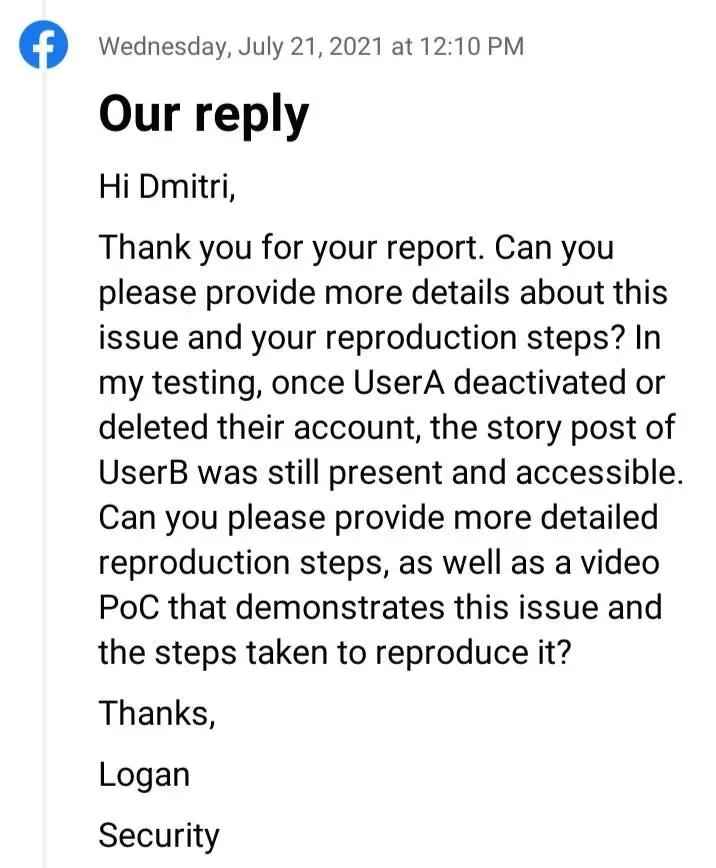
The screenshot shows that first reply, where the team says it could not reproduce the behaviour. This is a common stage in bug reporting: the vendor tries the steps and does not see the problem, often because a detail is missing or the environment differs. It does not mean the bug is not real; it means the report needs more evidence.
So the researcher sent a proof of concept video. A proof of concept, usually shortened to PoC, is a recording or a small demonstration that shows the bug happening, step by step, so the vendor can see it with their own eyes instead of reconstructing it from text. He linked it here:
https://www.youtube.com/watch?v=ddZDN5jbTYc
After the video, Meta replied again, and this time the report was triaged. The researcher describes being extremely excited, because this was his first Facebook bug to be triaged.
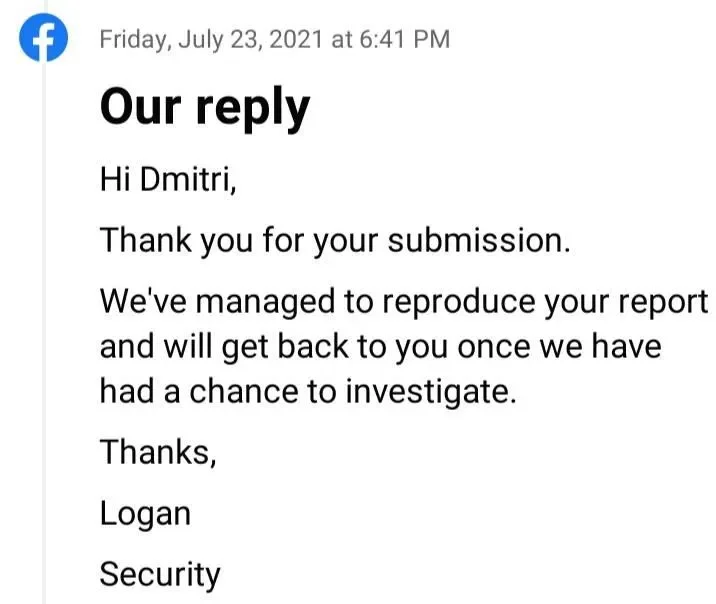
The screenshot shows the reply confirming the report had been triaged.
Some days later, Meta replied once more, and the researcher describes his reaction to that message.
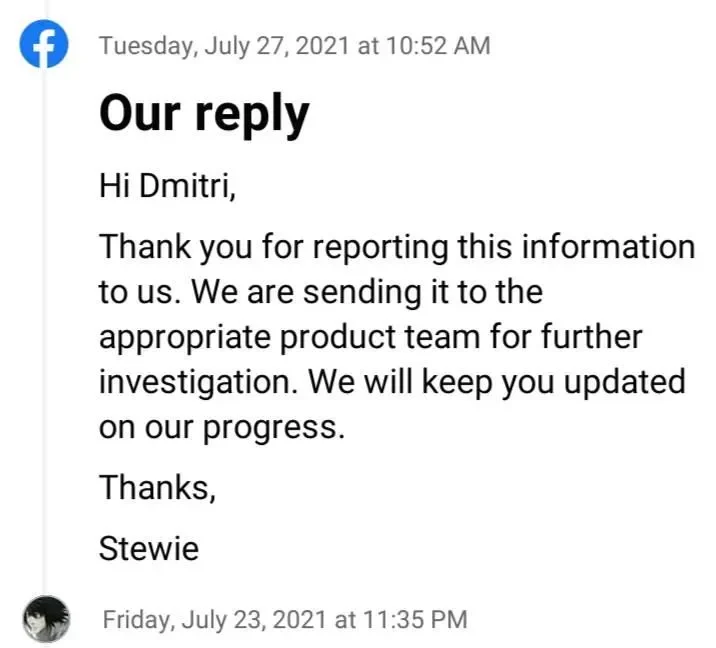
The screenshot shows that later reply. The report does not spell out its contents beyond the researcher's reaction to it.
Time then passed. The researcher was asking "Any update" frequently and got bored waiting, and eventually Meta replied again.
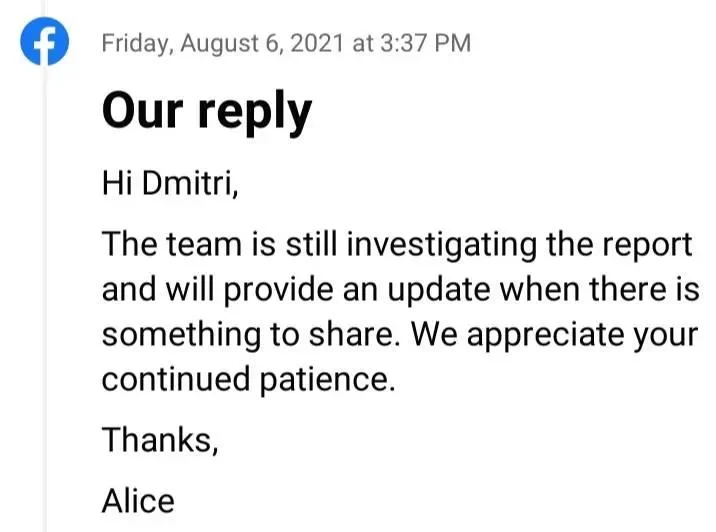
The screenshot shows that reply after the waiting period.
Then came the day the researcher describes as dying of excitement.
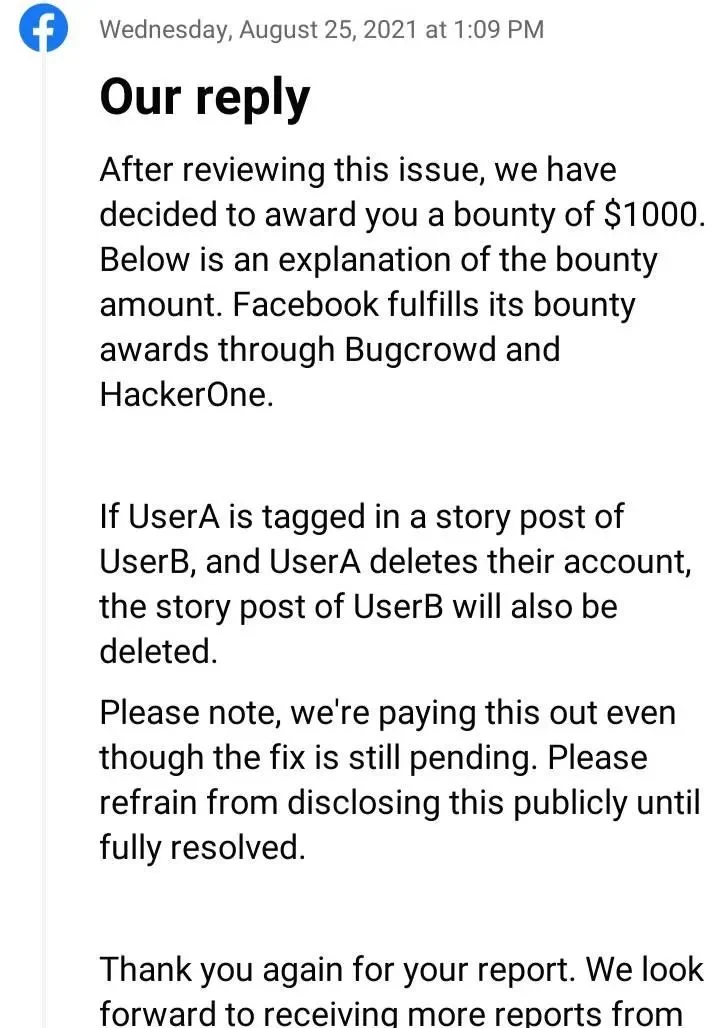
The screenshot shows the message the researcher reacted to. The report does not quote its text.
Why this is a bug at all
It is easy to read the three steps and think "so what, the story is gone". The reason it matters is ownership. The story belongs to user B. User A only appears in it as a name. One user's account setting should not be able to remove another user's content.
In authorisation terms: user A should be able to affect their own mention, for example by having their name removed from the story, but should not be able to affect the story itself. The researcher's own suggested correct behaviour is exactly that: remove the mention, keep the story.
Root cause
The report does not describe the server-side code or the exact data model, so we cannot say which part of Facebook's systems makes this decision. What the report establishes is the shape of the problem: a logic flaw where the lifecycle of a story is tied to the account state of a user who is only mentioned in it. When the mentioned account is deactivated or deleted, the story itself is removed rather than just the mention being detached.
If you are new to this, the useful lesson is not the specific mechanism but the pattern: two things that should be independent (a story, and the account of someone named in it) turned out to be linked. Bugs often live exactly where two features meet and nobody wrote down which one is supposed to be in charge.
Impact
Under the conditions in the report, an attacker can delete a victim's story by deactivating their own account, provided the victim has mentioned the attacker in that story. The attacker does not need access to the victim's account. The effect is limited to stories that mention the attacker, and the attacker has to give up their own account, by deactivating or deleting it, to trigger it. That last point is what keeps the impact modest: the attacker pays a price too.
Fix
Meta triaged the report and later paid a 1000 USD bounty. The report does not state what change was made to the product. Based on the researcher's own suggestion, the expected behaviour is that deactivating or deleting a mentioned account removes the mention from the story and leaves the story itself in place.
Variants to test
If you want to practise this kind of thinking on your own accounts, here are directions the same idea can be taken. Only ever test on accounts you own or on programs that explicitly allow it.
- On other social products, mention a second account in a post or story, then deactivate that second account and check whether the whole object disappears. A positive result is the object vanishing for its author while the mention is the only link to the deactivated account.
- Repeat with account deletion instead of deactivation, and with reactivation afterwards, to see whether the object reappears. A positive result is the object returning when the mentioned account is restored, which confirms the object's state is tied to the mentioned account.
- Test the same flow from different clients, for example the Lite app and the main app, to see whether the behaviour is consistent across them. A positive result is the same deletion from every client.
- Test mentions in other object types, such as comments or tagged photos, and check whether deactivating the mentioned account removes the parent object. A positive result is the parent object being removed rather than only the mention.
Glossary
- Account deactivation: hiding your account and its activity without destroying it, so you can come back later.
- Account deletion: removing an account, intended to be permanent.
- Attacker: in a report, the account that triggers the bad behaviour; here, user A.
- Authorisation: the rules about who is allowed to do what to whose content.
- Bug bounty: a reward a company pays for a responsibly reported security problem.
- Facebook Lite (FBLite): the lightweight version of the Facebook app, made for slower phones and connections.
- Logic flaw: a bug where the program follows its rules correctly but the rules themselves are wrong, so the behaviour is unintended without anything crashing.
- Mention / tag: naming another user inside a post or story, which links that user to the content.
- PoC (proof of concept): a demonstration, often a video, that shows a bug happening step by step.
- Privacy: the property that a user's content and information are only seen or changed by people allowed to do so.
- Reproduction steps: the exact sequence someone else can follow to make a bug happen again.
- Story: a photo or text post on Facebook that stays visible for a limited time.
- Triaged: the state of a report once the vendor has reviewed it and accepted it as a real issue.
- Victim: in a report, the account whose content is affected; here, user B.
- Vulnerability type: the category a researcher assigns to a bug, such as privacy or authorisation.

