Instagram account takeover by malicious apps
The Facebook OAuth endpoint for Android apps validated only the android_key (app signing certificate) and not the calling package name. An attacker could sign a malicious app with a publicly exposed debug keystore key that Instagram had trusted, and obtain Instagram access tokens without user interaction.

By Dzmitry - July 19, 2022
The full write-up lives on its author's site
It belongs to its author, so we link to it rather than copy it. The other two tabs are our own rewrites, checked against it.
Context
This write-up, published on 19 July 2022 by Dzmitry Lukyanenka (@vulnano), describes an Android account takeover issue in Meta's Facebook SDK for Android and the Facebook OAuth flow. The affected asset in the platform metadata is the researcher's own site, www.vulnano.com, where the write-up is hosted.
The report starts with a short explanation of Android app signing. Android applications are signed with keys generated by the app developers, as described in the Android documentation on APK signing. A signature lets a verifier confirm that an app was not modified by a third party. It also allows inter-process communication (IPC) between apps to verify the identity of the calling app by its key signature. If the caller's signature is verified, the callee can allow restricted actions, for example returning confidential information such as user data. Such keys are supposed to stay confidential and must not be exposed outside the app.
The feature under examination is the Facebook SDK for Android OAuth flow. When a Facebook app authorises a client, the SDK builds a request to the Facebook OAuth dialog. The report says this API call does not validate the package name when the client_id is authorised; it validates only the android_key parameter, which is the app signature value.
Setup
The researcher used a rooted Android 10.0 Pixel 3 device. The report notes that the issue should work on any other Android version. The Facebook for Android app version used was 302.0.0.45.119. The Facebook SDK version visible in the request is 8.1.0.
The precondition is a Facebook account that is also used for Instagram authentication, or an Instagram app authorised with that Facebook account. The attacker needs a malicious Android application signed with a key that Meta trusts for the target app (in this case Instagram). The report does not publish the PoC; it states that the PoC is simply an app signed with the debug.keystore key located in the React Native repository at https://github.com/facebook/react-native/tree/master/keystores. If the PoC is compiled from the provided sources, the build.gradle file must be edited to set the correct path to the debug.keystore file.
Finding it
The researcher was experimenting with the Facebook SDK for Android and noticed that the OAuth authorisation call does not validate the package name. The request contains both an android_key and a calling_package_key, but only android_key is checked. The request observed was:
https://m.facebook.com/dialog/oauth?android_key=Xo8WBi6jzSxKDVR4drqm84yr9iU&calling_package_key=com.vulnano.android.facebook.sdkat&client_id=124024574287414&display=touch&facebook_sdk_version=8.1.0&redirect_uri=fbconnect%3A%2F%2Fsuccess&response_type=token%2Csigned_request%2Cgraph_domain&scope=email&state=%7B%220_auth_logger_id%22%3A%2248b8ada7-fa9e-4136-a711-edc4778a8601%22%2C%223_method%22%3A%22katana_proxy_auth%22%7D&type=user_agent&_rdr
In this URL, android_key carries the app signature value, calling_package_key carries the package name of the calling app, client_id identifies the Facebook application, and redirect_uri is the SDK's fbconnect://success callback. The response type requests a token, a signed request and the graph domain, with the email scope.
The researcher then looked at Facebook application configurations. Some Facebook applications, Instagram among them, are configured not only with the release Facebook keystore but also with exposed keys that can be found on the internet. One example given is the keystore in the React Native repository, used to sign examples for React apps:
https://github.com/facebook/react-native/tree/master/keystores keystore
The researcher found the signature value by looking at Facebook sources, which contained lines like this:
public static final C016209j A01 = new C016209j("fbandroid_debug", "Xo8WBi6jzSxKDVR4drqm84yr9iU", "-[redacted]");
Searching for Xo8WBi6jzSxKDVR4drqm84yr9iU led to the original key, which is an Android debug key. Because the API call does not validate the package name, an app signed with that key can be authorised as the target application. In the researcher's case, the malicious app received an Instagram token through the Facebook for Android app.
Exploitation
The attack requires the victim to have Facebook for Android installed and be logged in with an account also used for Instagram, and the malicious app must be installed on the device. The steps in the report are:
- Install Facebook for Android.
- Log in to Facebook with the account that is also used for Instagram authentication, or install Instagram and authorise it there with the Facebook account.
- Install the PoC.
- Launch the PoC.
- If the message "Token is null, login" appears, press the Login button.
- The received token should then be displayed.
- Copy the token and verify it.
The report includes a video of the PoC, accessible at https://youtube.com/shorts/gcQk0lMZEUE. The researcher notes that the test token in the video is not fully blurred, but says it should be inactive.
Root cause
The root cause is that the OAuth authorisation endpoint validates only the android_key (the app signature) and does not validate the package name supplied in calling_package_key. Because the signature alone is treated as sufficient proof of app identity, any app signed with a key that Meta trusts for a given Facebook application can impersonate that application. Meta had configured some Facebook applications, including Instagram, with keys that were publicly exposed, such as the React Native debug.keystore. The existing defence, signature verification, therefore did not stop the attack: the signature was valid, but it belonged to a publicly available debug key rather than to the legitimate app.
The report also notes that Google Play prevents developers from uploading APKs signed with that key, so the malicious app cannot be distributed through the Play Store. However, the researcher warns that developers who use this key as a debug key in a React app and trust it through signature verification in code are exposed.
Impact
A malicious Android application can steal Instagram tokens, and probably tokens for other apps, without user interaction. The report says this is possible through the public keystore file that can be used to sign a malicious APK. The researcher also suggests that the same signature may allow bypassing some signature checks in inter-process communication with Facebook apps, or on Facebook devices such as Portal or Oculus, but this is stated as a possibility rather than demonstrated.
The attack requires the victim to have Facebook for Android installed and to be logged in with an account that is also used for Instagram. The malicious app must be installed on the device, and it must be signed with a key that Meta trusts for the target application.
Fix
The report's timeline states that the issue was fixed on 25 June 2021. The write-up does not describe the technical change that was made. The report's own guidance is that developers should be careful if they use the React Native debug key as a debug key and trust it through signature verification in code.
Timeline
| Date | Event |
|---|---|
| 26.01.2021 | Report sent |
| 26.01.2021 | Report reproduced by Meta team |
| 27.01.2021 | Report triaged |
| 08.06.2021 | Bounty 10000$ + 2000$ (Diamond league bonus) |
| 25.06.2021 | Fixed |
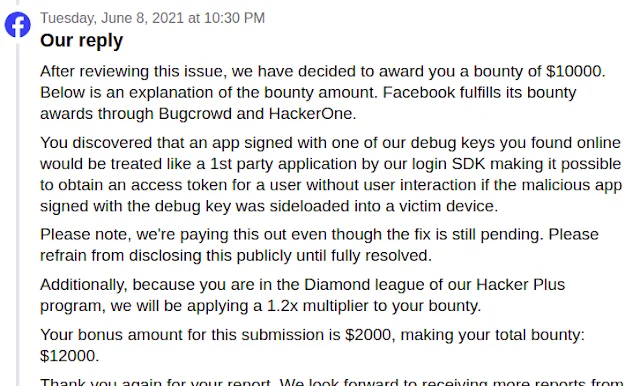
The image shows the timeline of the report as listed above.
Variants to test
- Test other Facebook applications that may be configured with publicly exposed debug keys. A positive result is an OAuth request that returns a token for the target application when the calling app is signed with the exposed key.
- Test whether the
calling_package_keyparameter is validated at all by changing it to a different package name while keeping a trustedandroid_key. A positive result is a successful authorisation despite the mismatched package name. - Test signature checks in IPC between Facebook apps, or on Facebook devices such as Portal or Oculus, using an app signed with a publicly exposed key. A positive result is a restricted action being allowed for the impersonating app.
- Search Facebook sources and public repositories for other hardcoded signature values and debug keystores, then check whether they are trusted by any production Facebook application. A positive result is a token issued to an app signed with such a key.
Promo
The researcher adds a community note about HackerOne. He says he trusted HackerOne to receive bounties from Meta, has an MVH 2019 belt from Vancouver and other awards from LHE organised by HackerOne. He states that HackerOne claims not to send rewards to researchers located in sanctioned areas such as Belarus and Russia, and that they do not send payments anywhere if the researcher has Belarusian or Russian citizenship. He says payments from his HackerOne account were locked and he could not send them to any other country, pay taxes there or spend the money there. He says he had good reputation in private programmes but lacks motivation to look for bugs when he cannot receive rewards, and that this is only because of his Belarusian citizenship. He also links to a story from a Belarusian colleague who could not get money from HackerOne, money earned before the war started and before HackerOne announced restrictions. He lists his experience as roughly top 10 in Meta bug bounty 2018-2022 and roughly top 15 in Google bug bounty.
Related posts
The page also lists other posts from the blog:
- Remote code execution through a vulnerability in Facebook Messenger for Windows (June 2024), published 2 September 2025.
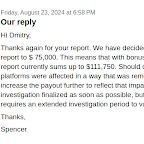
Image From the original on vulnano.com - Facebook Messenger server random memory exposure through a corrupted GIF image, published 6 March 2019.
- Meta Quest: attacker could make any Oculus user follow (subscribe to) him without any approval, published 9 January 2023.
Image From the original on vulnano.com
What happened, in plain words
This is a story about a phone app that could pretend to be another phone app, and in doing so could take over an Instagram account. The researcher, Dzmitry Lukyanenka (@vulnano), published it on 19 July 2022 on his own site, www.vulnano.com. The platform metadata lists the affected asset as that site, because that is where the write-up lives; the thing that was actually broken was in Meta's (Facebook's) systems.
To follow the story you only need to understand a few everyday ideas. Think of a phone app as a parcel. Android, the phone operating system, puts a wax seal on every parcel before it is delivered. The seal is called a signature, and it is made with a secret stamp called a key. Anyone can look at the seal and check it, but only the person holding the stamp can make a new parcel with the same seal. If the seal is intact, the receiver knows the parcel was not opened and repacked by someone else.
Apps on the same phone can also talk to each other. This is called inter-process communication (IPC): two programs passing messages, like two colleagues passing notes in an office. When one app asks another for something private, the receiving app can look at the sender's seal to decide whether to trust it. If the seal matches a known, trusted app, the receiver may hand over confidential information, such as details about the user.
For all of this to mean anything, the stamp (the key) has to stay secret. If the stamp is published on the internet, anyone can make parcels with the same seal, and the seal stops proving anything.
The feature in the report is the Facebook SDK for Android. An SDK is a box of ready-made tools that a developer drops into their app so they do not have to build everything from scratch, a bit like a furniture kit. This particular kit lets an Android app log users in through Facebook. The login step is called OAuth, which is a standard way for one service to ask another service for permission on your behalf, like showing a membership card at a partner shop so they let you in without issuing you a new card.
When an app uses the kit, it sends a request to a Facebook web address (an API, meaning a defined doorway that programs use to ask a server to do something). The report says this request does not check the name of the app that is calling (the package name). It checks only one thing: the android_key parameter, which is the app's signature value. So the doorway asks for a valid seal, but not for the caller's name.
That would be fine if every trusted seal belonged to exactly one app. But the researcher found that some Facebook applications, Instagram among them, were configured to trust seals made with keys that were already public on the internet. One such key is the debug.keystore file in Facebook's React Native project on GitHub. A keystore is a small file that holds keys, like a keyring. A debug key is a throwaway key developers use while testing, not a secret production key.
Because the doorway only checked the seal, and because the seal could be made by anyone who downloaded the public key, the researcher could sign his own malicious app with that key and have Facebook treat it as Instagram. The result was an Instagram token handed to his app. A token is a short string that acts like a temporary pass: whoever holds it can act as the logged-in user, a bit like a coat-check ticket that gets you the coat without proving who you are.
This class of bug is an account takeover: an attacker gains control of someone else's account. It is also an Android issue, because it depends on how Android apps are signed and how they talk to each other.
Context
The write-up describes an Android account takeover in Meta's Facebook SDK for Android and in the Facebook OAuth flow. The target is the Facebook OAuth authorisation endpoint that the Android SDK uses. The affected asset recorded in the platform metadata is the researcher's own site, www.vulnano.com, where the write-up is hosted.
The report opens with a short explanation of Android app signing. Android applications are signed with keys generated by the app developers, as described in the Android documentation on APK signing. A signature lets a verifier confirm that an app was not modified by a third party. It also allows inter-process communication (IPC) between apps to verify the identity of the calling app by its key signature. If the caller's signature is verified, the callee can allow restricted actions, for example returning confidential information such as user data. Such keys are supposed to stay confidential and must not be exposed outside the app.
In plain terms: the seal on the parcel is only useful if the stamp is locked away. The moment the stamp is copied and posted publicly, the seal proves nothing about who sent the parcel.
The feature under examination is the Facebook SDK for Android OAuth flow. When a Facebook app authorises a client, the SDK builds a request to the Facebook OAuth dialog. The report says this API call does not validate the package name when the client_id is authorised; it validates only the android_key parameter, which is the app signature value.
So the doorway checks the seal but not the name on the envelope. If two different apps can produce the same seal, the doorway cannot tell them apart.
Setup
The researcher used a rooted Android 10.0 Pixel 3 device. Rooted means the owner has removed the normal restrictions of the phone and has full administrator control, which is useful for testing. The report notes that the issue should work on any other Android version. The Facebook for Android app version used was 302.0.0.45.119. The Facebook SDK version visible in the request is 8.1.0.
The precondition is a Facebook account that is also used for Instagram authentication, or an Instagram app authorised with that Facebook account. The attacker needs a malicious Android application signed with a key that Meta trusts for the target app, in this case Instagram.
The report does not publish the PoC. PoC stands for proof of concept: a small demonstration that shows the bug is real, like a model built to show a bridge design will hold. The report states that the PoC is simply an app signed with the debug.keystore key located in the React Native repository at https://github.com/facebook/react-native/tree/master/keystores. If the PoC is compiled from the provided sources, the build.gradle file must be edited to set the correct path to the debug.keystore file. build.gradle is a configuration file that tells the build tools how to assemble the app, and here it needs to know where the keyring file sits on the researcher's computer.
Finding it
The researcher was experimenting with the Facebook SDK for Android and noticed that the OAuth authorisation call does not validate the package name. The request contains both an android_key and a calling_package_key, but only android_key is checked. The request observed was:
https://m.facebook.com/dialog/oauth?android_key=Xo8WBi6jzSxKDVR4drqm84yr9iU&calling_package_key=com.vulnano.android.facebook.sdkat&client_id=124024574287414&display=touch&facebook_sdk_version=8.1.0&redirect_uri=fbconnect%3A%2F%2Fsuccess&response_type=token%2Csigned_request%2Cgraph_domain&scope=email&state=%7B%220_auth_logger_id%22%3A%2248b8ada7-fa9e-4136-a711-edc4778a8601%22%2C%223_method%22%3A%22katana_proxy_auth%22%7D&type=user_agent&_rdr
Line by line, in plain words:
https://m.facebook.com/dialog/oauthis the web address of the Facebook login doorway. The?starts the list of parameters, which are the pieces of information the app sends along with the request, like the fields on a paper form.android_key=Xo8WBi6jzSxKDVR4drqm84yr9iUis the app signature value. This is the seal. The doorway checks this one.calling_package_key=com.vulnano.android.facebook.sdkatis the package name of the calling app. A package name is the unique name Android gives an app, like a surname. The report says this one is not checked.client_id=124024574287414identifies which Facebook application is being authorised. Each Facebook app has its own number.display=touchasks Facebook to show the login page in a form suited to a touch screen.facebook_sdk_version=8.1.0tells Facebook which version of the kit is being used.redirect_uri=fbconnect%3A%2F%2Fsuccessis where Facebook should send the user afterwards. The%3A%2F%2Fis the URL-encoded form of://, so the real value isfbconnect://success, the SDK's callback address.response_type=token%2Csigned_request%2Cgraph_domainasks for three things back: a token, a signed request and the graph domain. The%2Cis an encoded comma.scope=emailasks for permission to read the user's email address. Scope is the list of permissions being requested, like ticking boxes on a consent form.state=%7B...%7Dis a blob of bookkeeping data the SDK sends and expects back, so it can match the reply to the request. The%7Band%7Dare encoded curly braces.type=user_agentand_rdrare further SDK parameters; the report does not explain them.
The researcher then looked at Facebook application configurations. Some Facebook applications, Instagram among them, are configured not only with the release Facebook keystore but also with exposed keys that can be found on the internet. One example given is the keystore in the React Native repository, used to sign examples for React apps:
https://github.com/facebook/react-native/tree/master/keystores keystore
This is a web address pointing at a folder in a public code repository. Anyone with a browser can open it and download the keyring file. That is the heart of the problem: a key that is supposed to be secret is sitting in public view.
The researcher found the signature value by looking at Facebook sources, which contained lines like this:
public static final C016209j A01 = new C016209j("fbandroid_debug", "Xo8WBi6jzSxKDVR4drqm84yr9iU", "-[redacted]");
This is a line of Java code, the language Android apps are commonly written in. In plain words:
public static finalmeans this value is a fixed constant that the code can read from anywhere.C016209jis the name of a class, a kind of blueprint in the code.A01is the name of the variable holding the value.new C016209j(...)creates a new object of that class, passing three pieces of text into it."fbandroid_debug"is a label, suggesting this is the debug configuration for the Facebook Android app."Xo8WBi6jzSxKDVR4drqm84yr9iU"is the signature value, the same one that appears in the request above asandroid_key."-[redacted]"is another string stored alongside it; the report does not say what it is used for.
Searching for Xo8WBi6jzSxKDVR4drqm84yr9iU led to the original key, which is an Android debug key. Because the API call does not validate the package name, an app signed with that key can be authorised as the target application. In the researcher's case, the malicious app received an Instagram token through the Facebook for Android app.
Exploitation
The attack requires the victim to have Facebook for Android installed and be logged in with an account also used for Instagram, and the malicious app must be installed on the device. The steps in the report are:
- Install Facebook for Android. Install Facebook for Android.
- Log in to Facebook with the account that is also used for Instagram authentication, or install Instagram and authorise it there with the Facebook account.
- Install the PoC. Install the PoC.
- Launch the PoC. Launch the PoC.
- If the message "Token is null, login" appears, press the Login button.
- The received token should then be displayed.
- Copy the token and verify it. Copy the token and verify it.
The report includes a video of the PoC, accessible at https://youtube.com/shorts/gcQk0lMZEUE. The researcher notes that the test token in the video is not fully blurred, but says it should be inactive. In other words, the researcher says the token visible in the recording should be inactive.
Root cause
The root cause is that the OAuth authorisation endpoint validates only the android_key (the app signature) and does not validate the package name supplied in calling_package_key. Because the signature alone is treated as sufficient proof of app identity, any app signed with a key that Meta trusts for a given Facebook application can impersonate that application. Meta had configured some Facebook applications, including Instagram, with keys that were publicly exposed, such as the React Native debug.keystore. The existing defence, signature verification, therefore did not stop the attack: the signature was valid, but it belonged to a publicly available debug key rather than to the legitimate app.
A useful comparison: a bouncer checks that your membership card is genuine, but never checks that the photo on it is you. If the card design is published online, anyone can print a genuine-looking card. The check is real, but it is checking the wrong thing.
The report also notes that Google Play prevents developers from uploading APKs signed with that key, so the malicious app cannot be distributed through the Play Store. An APK is the installable package file of an Android app. However, the researcher warns that developers who use this key as a debug key in a React app and trust it through signature verification in code are exposed. The researcher warns that developers who use this key as a debug key in a React app and trust it through signature verification in code are exposed.
Impact
A malicious Android application can steal Instagram tokens, and probably tokens for other apps, without user interaction. The report says this is possible through the public keystore file that can be used to sign a malicious APK. The researcher also suggests that the same signature may allow bypassing some signature checks in inter-process communication with Facebook apps, or on Facebook devices such as Portal or Oculus, but this is stated as a possibility rather than demonstrated.
The attack requires the victim to have Facebook for Android installed and to be logged in with an account that is also used for Instagram. The malicious app must be installed on the device, and it must be signed with a key that Meta trusts for the target application.
Fix
The report's timeline states that the issue was fixed on 25 June 2021. The report's own guidance is that developers should be careful if they use the React Native debug key as a debug key and trust it through signature verification in code.
Timeline
| Date | Event |
|---|---|
| 26.01.2021 | Report sent |
| 26.01.2021 | Report reproduced by Meta team |
| 27.01.2021 | Report triaged |
| 08.06.2021 | Bounty 10000$ + 2000$ (Diamond league bonus) |
| 25.06.2021 | Fixed |
The image shows the timeline of the report as listed above.
A few words on the table. Triaged means the receiving team confirmed the report is valid and started handling it. Reproduced means they managed to make the bug happen themselves. The bounty is the reward paid for the report; here it was 10,000 US dollars plus a 2,000 dollar bonus from a programme called the Diamond league.
Variants to test
These are follow-up ideas the technical write-up lists, each with a clear sign of success:
- Test other Facebook applications that may be configured with publicly exposed debug keys. A positive result is an OAuth request that returns a token for the target application when the calling app is signed with the exposed key.
- Test whether the
calling_package_keyparameter is validated at all by changing it to a different package name while keeping a trustedandroid_key. A positive result is a successful authorisation despite the mismatched package name. - Test signature checks in IPC between Facebook apps, or on Facebook devices such as Portal or Oculus, using an app signed with a publicly exposed key. A positive result is a restricted action being allowed for the impersonating app.
- Search Facebook sources and public repositories for other hardcoded signature values and debug keystores, then check whether they are trusted by any production Facebook application. A positive result is a token issued to an app signed with such a key.
Promo
The researcher adds a community note about HackerOne, a platform that runs bug bounty programmes. He says he trusted HackerOne to receive bounties from Meta, has an MVH 2019 belt from Vancouver and other awards from LHE organised by HackerOne. He states that HackerOne claims not to send rewards to researchers located in sanctioned areas such as Belarus and Russia, and that they do not send payments anywhere if the researcher has Belarusian or Russian citizenship. He says payments from his HackerOne account were locked and he could not send them to any other country, pay taxes there or spend the money there. He says he had good reputation in private programmes but lacks motivation to look for bugs when he cannot receive rewards, and that this is only because of his Belarusian citizenship. He also links to a story from a Belarusian colleague who could not get money from HackerOne, money earned before the war started and before HackerOne announced restrictions. He lists his experience as roughly top 10 in Meta bug bounty 2018-2022 and roughly top 15 in Google bug bounty.
This section is the researcher's personal opinion about payment policy. It is not part of the technical finding, and the report does not provide further evidence beyond what is described here.
Related posts
The page also lists other posts from the blog:
- Remote code execution through a vulnerability in Facebook Messenger for Windows (June 2024), published 2 September 2025.
Image From the original on vulnano.com - Facebook Messenger server random memory exposure through a corrupted GIF image, published 6 March 2019.
- Meta Quest: attacker could make any Oculus user follow (subscribe to) him without any approval, published 9 January 2023.
Image From the original on vulnano.com
Glossary
- Account takeover: a situation where an attacker gains control of someone else's account, here an Instagram account.
- Android: the operating system that runs on many phones and tablets.
- API: a defined doorway that one program uses to ask another program or a server to do something.
- APK: the installable package file of an Android app.
- Bounty: a reward paid to a researcher for reporting a valid security bug.
- Build.gradle: a configuration file that tells Android build tools how to assemble an app.
- Callback (redirect_uri): the address a service sends the user back to after a login step.
- Client_id: a number that identifies which application is making an OAuth request.
- Debug key: a throwaway signing key used during development and testing, not meant for production.
- Debug.keystore: the keyring file holding a debug key, in this case one published in the React Native repository.
- Facebook SDK for Android: a box of ready-made tools that developers add to Android apps to use Facebook features such as login.
- Inter-process communication (IPC): two programs on the same device passing messages to each other.
- Java: a programming language commonly used for Android apps.
- Key: a secret value used to create a signature.
- Keystore: a file that holds one or more keys, like a keyring.
- OAuth: a standard way for one service to ask another service for permission on a user's behalf.
- Package name: the unique name Android gives an app, such as
com.vulnano.android.facebook.sdkat. - Parameter: a named piece of information sent with a web request, like a field on a form.
- PoC (proof of concept): a small demonstration that shows a bug is real.
- Rooted: a phone whose normal restrictions have been removed so the owner has full administrator control.
- Scope: the list of permissions an app requests during login, for example
email. - SDK: a set of ready-made tools a developer adds to an app instead of building everything from scratch.
- Signature: a cryptographic seal on an app that lets others check it was not modified and identify who signed it.
- State: bookkeeping data sent with an OAuth request and expected back, so the reply can be matched to the request.
- Token: a short string that acts as a temporary pass, letting whoever holds it act as the logged-in user.
- Triaged: confirmed as valid by the receiving security team and moved into handling.
- URL encoding: writing special characters in a web address in a safe form, for example
%3Afor a colon or%2Cfor a comma.




