Irremovable comments on the FB Lite app
The FB Lite app failed to delete comments made in 2013 or earlier, showing an error message. An attacker could not exploit this directly, but it prevented users from removing their own old comments.
 Published on theshubh77.medium.com
Hi guys, I’m Shubham Bhamare again. In this write-up, I’m going to tell you how I found a simple FB Lite bug that restricted FB Lite app users from deleting comments under certain circumstances.
The full write-up lives on its author's site
It belongs to its author, so we link to it rather than copy it. The other two tabs are our own rewrites, checked against it.
Context
This is a story about the Facebook Lite app, the lightweight client that Facebook (now Meta) offers to users on low-bandwidth or low-storage devices. The feature in question is the ordinary ability to delete a comment: a user should be able to remove their own comments, and to remove other people's comments on their own posts.
When the bug was reported, Facebook accepted reports where an action could not be performed through FB Lite but worked on other platforms such as Facebook Web or Facebook for Android/iOS. The reasoning given in the write-up is that users with low bandwidth and storage cannot fall back to those heavier platforms. The author notes that he does not know whether Facebook still accepts this class of bug, as he is no longer hunting.
Setup
The write-up describes no special tooling, accounts or configuration. The researcher was using the FB Lite app on his own account, scrolling through his own old posts. The only precondition that mattered in the end was the age of the content: the affected comments were made in 2013 or earlier. The report also notes as a takeaway that some bugs may be time and account specific.
Finding it
While scrolling through old posts on FB Lite, the researcher came across an old post of his own on which he had commented twice with the same word. He tried to delete that comment and the app returned an error:
We can’t process this request at the moment. Please try a bit later!
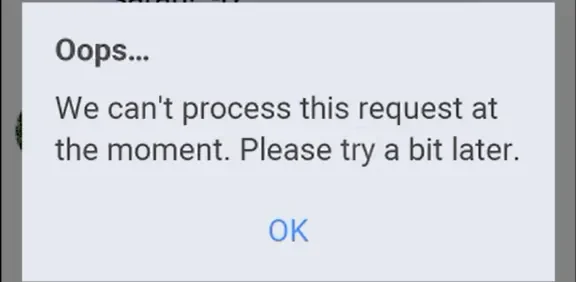
He then tried deleting his other comments, and they also failed to delete. He tried deleting other people's comments on his old posts, and got the same error. Assuming a stale client, he updated the FB Lite app and retried, but the deletions still failed. Since the action was clearly intended to work, he recorded a video proof of concept and reported it to Facebook.
Exploitation
Step 1: Reproduce on old content
On the same day, Facebook replied asking for additional information, including Post ID, FB Lite version and device information, because the team could not reproduce the issue.
Step 2: Test with a fresh post
To supply a Post ID, the researcher created a test post, commented on it and tried to delete the comment. This time the comment was deleted successfully, which made him suspect the report was a false positive.
Step 3: Narrow down the condition
He went back to deleting old comments, and the same error returned. Further testing showed that only old comments made in the year 2013 or prior were affected. He added this detail to the report, and after some follow-ups the team was able to reproduce the issue.
No HTTP requests, parameters or headers are shown in the write-up; the only observable is the error message above and the difference in behaviour between recent and old comments.
Root cause
The write-up does not describe the underlying defect. What it establishes is the boundary of the behaviour: deletion fails for comments created in 2013 or earlier, and succeeds for a newly created comment on a newly created post. The report does not say whether the same actions worked on other platforms. The precise mistake in the code is not stated, so any explanation of it would be speculation.
Impact
A user of FB Lite could not delete their own comments, nor other people's comments on their own posts, when those comments dated from 2013 or earlier. The practical consequence is that a user of FB Lite could not delete those comments.
Fix
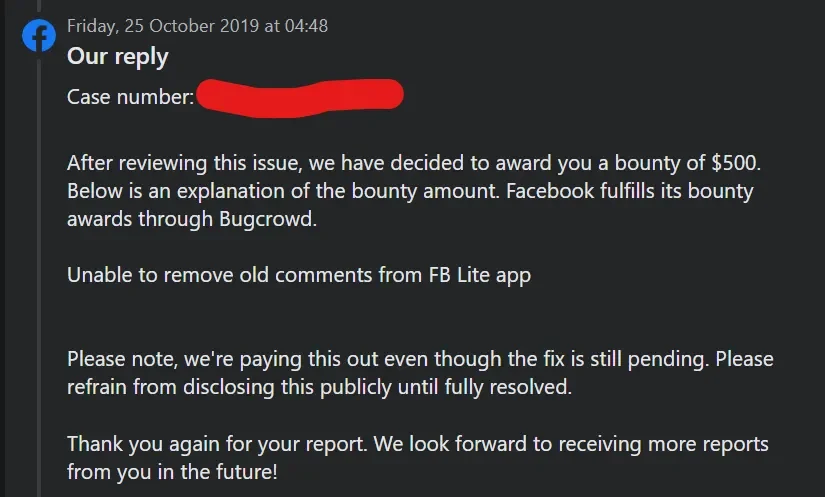
The timeline records that the issue was fixed completely on 07 February 2020.
Timeline
| Date | Event |
|---|---|
| Aug 01, 2019 | Report sent |
| Aug 01, 2019 | Additional information requested by Facebook |
| Aug 02, 2019, Aug 16, 2019 | Follow-ups |
| Aug 23, 2019 | Triaged |
| Oct 25, 2019 | 500 USD bounty awarded |
| Feb 07, 2020 | Fixed completely |
Variants to test
- Repeat the same observation on other lightweight or alternative clients of a service: try an action that works on the main web or native app and see whether the lite client returns an error. A positive result is a consistent, reproducible error message where the action should succeed.
- Vary the age of the object being acted on. Create a fresh object and act on it, then act on an old one. A positive result is a difference in behaviour that tracks the age of the object rather than the client version.
- Vary the ownership of the object: your own content, your content on someone else's post, and other people's content on your own post. A positive result is a failure that appears in one ownership case but not the others.
- When a first attempt fails, update the client and retry before concluding anything, so that a stale build is ruled out. A positive result is the failure persisting after the update.
- When a team cannot reproduce, supply the identifiers they ask for (object ID, client version, device details) and a minimal test case. A positive result is reproduction by the team from those details alone.
What happened, in plain words
A security researcher found that the Facebook Lite app would not let him delete certain comments. When he tried, the app showed an error message instead of removing the comment. This happened for his own comments and for other people's comments on his own posts, but only when the comments were old, made in 2013 or earlier. Newer comments deleted normally. Facebook paid him 500 USD for the report and fixed the problem completely on 07 February 2020.
This article walks through the story from the beginning, explaining every technical idea as it comes up, so you can follow it even if you have never done security work before.
Background: what Facebook Lite is and why it matters
Facebook Lite is a lightweight version of the Facebook app. Facebook (now Meta) made it for people whose phones have slow internet connections or very little free storage. The full Facebook app and the Facebook website need more data and more space, so on a cheap phone or a weak connection they may be too heavy to use.
Because of that, when this bug was reported, Facebook accepted reports where something could not be done in FB Lite but worked fine on Facebook Web or the full Android/iOS app. The reasoning is simple: if a person cannot use the heavier platforms at all, then a broken feature in Lite is a real problem for them, not a minor inconvenience. The author adds that he does not know whether Facebook still accepts this kind of report today, because he is no longer hunting for bugs.
A quick word on the kind of bug this is. Security people call it a logic flaw. Most people imagine security bugs as break-ins: someone stealing a password or reading data they should not see. A logic flaw is different. The program does exactly what it was told to do, but the instructions themselves are wrong for some situations. Think of a shop till that refuses to give a refund on any receipt older than a certain date because of a mistake in its rules: nothing is hacked, the till simply follows a bad rule. Here, the rule about deleting comments misbehaved for old comments.
Setting the scene
The write-up describes no special tools, no test accounts and no configuration. The researcher was simply using the FB Lite app on his own normal account, scrolling through his own old posts. The only condition that turned out to matter was the age of the content: the comments that failed were made in 2013 or earlier. The author also lists as a lesson that some bugs may be specific to a certain time and a certain account, meaning the same steps might not fail for everyone.
Finding it
Chapter 1: the error appears
On 1 August 2019, the researcher was lying on his bed after lunch, scrolling through old Facebook posts in the FB Lite app. He came across an old post of his own where he had commented twice with the same word. He tried to delete that comment, and the app showed this error:
We can’t process this request at the moment. Please try a bit later!
What does the message mean? It is the app's way of saying that the request to delete the comment did not go through. In everyday terms, it is like a shop assistant telling you "the system is down, try again later". The important detail is that the message is vague: it does not say why the request failed, only that it did.
He then tried to delete his other comments, and those did not get deleted either. He tried to delete other people's comments on his old posts, and the same error appeared. At first he assumed the app was simply out of date, so he updated FB Lite and tried again. The deletions still failed.
This is the moment the researcher realised something was wrong in a way that was not intended. He recorded a short video showing the bug happening and sent it to Facebook as his report. A proof of concept (often shortened to PoC) is simply a demonstration that a problem is real: a recording or a set of steps that shows the faulty behaviour happening, so the people receiving the report can see it for themselves instead of taking your word for it.
Chapter 2: Facebook cannot reproduce it
On the same day, Facebook replied. They asked for more information, including the Post ID, the FB Lite version and details about the device, because they could not reproduce the issue. To reproduce a bug means to follow the reporter's steps on your own side and see the same failure happen. If the team cannot make it happen, they cannot study or fix it, so they ask for details that might let them try again more precisely.
A Post ID is the unique number that identifies one particular post, in the same way a passport number identifies one particular passport. The team needed it to look at the exact post involved. The FB Lite version is the release number of the app installed on the phone, and the device information describes the phone model and system, because behaviour can differ between versions and devices.
To give them a Post ID, the researcher created a brand new test post, commented on it, and tried to delete that comment. This time the comment was deleted successfully. He felt sad, assuming his report was a false positive: a report of a problem that turns out not to be a real problem, like a smoke alarm going off because of burnt toast.
But then he went back to his old comments, and the same error returned. That was strange, and it was the clue. He tested further and found the pattern: only old comments made in the year 2013 or earlier were affected. He added this detail to the report, and after some follow-ups the team was able to reproduce the issue.
Why did this matter so much? Because a bug report that says "deleting comments fails" is hard to act on. A bug report that says "deleting comments fails only for comments from 2013 or earlier" gives the team a precise condition to test. Narrowing down the exact circumstances is often the most valuable part of a report, more than the first observation itself.
What the report does and does not show
The write-up contains no web requests, no parameters and no headers. The only things it shows are the error message above and the difference in behaviour between recent comments and old ones. If you are used to technical reports full of code, this one is different: the evidence is the observed behaviour, not a captured request.
Why it happened
The write-up does not describe the underlying defect in the code. What it establishes is the boundary of the behaviour: deletion fails for comments created in 2013 or earlier, and succeeds for a newly created comment on a newly created post. The exact mistake in the code is not stated, so any explanation of it would be guesswork.
Impact: who was affected and how
A user of FB Lite could not delete their own comments, nor other people's comments on their own posts, when those comments dated from 2013 or earlier. The practical result is that a user of FB Lite could not delete those comments.
The fix
The timeline records that the issue was fixed completely on 07 February 2020.
Timeline
| Date | Event |
|---|---|
| Aug 01, 2019 | Report sent |
| Aug 01, 2019 | Additional information requested by Facebook |
| Aug 02, 2019, Aug 16, 2019 | Follow-ups |
| Aug 23, 2019 | Triaged |
| Oct 25, 2019 | 500 USD bounty awarded |
| Feb 07, 2020 | Fixed completely |
A few of those words deserve a plain explanation. Triaged means the receiving team has reviewed the report and accepted it as a genuine issue worth working on; it is the step between "we received this" and "we are fixing this". A bounty is a payment a company makes to someone who reports a security problem responsibly, instead of exploiting it or selling it. Follow-ups are the back-and-forth messages after the first report, where the reporter and the team exchange extra details.
Lessons for someone starting out
- While browsing anything, even when you are not in the mood for hunting bugs, notice whether things work as intended. The researcher found this while lying in bed scrolling through old posts.
- If you are new to the Facebook bug bounty programme, this kind of FB Lite bug is low-hanging fruit: easy to reach. Just observe, apply your logic and grab them.
- Some bugs may be specific to a certain time and a certain account, so do not assume that because something fails for you it will fail for everyone, or the reverse.
How to look for similar issues yourself
- Repeat the same observation on other lightweight or alternative clients of a service. Try an action that works on the main website or the full app, and see whether the lite client returns an error. A positive result is a consistent, reproducible error message where the action should succeed.
- Vary the age of the object you act on. Create a fresh object and act on it, then act on an old one. A positive result is a difference in behaviour that follows the age of the object rather than the version of the client.
- Vary who owns the object: your own content, your content on someone else's post, and other people's content on your own post. A positive result is a failure that appears in one ownership case but not the others.
- When a first attempt fails, update the client and retry before concluding anything, so that an out-of-date build is ruled out. A positive result is the failure continuing after the update.
- When a team cannot reproduce your report, supply the identifiers they ask for (object ID, client version, device details) and a minimal test case. A positive result is the team reproducing the issue from those details alone.
Glossary
- Facebook Lite (FB Lite): a lightweight version of the Facebook app, made for phones with slow connections or little free storage.
- Meta: the company that owns Facebook, Instagram and WhatsApp; Facebook was renamed Meta.
- Logic flaw: a bug where the program follows its rules correctly but the rules themselves are wrong for some situations, so it refuses or allows something it should not.
- Bug bounty: a programme where a company pays people for reporting security problems responsibly.
- Bounty: the payment made under such a programme; here, 500 USD.
- Proof of concept (PoC): a demonstration, such as a video or a set of steps, that shows a problem really happens.
- Reproduce: to follow the reporter's steps and see the same failure happen on your own side.
- False positive: a report of a problem that turns out not to be a real problem.
- Post ID: the unique number that identifies one particular post.
- Client: the program or app you use to talk to a service; FB Lite is a client of Facebook.
- Version: the release number of a piece of software, which changes as it is updated.
- Device information: details about the phone and its system, such as model and operating system.
- Triaged: reviewed and accepted by the receiving team as a genuine issue worth working on.
- Follow-up: an extra message after the first report, exchanging more details.
- Low-hanging fruit: an easy target, something simple to find and reach.
- Platform: one of the ways a service is offered, such as the website, the full app or the lite app.
- Bandwidth: the amount of data a connection can carry in a given time; low bandwidth means a slow connection.
- Storage: the space available on a device to hold apps and data.
- Workaround: an alternative way of doing something when the normal way is broken.





