Privileges escalation to adding external participants to issues by user with Planner role
A user with the Planner role could add external participants to issues via a quick action, even though the documentation requires at least the Reporter role. This allowed a lower-privileged user to perform an action reserved for higher roles.

GitLab
Originally disclosed on GitLab
- Fixed in 2 months
- Disclosed after 2 months
⚠️ Please read the process on how to fix security issues before starting to work on the issue. Vulnerabilities must be fixed in a security mirror.
HackerOne report #3335318 by mateuszek on 2025-09-11, assigned to GitLab Team:
Report | Attachments | How To Reproduce
Original Report
1. Description:
As I can read in Gitlab docs:
https://docs.gitlab.com/user/project/service_desk/external_participants/#add-an-external-participant
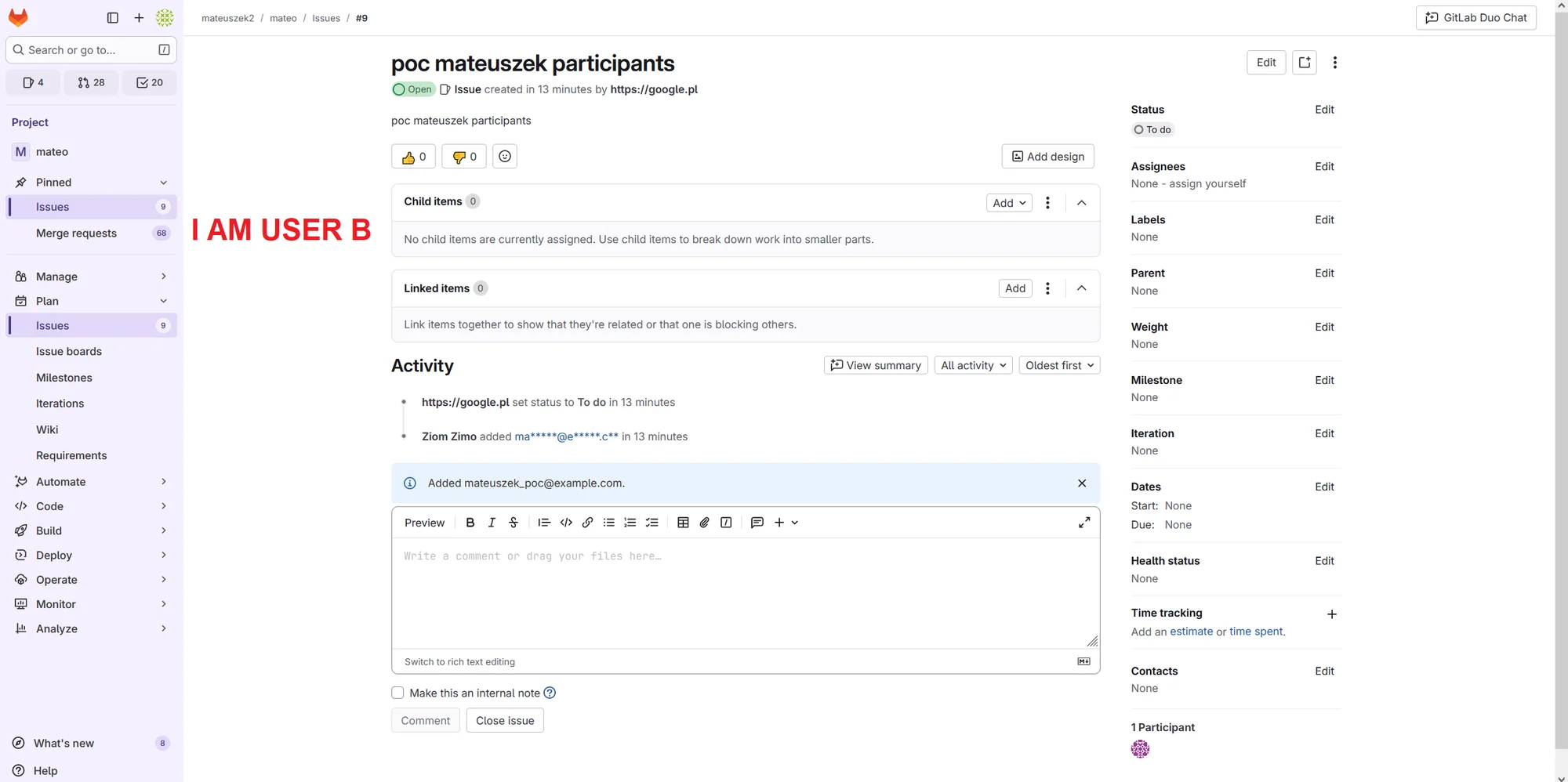
You must have at least the Reporter role for the project. - I found that the user with lower role - Planner can add external participants to the issues without any problems - Privileges escalation to adding external participants to issues by user with not sufficient role
2. Scenario:
2.1. Actors:
User A - owner of the public group A and owner of the public project A_PROJ (project inside group A)
User B - member with role Planner in the public group A and public project A_PROJ (project inside group A)
2.2. Steps:
- User A - in PoC public project A_PROJ create the public issue
- User B - go to the PoC public issue in the public project A_PROJ and add the comment:
/add_email [email protected] - User A / User B - notice that User B added the external participant without any problems - Privileges escalation to adding external participants to issues by user with not sufficient role
Best regards,
Mateusz
Impact
- Privileges escalation to adding external participants to issues by user with not sufficient role
Attachments
Warning: Attachments received through HackerOne, please exercise caution!
How To Reproduce
Please add reproducibility information to this section:
Not written yet. The AI write-up for this report has not been written yet. The Original tab links to the source.
How it worked
Root cause
Likely the permission check for the quick action that adds external participants does not enforce the required Reporter role, allowing Planner users to perform it.
What the attacker needed
Public project; attacker has Planner role; victim has an issue in the project
How it was found
- User A creates a public issue in the public project.
- User B, who has the Planner role, goes to that issue and adds a comment with the quick action to add an external participant.
- User B successfully adds the external participant, despite lacking the required role.
Explained by bugbounty.wiki with AI from the original and checked against quotes from it; it can still be wrong. Read the original before relying on a detail.
Not written yet. The AI write-up for this report has not been written yet. The Original tab links to the source.
In GitLab, different roles have different permissions. The documentation says you need at least the Reporter role to add external participants to issues. However, a user with the lower Planner role could still do it, which is a privilege escalation.
What is Access control?
A user can do something their role should not allow: reach an admin function, act on a feature they have not paid for, or skip a permission check. IDOR is the special case where the object belongs to someone else.

