Stored XSS in repository file viewer
GitLab's OpenAPI viewer used an outdated swagger-ui with a vulnerable DOMPurify, allowing an attacker to inject arbitrary HTML elements into a repository file page. A victim who opens the page and clicks anywhere triggers the stored XSS, which could be used to steal a CSRF token and take over the account.

- Triaged in 18 hours
- Fixed in 2 months
- Paid in 2 months
- Disclosed after 16 months
Summary
There exists XSS in swagger-ui version used in GitLab open API viewer. The XSS exists due to the old version of DOMpurify used in swagger-ui that allows an attacker can inject any HTML elements with any attributes (except script tag) on the page.
The XSS in POC requires 1 click anywhere on the page to execute, because of CSP that does not allow to execute events from HTML tags. (f.e. <img src=1 onerror=alert(1)). I will try to find CSP bypass that will allow me to execute the script with no user interaction.
My script uses the CSP bypass presented in https://gitlab.com/gitlab-org/gitlab/-/issues/213273
<a
  data-remote="true"
  data-method="get"
  data-type="script"
  href="/wbowling/wiki/raw/master/test.js"
  class='atwho-view select2-drop-mask pika-select'>
</a>
Steps to reproduce
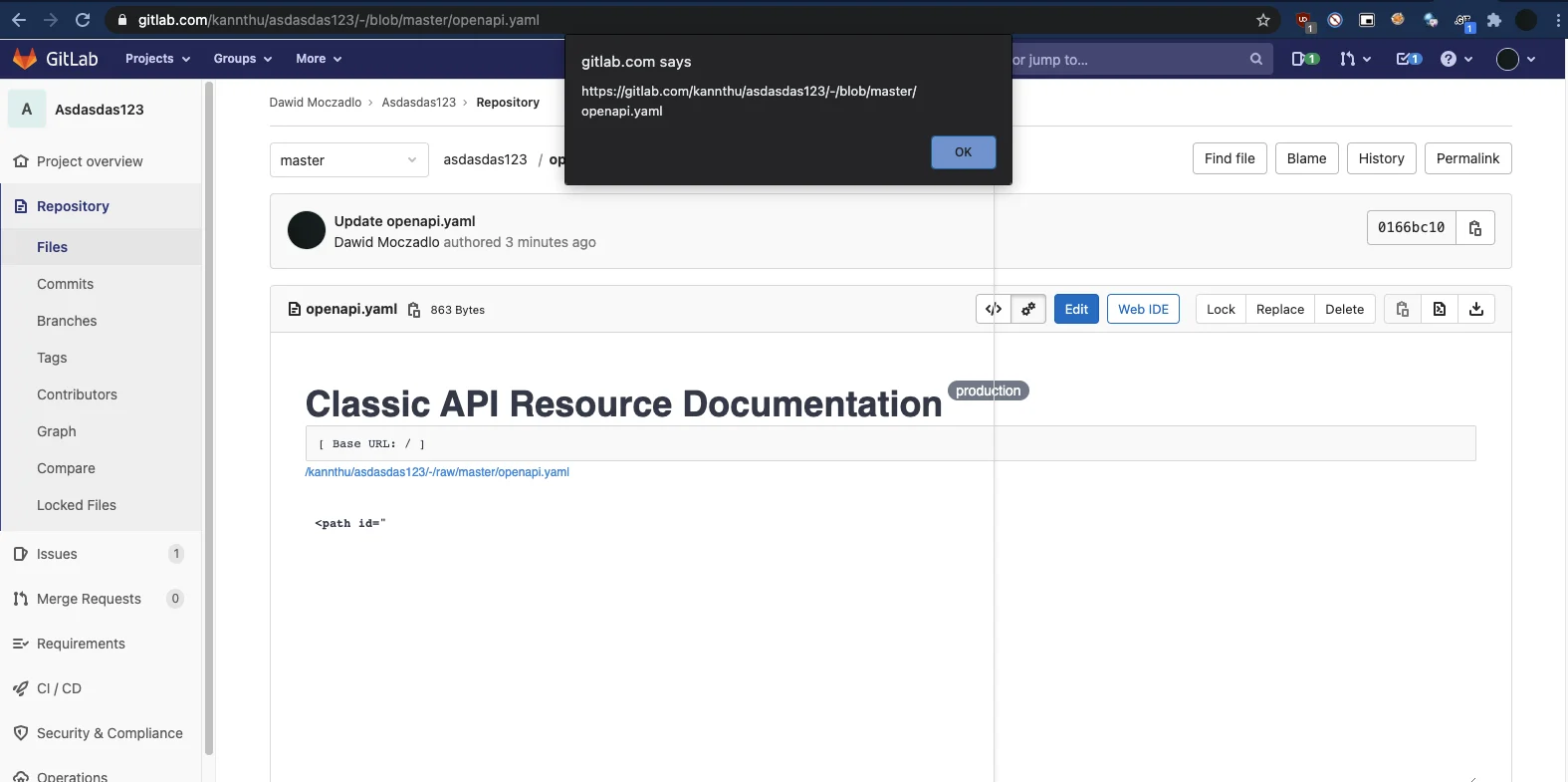
- Go to https://gitlab.com/kannthu/asdasdas123/-/blob/master/openapi.yaml (tested on Chrome and Firefox)
- Click anywhere on the page
- You should see the alert box
There is another way of executing this XSS. You can add "url=https://gitlab.com/kannthu/asdasdas123/-/raw/master/openapi.yaml" parameter to the URL of any open API file in any repository, and the XSS will still work.
- Open https://gitlab.com/gitlab-org/build/omnibus-mirror/alertmanager/blob/master/api/v2/openapi.yaml?url=https://gitlab.com/kannthu/asdasdas123/-/raw/master/openapi.yaml
- Click anywhere on the page
- You should see the alert box
Impact
The stored XSS is triggering for any user that opens the page and clicks anywhere on the page. The PoC can easily be extended to steal the user's CSRF token and to take over the victim's account.
Examples
- https://gitlab.com/kannthu/asdasdas123/-/blob/master/openapi.yaml
- https://gitlab.com/gitlab-org/build/omnibus-mirror/alertmanager/blob/master/api/v2/openapi.yaml?url=https://gitlab.com/kannthu/asdasdas123/-/raw/master/openapi.yaml
What is the current bug behavior?
Gitlab uses an old version of swagger-ui.
What is the expected correct behavior?
Gitlab should use the newest version of swagger-ui.
Relevant logs and/or screenshots
F1146909
Output of checks
This bug happens on GitLab.com
Results of GitLab environment info
Impact
The stored XSS is triggering for any user that opens the page and clicks anywhere on the page. An attacker can render anything on that page - malicious form to steal the user's login and password, or simply get the user's CSRF token and to take over the victim's account.
Attachments
Not written yet. The AI write-up for this report has not been written yet. The Original tab links to the source.
How it worked
Root cause
Likely an outdated swagger-ui bundled an old DOMPurify that did not properly sanitise HTML, and GitLab's CSP only blocked automatic event execution, requiring a click.
Impact
The stored XSS triggers for any user who opens the page and clicks anywhere, and could be extended to steal the user's CSRF token and take over the victim's account.
What the attacker needed
Victim opens the crafted page; victim clicks anywhere on the page
The fix
GitLab should use the newest version of swagger-ui.
How it was found
- Open the attacker's openapi.yaml file in the GitLab repository file viewer.
- Click anywhere on the page.
- Observe the alert box confirming script execution.
Explained by bugbounty.wiki with AI from the original and checked against quotes from it; it can still be wrong. Read the original before relying on a detail.
Not written yet. The AI write-up for this report has not been written yet. The Original tab links to the source.
A stored cross-site scripting (XSS) flaw lets an attacker save malicious content that runs in other people's browsers when they view it. Here, a file in a GitLab repository was shown through an old OpenAPI viewer that failed to clean up HTML properly, so opening the file and clicking anywhere ran the attacker's code.
What is XSS?
Script an attacker supplies runs in another user's browser, on the target's origin, with that user's session.





