Stored XSS on Issue details page
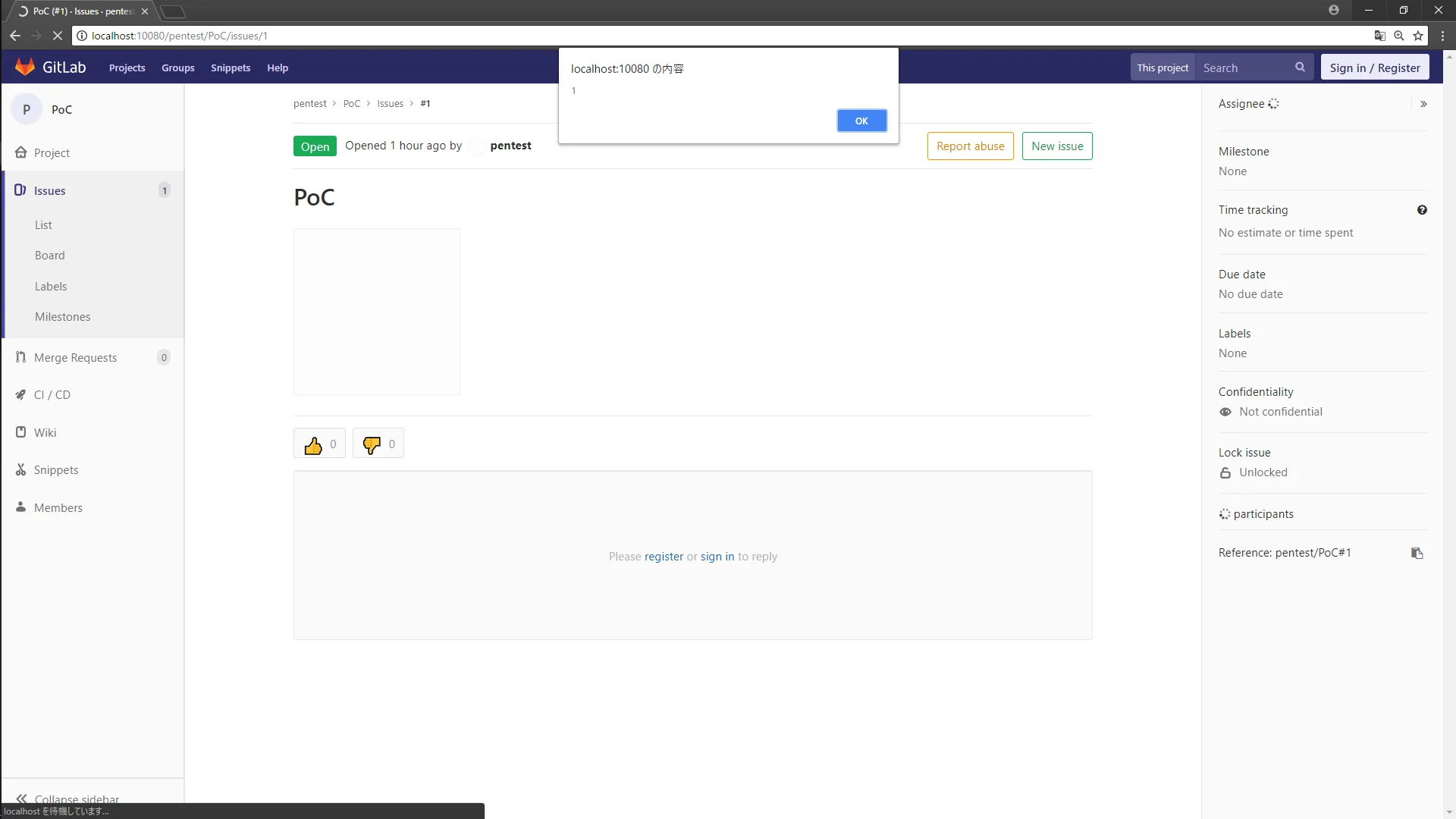
The issue details page was vulnerable to stored XSS via the issue description, executing when the issue is viewed.

- Triaged in under an hour
- Fixed in 2 months
- Disclosed after 3 months
Summary by the program
The detail page of Issue (the page that provides the content of an Issue) is vulnerable to Stored XSS.
The report
Summary: The detail page of Issue (the page that provides the content of an Issue) is vulnerable to Stored XSS.
Description:
The two exploits are via the function of submittin an issue or the function of editing an issue.
This vulnerability is reproduced in Firefox andChrome. IE11 andEdge are not. I did not test the reproduction on other browsers.
Steps To Reproduce:
- Sign in to GitLab.
- Click the "[+]" icon.
- Click "New Project".
- Fill out "Project name" form with "PoC".
- Check the check box of "Public".
- Click "Issues"
- Click "New issue" button.
- Fill out the each form as follows:
- Title: PoC
- Description:
{{media:0}}
- Click "Submit issue".
Furthermore, when editing an already existing issue, you can also reproduce by entering A in the "Description" form and saving it.
Impact
The security impact is the same as any typical Stored XSS.
Thank you!
Attachments
Not written yet. The AI write-up for this report has not been written yet. The Original tab links to the source.
How it worked
Root cause
Likely the application failed to sanitise or escape user-controlled input in the issue description before rendering it on the issue details page.
Impact
The impact is the same as any typical stored XSS, executing scripts in viewers' browsers.
What the attacker needed
A GitLab account; ability to create or edit an issue; victim views the issue
How it was found
- Sign in to GitLab.
- Click the "[+]" icon.
- Click "New Project".
- Fill out "Project name" form with "PoC".
- Check the check box of "Public".
- Click "Issues"
Explained by bugbounty.wiki with AI from the original and checked against quotes from it; it can still be wrong. Read the original before relying on a detail.
Not written yet. The AI write-up for this report has not been written yet. The Original tab links to the source.
Stored cross-site scripting (XSS) happens when a website saves harmful code that a user types in, and later shows it to other people without cleaning it. Here, the issue description field allowed a special placeholder to be saved and then displayed as active content, so anyone viewing the issue could run the attacker's script in their browser.
What is XSS?
Script an attacker supplies runs in another user's browser, on the target's origin, with that user's session.




