Unauthorized user is able to access schedule pipeline variables and values
The pipeline schedules API endpoint returned custom variables and their values to any authenticated user, even those not belonging to the project. An attacker could read sensitive schedule variables and potentially hijack schedules.
 Originally disclosed on HackerOne
- Triaged in 2 days
- Fixed in 2 months
- Paid in 2 days
- Disclosed after 3 months
Summary
The feature allows to add or overwrite variables that are passed to jobs in order to modify the behavior just for that specific instance.
As per this https://gitlab.com/gitlab-org/gitlab-foss/-/issues/32568#note_32531510 , the current security model is
If you are owner of schedule (as developer) or master => you can read, modify and delete, If you are developer => you can just list, not read,
This allows only owners and masters to read variables assigned to the schedule. It prevents other developers from hijacking schedules, but allows master to fully control them. Master already has access to Secret Variables.
But api endpoints are cleary showing this values to everyone even if the user is not part of the project. https://docs.gitlab.com/ee/api/pipeline_schedules.html#get-a-single-pipeline-schedule
PoC
This is my test project https://gitlab.com/thevicc/trigg with schedule pipeline which custom variables you can't read.
Now, run this to read the variable and its value
curl --header "Private-Token: <your_access_token>" https://gitlab.com/api/v4/projects/20618145/pipeline_schedules/69918
Response
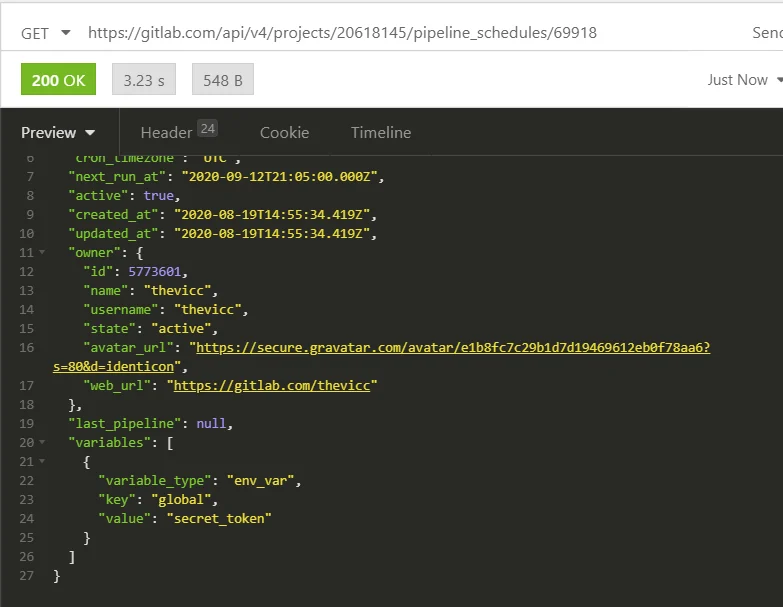
Steps to reproduce
- Create a project and add a schedule pipeline with custom variables
- Only you or owner can read variables
- As second account, use the api
https://docs.gitlab.com/ee/api/pipeline_schedules.html#get-a-single-pipeline-schedule
Impact
This bug allows unauthorized users to read scheduled pipeline custom variables and values. As per security model, this allows other devs to hijack schedules.
Not written yet. The AI write-up for this report has not been written yet. The Original tab links to the source.
How it worked
Impact
This bug allows unauthorized users to read scheduled pipeline custom variables and values, which could allow other developers to hijack schedules.
What the attacker needed
A GitLab account; knowledge of a project ID and schedule ID
How it was found
- Create a project and add a schedule pipeline with custom variables
- As a second account, use the API to get a single pipeline schedule
- Observe that the variables and values are returned
Explained by bugbounty.wiki with AI from the original and checked against quotes from it; it can still be wrong. Read the original before relying on a detail.
Not written yet. The AI write-up for this report has not been written yet. The Original tab links to the source.
A pipeline schedule is a way to run jobs automatically at set times, and it can have secret variables like passwords. The API that returns details about a schedule was not checking if the person asking was allowed to see those secrets. So anyone with an account could read them.
What is Access control?
A user can do something their role should not allow: reach an admin function, act on a feature they have not paid for, or skip a permission check. IDOR is the special case where the object belongs to someone else.



