Cross Site Scripting (XSS) Stored - Private messaging
The private messaging feature of concrete5 8.5.2 does not properly validate user input, allowing a low-privileged user to send a message containing an XSS payload. When an administrator views the message and hovers over it, the payload executes, potentially redirecting the admin to a malicious site or running arbitrary JavaScript.
 Originally disclosed on HackerOne
- Fixed in 31 days
- Disclosed after 9 months
• Title: concrete5-8.5.2 Cross Site Scripting (XSS) Stored - Private messaging • Keyword: crayons • Software : concrete5 • Product Version: 8.5.2 • Vulnerability : Cross Site Scripting (XSS) Stored • Vulnerable component: Private messaging
concrete5 latest version 8.5.2 suffer from persistent (Stored) cross site scripting and html injection vulnerabilities. Insufficient validation of user input on the authenticated part of the concrete5 application exposes the application to persistent cross site scripting (XSS) vulnerabilities. These vulnerabilities enable potentially dangerous input from the user to be accepted by the application and then embedded back in the HTML response of the page returned by the web server. It is possible for lowest privileged user with access to private messaging to send private message to Administrator with malicious XSS payload.
- Steps to Reproduce:
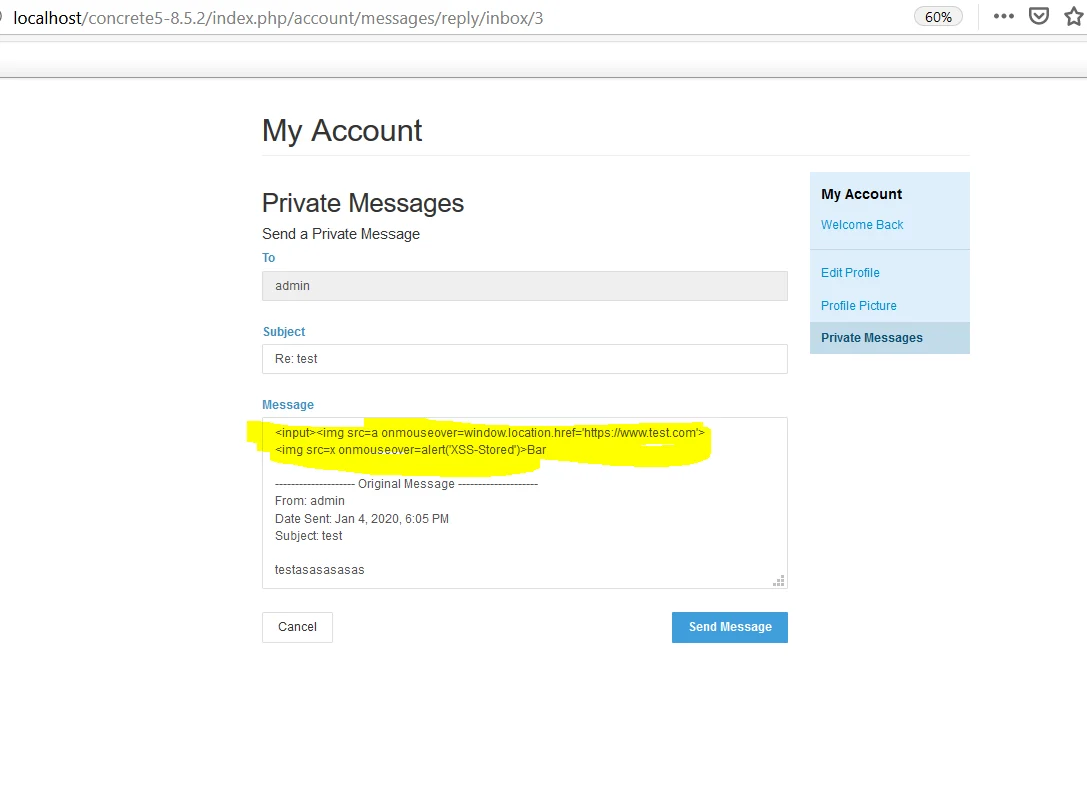
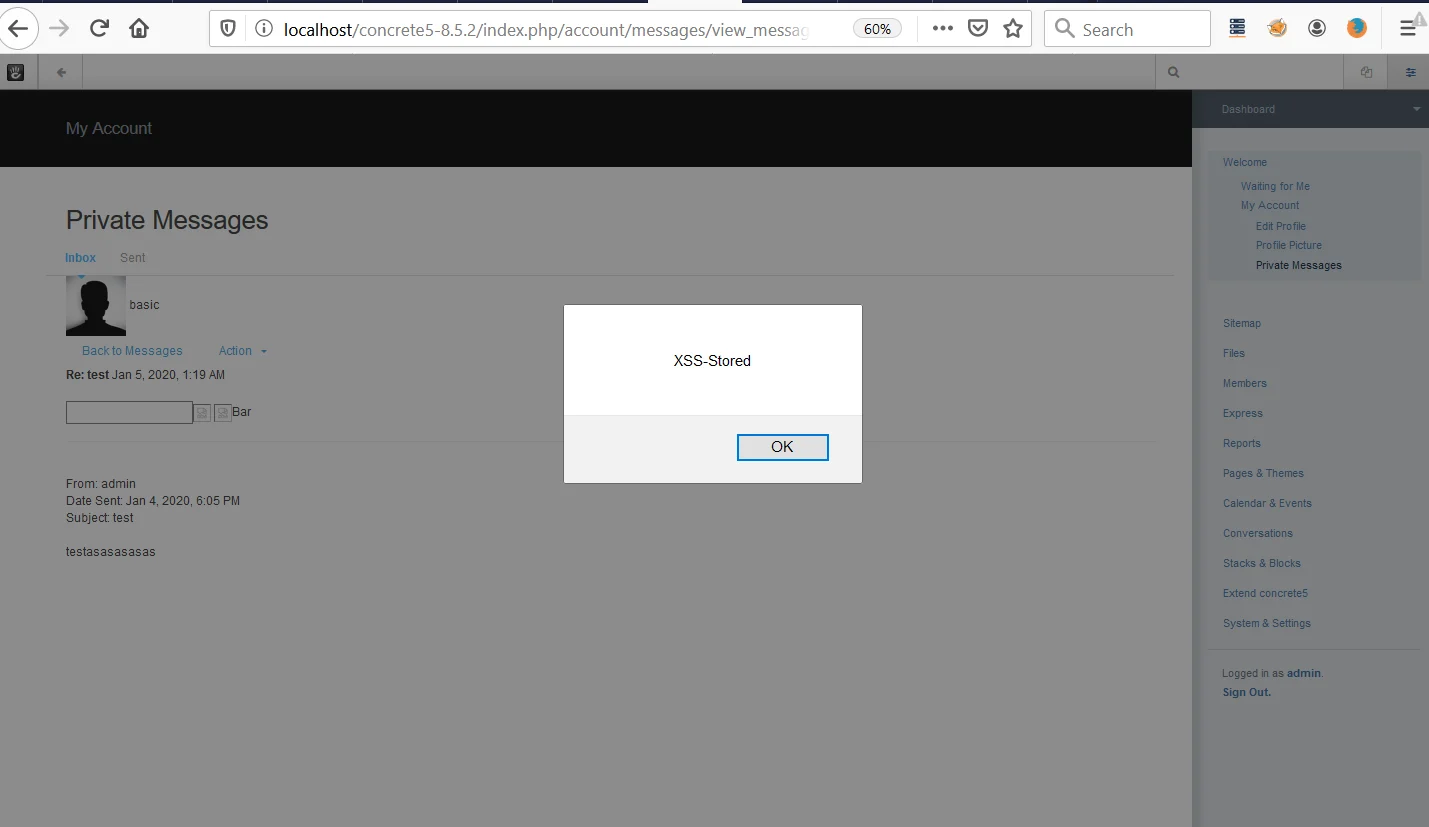
Login as basic user and visit private messages, and if there is message from admin you can just reply to it and insert the XSS payload into the body area and submit. Then login as Admin user who would have received the message and when the admin checks the messages there will be message body where admin will hover over the mouse on message body, and either admin will be automatically redirected to malicious site or the XSS payload will render in the browser. Both payloads are provided below:
-
Two Attack vector:
• <input><img src=a onmouseover=window.location.href='https://www.test.com'> • <img src=x onmouseover=alert('XSS-Stored')>Bar -
Vulnerable parameter: msgBody
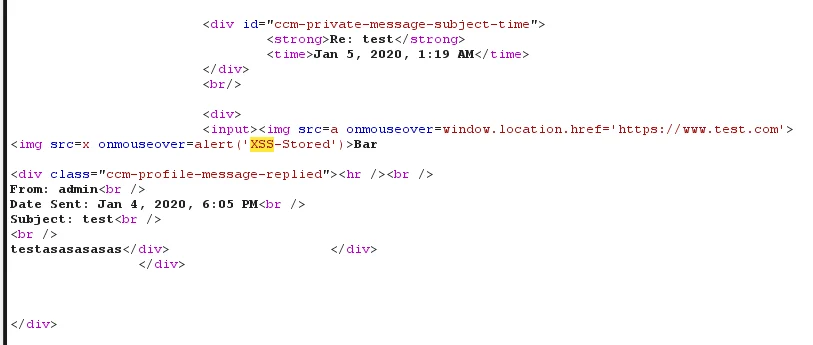
See four screenshots below illustrating both injection part and the part where the payload renders in the browser
Impact
It is possible for lowest privileged user with access to private messaging to send private message to Administrator with malicious XSS payload. Cross-site scripting is a flaw that allows users to inject HTML or JavaScript code into a page enabling arbitrary input. Stored XSS allows an attacker to embed a malicious script into a vulnerable page, which is then executed when a victim views the page in this case Admin
Attachments

Not written yet. The AI write-up for this report has not been written yet. The Original tab links to the source.
How it worked
Root cause
Likely insufficient validation and sanitisation of user input in the private messaging body, allowing HTML and JavaScript to be stored and later rendered without encoding.
Impact
A low-privileged user could execute JavaScript in an administrator's browser, potentially redirecting the admin to a malicious site.
What the attacker needed
A low-privileged account with private messaging access; victim (admin) opens the message; victim hovers over the message body
How it was found
- Log in as a basic user and go to private messages.
- Reply to an existing message from the admin and insert the XSS payload into the message body.
- Submit the message.
- Log in as the admin who received the message and open it.
- Hover the mouse over the message body to trigger the payload.
Explained by bugbounty.wiki with AI from the original and checked against quotes from it; it can still be wrong. Read the original before relying on a detail.
Not written yet. The AI write-up for this report has not been written yet. The Original tab links to the source.
This report describes a stored cross-site scripting bug in a content management system's private messaging. A basic user can send an administrator a message containing hidden code. When the administrator opens the message and moves the mouse over it, the code runs in the admin's browser, which could redirect them to a harmful website.
What is XSS?
Script an attacker supplies runs in another user's browser, on the target's origin, with that user's session.




