FogBugz import attachment full SSRF requiring vulnerability in *.fogbugz.com
The FogBugz import feature used Kernel.Open to download attachments, which allows requests to localhost. An attacker who can control a fogbugz.com subdomain could craft an API response with an attachment URL pointing to an internal service, leading to a full GET-based SSRF.
 Originally disclosed on HackerOne
- Triaged in 31 hours
- Fixed in 3 months
- Paid in 31 hours
- Disclosed after 5 months
Summary:
Hi Team, a bit of a odd one here. The FogBugz import code uses CarrierWave::Uploader::Base:download! to download attachments from fogbugz.com when importing a FogBugz repository. CarrierWave::Uploader::Base:download! ultimately uses Kernel.Open to download the provided attachment URL. Kernel.Open permits URLs which resolve to, or redirect to 127.0.0.1, making it vulnerable to SSRF issues. There is a check within the FogBugz import code which requires attachments to be downloaded with an http or https scheme from a fogbugz.dom subdomain:
app/services/projects/download_service.rb
WHITELIST = [
  /^[^.]+\.fogbugz.com$/
].freeze

...

def valid_url?(url)
  url && http?(url) && valid_domain?(url)
end

def http?(url)
  url =~ /\A#{URI::DEFAULT_PARSER.make_regexp(%w(http https))}\z/
end

def valid_domain?(url)
  host = URI.parse(url).host
  WHITELIST.any? { |entry| entry === host }
end
If a vulnerability can be identified in a fogbugz.com subdomain which results in returning a crafted API response including an arbitrary attachment URL, a full read GET based SSRF would be exploitable on gitlab.com (or a gitlab instance). I've done some basic analysis on potential vulnerabilities which could trigger this issue, they include (but are by no means limited to):
- URL parameter clobbering to force a 302 redirect on attachment download
- Intercept and modify an unencrypted HTTP API response
- Subdomain takeover / dangling sub domain to return an arbitrary API response
- HTTP Request smuggling to modify an in-flight API response
- Cache poisoning to poison a malicious API response
- SQL Injection to replace an attachment URL
- Code Execution to modify
api.aspto return an arbitrary API response - Social engineering / malicious insider FogBugz employee
Due to the third party nature of these issues it is not feasible to probe for, or disclose the potential existence of, any of these potential issues on fogbugz.com to GitLab. However, if any one of these issues exists now or in the future it would render gitlab.com vulnerable.
Steps to reproduce:
This issue can be simulated by placing an /etc/hosts entry on a GitLab server as follows:
198.211.125.160 poc.fogbugz.com
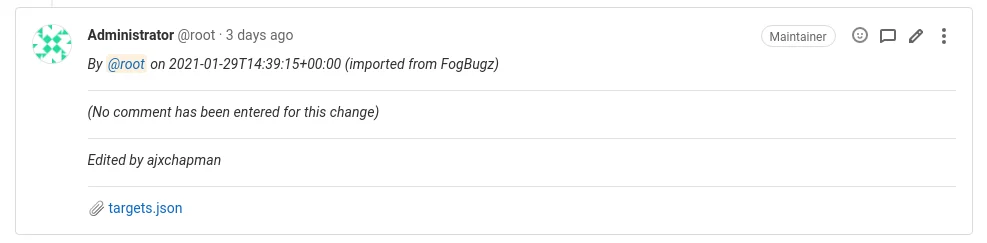
This will point poc.fogbugz.com to a VPS I control, which responds with a crafted FogBugz API response designed to simulate the exploitation of a bug on a fogbugz.com domain. Importing the SSRF Repository FogBugz repository from this host will create a repository with a single issue which includes the SSRF result of requesting http://127.0.0.1:9090/api/v1/targets.
Impact:
A vulnerability in a fogbugz.com subdomain, which meets the above criteria, would result in a full GET based SSRF issue against gitlab.com.
What is the current bug behavior?
FogBugz import code uses Kernel.Open to download and store the result of an untrusted URL.
What is the expected correct behavior?
GitLab::Http should be used to download attachments to prevent SSRF attacks.
Output of checks:
Results of GitLab environment info
System information
System:         Ubuntu 20.04
Proxy:          no
Current User:   git
Using RVM:      no
Ruby Version:   2.7.2p137
Gem Version:    3.1.4
Bundler Version:2.1.4
Rake Version:   13.0.3
Redis Version:  5.0.9
Git Version:    2.29.0
Sidekiq Version:5.2.9
Go Version:     unknown

GitLab information
Version:        13.8.1-ee
Revision:       e10a21e66ce
Directory:      /opt/gitlab/embedded/service/gitlab-rails
DB Adapter:     PostgreSQL
DB Version:     12.4
URL:            http://188.166.97.195
HTTP Clone URL: http://188.166.97.195/some-group/some-project.git
SSH Clone URL:  [email protected]:some-group/some-project.git
Elasticsearch:  no
Geo:            no
Using LDAP:     no
Using Omniauth: yes
Omniauth Providers:

GitLab Shell
Version:        13.15.0
Repository storage paths:
- default:      /var/opt/gitlab/git-data/repositories
GitLab Shell path:              /opt/gitlab/embedded/service/gitlab-shell
Git:            /opt/gitlab/embedded/bin/git
Impact
A vulnerability in a fogbugz.com subdomain, which meets the above criteria, would result in a full GET based SSRF issue against gitlab.com.
Not written yet. The AI write-up for this report has not been written yet. The Original tab links to the source.
How it worked
Root cause
The FogBugz import code uses Kernel.Open to download attachments, which allows requests to localhost, instead of using a safe HTTP client that blocks internal addresses.
Impact
A vulnerability in a fogbugz.com subdomain would result in a full GET-based SSRF issue against gitlab.com.
What the attacker needed
Attacker controls a fogbugz.com subdomain; victim imports a FogBugz repository
The fix
GitLab::Http should be used to download attachments to prevent SSRF attacks.
How it was found
- Add an /etc/hosts entry on a GitLab server pointing poc.fogbugz.com to a controlled VPS.
- The VPS responds with a crafted FogBugz API response that includes an attachment URL pointing to http://[redacted]:9090/api/v1/targets.
- Import the 'SSRF Repository' FogBugz repository from that host.
- The import creates a repository with an issue containing the SSRF result.
Explained by bugbounty.wiki with AI from the original and checked against quotes from it; it can still be wrong. Read the original before relying on a detail.
Not written yet. The AI write-up for this report has not been written yet. The Original tab links to the source.
When you import a project from FogBugz, GitLab downloads attachments from a URL. The code that does the download can be tricked into fetching internal addresses like localhost. If an attacker can control a fogbugz.com subdomain, they could make GitLab request internal services, which is called SSRF (server-side request forgery).
What is SSRF?
The server can be made to fetch an address the attacker chooses, reaching internal services, cloud metadata or other customers' data.





