POODLE SSLv3 bug on multiple twitter smtp servers
Several Twitter SMTP servers accepted SSLv3 connections, which is vulnerable to the POODLE padding oracle attack. A man-in-the-middle attacker could potentially obtain cleartext data from those connections.
 Published on omespino.com
Hi Twitter Sec team I’ve found that some of your SMTP servers are vulnerable to the POODLE SSLv3 bug
The full write-up lives on its author's site
It belongs to its author, so we link to it rather than copy it. The other two tabs are our own rewrites, checked against it.
Context
This is the write-up of the researcher's first bug bounty, reported to Twitter in 2017 through HackerOne and later listed in the Twitter Security Hall of Fame (2017). The target was not a web application but Twitter's SMTP servers on port 25, which the researcher found to be vulnerable to the POODLE SSLv3 bug.
The weakness is CVE-2014-3566, the POODLE issue. As the report quotes it: "The SSL protocol 3.0, as used in OpenSSL through 1.0.1i and other products, uses nondeterministic CBC padding, which makes it easier for man-in-the-middle attackers to obtain cleartext data via a padding oracle attack". In practice, a server that still negotiates SSLv3 gives a network attacker a padding oracle against CBC-encrypted traffic, which can be used to recover plaintext from the session.
Setup
The researcher needed only three things:
- Shodan, used to search the public internet for hosts belonging to the target organisation.
- An nmap installation, which ships the
ssl-poodleNSE script. - A text file named
twitter_smtp_ssl_servers.txtcontaining the hosts to test, one per line.
Finding it
The starting idea was to look for companies that still had SSLv3 enabled in production environments, prompted by the memory of heartbleed. The researcher went to Shodan and used dorks such as org:Twitter, port:443 and port:25 to narrow the results to Twitter-owned hosts exposing those ports. One server came back in the results:
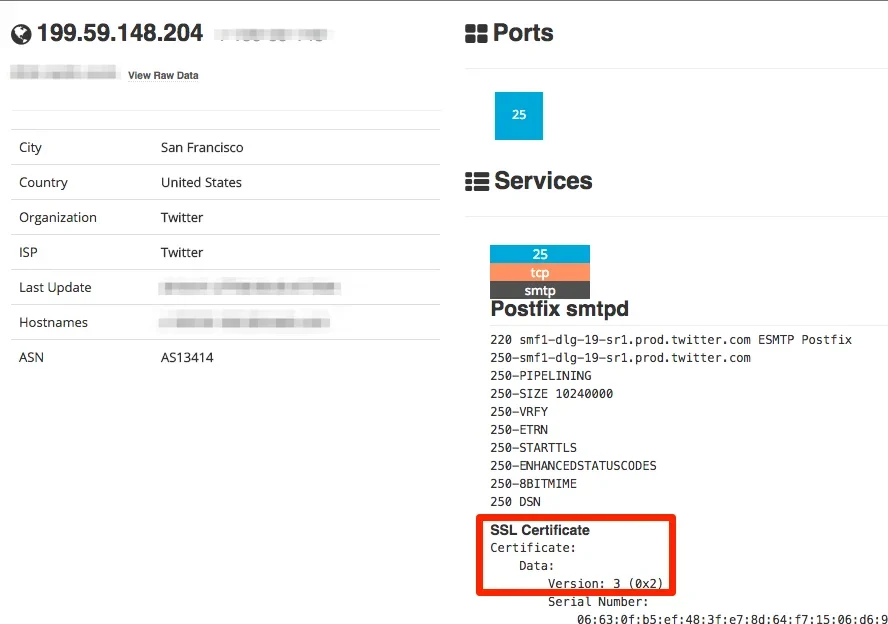
The researcher then looked for more SMTP servers with SSLv3 activated in the same network. The researcher then collected the four SMTP servers available in the same network: mx3.twitter.com, [redacted], [redacted] and [redacted] (the last address appears twice in the list as given in the report).
Exploitation
Step 1: prepare the host list
Create twitter_smtp_ssl_servers.txt with the four hosts, one per line, exactly as collected:
mx3.twitter.com
[redacted]
[redacted]
[redacted]
Step 2: run the POODLE check
The proof of concept sent to the Twitter security team was a single nmap invocation using the ssl-poodle script against port 25 of every host in the file:
nmap -sV –version-light -Pn –script ssl-poodle -p 25 -iL twitter_smtp_ssl_servers.txt | grep -B 5 VULNERABLE
The important parts:
-sV –version-lightperforms service and version detection with a lighter probe set, so each host is identified as an SMTP service.-Pnskips host discovery and treats every target as up, which matters when ICMP is filtered.--script ssl-poodleruns the NSE script that checks whether the service accepts SSLv3 and is therefore exposed to the POODLE attack.-p 25restricts the scan to the SMTP port.-iL twitter_smtp_ssl_servers.txtreads the targets from the prepared file.grep -B 5 VULNERABLEkeeps only the lines reporting a vulnerable host, plus the five lines before each match so the host context stays visible in the output.
Step 3: read the results
The researcher presented the scan results as the proof of concept:
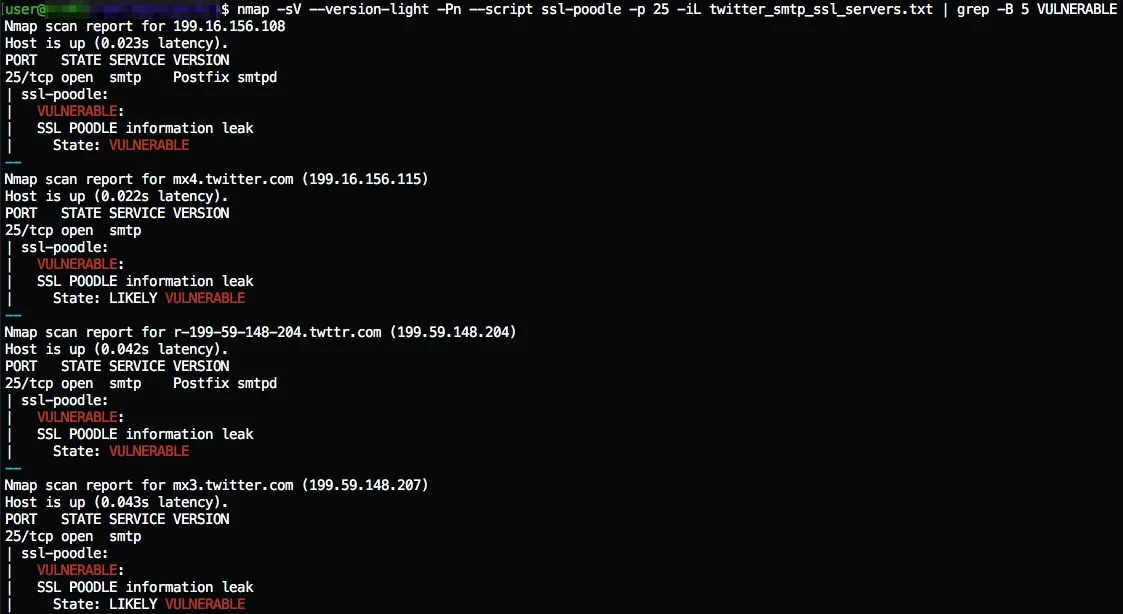
That was the whole submission: the Shodan hit, the host list and the nmap output. The researcher also answered the standard triage questions in the report: the bug was not public or known to third parties, it could be reproduced every time, and it had been found via Shodan.
Root cause
The SMTP servers were vulnerable to the POODLE SSLv3 bug. SSLv3 uses nondeterministic CBC padding and, as described in CVE-2014-3566, exposes a padding oracle that a man-in-the-middle can query to recover cleartext data from the encrypted session. Disabling SSLv3 on the mail listeners, or restricting them to TLS, would remove the oracle. The report does not describe the server software or configuration responsible, so the exact reason SSLv3 remained enabled is not stated.
Impact
An attacker positioned between a client and one of these SMTP servers could use the padding oracle to obtain cleartext data from the connection. The report does not go further into which data, which clients or which mail flows would be affected, and it does not claim any data was actually recovered. The practical precondition is a man-in-the-middle position on the path to the affected servers.
Fix
The report does not describe any remediation applied by Twitter. The fix implied by the finding is to disable SSLv3 on the SMTP listeners and allow only TLS, so that the ssl-poodle check no longer reports the hosts as vulnerable.
Variants to test
- Run the same
ssl-poodleNSE check against other mail ports on the same hosts, for example submission ports, to see whether SSLv3 is disabled everywhere or only on port 25. A positive result is a host reported asVULNERABLEon the additional port. - Repeat the Shodan search with other organisation filters and ports to find sibling hosts in the same network that share the configuration. A positive result is another host from the same organisation answering with SSLv3 enabled.
- Test other services that terminate TLS, such as HTTPS or IMAPS, with the same script. A positive result is any service that still completes an SSLv3 handshake.
- Check whether the servers also accept other deprecated protocol versions, using the corresponding nmap scripts. A positive result is a service that negotiates a protocol version it should have retired.
What happened, in plain words
A security researcher was browsing a website called Shodan, which is a search engine for internet-connected devices, and noticed that some of Twitter's mail servers were still using an old, broken version of the encryption protocol that protects connections. That old version is called SSLv3, and it has a known flaw nicknamed POODLE. The researcher collected the addresses of four of these mail servers, ran a free tool called nmap against them to confirm the flaw, and sent the results to Twitter's security team through a bug bounty platform called HackerOne. The researcher was listed in Twitter's 2017 Security Hall of Fame, and the bounty was 280.00 USD. This was the researcher's first ever bug bounty.
The rest of this article walks through exactly what was done, step by step, explaining every term along the way. You only need to be comfortable using a browser and a computer to follow it.
Background: what are we even looking at?
Before the steps, a few ideas need to be clear.
A server is a computer somewhere on the internet whose job is to answer requests from other computers. When you open a website, your browser asks a server for the page and the server sends it back.
SMTP stands for Simple Mail Transfer Protocol. It is the language computers use to send and relay email. An SMTP server is the machine that receives outgoing mail and passes it on towards its destination. Twitter runs SMTP servers so that emails from Twitter (notifications, password resets and so on) can leave its network and reach people's inboxes.
A port is like a numbered door on a server. One machine can run many services at once, and each service listens on its own door number. Web traffic normally uses port 443 (the secure version, HTTPS) and port 80 (the unencrypted version). SMTP normally uses port 25. When someone says a server is "listening on port 25", they mean the mail service on that machine is answering at door number 25.
Encryption is the process of scrambling data so that anyone watching the connection cannot read it. When your browser shows a padlock, the page travelled over an encrypted connection.
SSL and TLS are the family of protocols that provide that encryption. SSLv3 is version 3 of SSL, released in the 1990s. It was replaced by TLS, and modern systems should refuse to use SSLv3 at all because it is outdated and unsafe.
POODLE is the nickname of a specific weakness in SSLv3, catalogued as CVE-2014-3566. CVE is just an ID number that the security world gives to a publicly known vulnerability so everyone can refer to the same thing. The report quotes the official description:
CVE-2014-3566: The SSL protocol 3.0, as used in OpenSSL through 1.0.1i and other products, uses nondeterministic CBC padding, which makes it easier for man-in-the-middle attackers to obtain cleartext data via a padding oracle attack, aka the "POODLE" issue.
That sentence is dense, so let us unpack it. Encryption schemes often work in blocks, and the last block is padded (filled with extra bytes) to make it the right size. In SSLv3 the way that padding is chosen is not fully predictable, and an attacker who can sit between two computers (a man-in-the-middle) can send slightly modified messages and watch how the server reacts. Each reaction leaks a tiny clue about the scrambled data. Collect enough clues and the attacker can work out the original plaintext, that is, the readable content of the connection. A system that gives out these clues is said to offer a padding oracle: an oracle in this sense is simply something that answers questions, and each answer reveals a little secret.
Shodan is a search engine, but instead of indexing web pages it indexes devices connected to the internet. You can search for things like which organisation owns a machine, which port is open, or which software version is running. The search queries people type into Shodan are informally called dorks. A dork like org:Twitter means "show me machines registered to the organisation Twitter".
nmap is a free, well-known tool for probing machines on a network. It can tell you which ports are open and which services are running behind them. It also supports extra checks called NSE scripts (Nmap Scripting Engine), small programs that test for specific things. One of them, ssl-poodle, checks whether a service still accepts SSLv3 and is therefore exposed to POODLE.
A bug bounty is a programme where a company invites outside researchers to look for security problems and pays them for valid reports. HackerOne is one of the platforms that hosts these programmes. A Hall of Fame is a public page where a company thanks the researchers who reported issues.
The setup
The researcher needed only three things:
- Shodan, to search the public internet for machines belonging to Twitter.
- An nmap installation, which includes the
ssl-poodlescript. - A plain text file named
twitter_smtp_ssl_servers.txtlisting the machines to test, one per line.
Finding it
The starting idea was to look for companies that still had SSLv3 switched on in their live (production) systems. The researcher had the memory of heartbleed, another famous encryption bug, in mind, and wondered who else might be running old encryption. So the next step was to go to Shodan and search with dorks such as org:Twitter, port:443 and port:25. Each dork narrows the results: org:Twitter limits the search to Twitter-owned machines, port:443 asks for machines with the secure web port open, and port:25 asks for machines with the mail port open. Combining them is a way of asking Shodan: "show me Twitter machines that are exposing these particular doors to the internet".
Suddenly one server came back in the results:
The screenshot shows the Shodan result that triggered the whole investigation. The researcher then looked for more SMTP servers with SSLv3 activated in the same network. The researcher then gathered the four SMTP servers available in the same network: mx3.twitter.com, [redacted], [redacted] and [redacted]. The last address appears twice in the list exactly as it was written in the report.
Confirming it
Step 1: prepare the list of machines
The first practical step was to create the file twitter_smtp_ssl_servers.txt containing the four hosts, one per line, exactly as collected:
mx3.twitter.com
[redacted]
[redacted]
[redacted]
Line by line: the first line is a hostname, a human-friendly name that the internet translates into a numeric address. The other three lines are IP addresses, the numeric addresses themselves. Keeping them in a file means the scanning tool can read the whole list in one go instead of being typed out each time. This is the same idea as saving a list of contacts in your phone rather than memorising every number.
Step 2: run the POODLE check
The proof of concept sent to the Twitter security team was a single nmap command that runs the ssl-poodle script against port 25 of every host in the file:
nmap -sV –version-light -Pn –script ssl-poodle -p 25 -iL twitter_smtp_ssl_servers.txt | grep -B 5 VULNERABLE
This is one long line, so let us take it apart piece by piece:
nmapis the program being run.-sV –version-lightasks nmap to identify which service and version is running on each machine, using a lighter, quicker set of probes. The point is to confirm that the thing behind port 25 really is a mail service.-Pntells nmap to skip the usual "is this machine alive?" check and treat every target as up. This matters because some networks block the ping messages nmap would normally use, and without this option nmap might wrongly conclude a machine is down.--script ssl-poodleruns the specific NSE script that checks whether the service accepts SSLv3 and is therefore exposed to POODLE. This is the actual security test.-p 25restricts the scan to port 25, the mail port, so nmap does not waste time on other doors.-iL twitter_smtp_ssl_servers.txttells nmap to read its targets from the file prepared in step 1.-iLstands for input list.- The vertical bar
|is a pipe. It takes the output of nmap and hands it to the next program. grep -B 5 VULNERABLEis that next program. grep searches text for a pattern. Here it looks for the wordVULNERABLE, which the script prints when it finds a host that accepts SSLv3.-B 5means "also show the five lines before each match", so the host name and context stay visible next to the word VULNERABLE instead of appearing alone.
Why do it this way? Because the goal is not to attack anything, but to produce clear evidence: a list of machines, a standard check, and output that plainly says which ones are affected. That is exactly what a security team needs in order to verify and fix the problem.
Step 3: read the results
The researcher presented the scan results as the proof of concept:
The screenshot shows the nmap output. That was the whole submission: the Shodan hit, the list of hosts and the nmap output. The researcher also answered the standard questions that triage teams ask when a report arrives: the bug was not public or known to third parties, it could be reproduced every time, and it had been found via Shodan. These answers matter because they tell the company whether the issue is new, whether it is reliably real, and how it came to light.
Why it works
The mail servers were vulnerable to the POODLE SSLv3 bug. As the CVE description explains, SSLv3 uses nondeterministic CBC padding, and that exposes a padding oracle which a man-in-the-middle can query to recover readable data from the encrypted session. In everyday terms: imagine two people talking through a locked box, and a eavesdropper who cannot open the box but can shake it and watch how the lock rattles. If the lock rattles differently depending on what is inside, the eavesdropper can gradually work out the contents. SSLv3's padding behaves a little like that rattle. Turning SSLv3 off on the mail listeners, or allowing only TLS, would remove the rattle and with it the oracle. The report does not describe which server software or configuration left SSLv3 enabled, so the exact reason it was still on is not stated.
What the impact is
An attacker sitting between a client and one of these mail servers could use the padding oracle to obtain readable data from the connection. The report does not go further into which data, which clients or which mail flows would be affected, and it does not claim that any data was actually recovered. The practical precondition is a man-in-the-middle position on the path to the affected servers, meaning the attacker has to be able to intercept traffic between the two ends.
How it would be fixed
The report does not describe any fix that Twitter applied. The fix implied by the finding is to disable SSLv3 on the mail listeners and allow only TLS, so that the ssl-poodle check no longer reports the hosts as vulnerable.
Other things worth testing
- Run the same
ssl-poodlecheck against other mail ports on the same hosts, for example the ports used for mail submission, to see whether SSLv3 is disabled everywhere or only on port 25. A positive result is a host reported asVULNERABLEon the additional port. - Repeat the Shodan search with other organisation filters and ports to find sibling machines in the same network that share the configuration. A positive result is another host from the same organisation answering with SSLv3 enabled.
- Test other services that use encryption, such as HTTPS or IMAPS, with the same script. A positive result is any service that still completes an SSLv3 handshake.
- Check whether the servers also accept other deprecated protocol versions, using the corresponding nmap scripts. A positive result is a service that negotiates a protocol version it should have retired.
Glossary
- Bug bounty: a programme where a company pays outside researchers for valid security reports.
- Bounty: the money paid for an accepted report; here 280.00 USD.
- CBC: a way of encrypting data in blocks, where each block is combined with the previous one.
- Cleartext / plaintext: data in its readable, unencrypted form.
- CVE: a public ID number given to a known vulnerability, such as CVE-2014-3566 for POODLE.
- Dork: a search query written to find specific things, here used in Shodan.
- Encryption: scrambling data so that only the intended recipient can read it.
- grep: a command-line program that searches text for a pattern.
- HackerOne: a platform that hosts bug bounty programmes and report handling.
- Hall of Fame: a public page where a company thanks researchers who reported issues.
- Heartbleed: another well-known encryption bug, referenced here as inspiration.
- Host: a machine on a network, identified by a name or an IP address.
- Hostname: a human-friendly name for a machine, such as
mx3.twitter.com. - IMAPS: the encrypted version of the IMAP mail-reading protocol.
- IP address: the numeric address of a machine on the internet.
- Man-in-the-middle: an attacker who can intercept and alter traffic between two parties.
- nmap: a free tool for probing machines and the services they expose.
- NSE script: a small add-on program for nmap that tests for a specific condition.
- Oracle (padding oracle): something that answers questions about encrypted data and leaks a little secret with each answer.
- Padding: extra bytes added to the end of a block of data so it fits the required size.
- Pipe (
|): a way to pass the output of one command into another. - POODLE: the nickname for the SSLv3 weakness described in CVE-2014-3566.
- Port: a numbered door on a machine through which a particular service is reached; 25 for SMTP, 443 for HTTPS.
- Production: the live systems that real users and real traffic depend on.
- Proof of concept (POC): a minimal demonstration that a problem is real.
- Shodan: a search engine for internet-connected devices and services.
- SMTP: the protocol used to send and relay email.
- SSLv3: version 3 of the SSL encryption protocol, now obsolete and unsafe.
- TLS: the modern successor to SSL, the protocol that should be used instead.
- Triage: the process a security team uses to review and prioritise incoming reports.
- Vulnerability: a weakness in a system that can be used to cause harm or break security.






